

Air conditioning equipment for Russia: OKPD 2 codes, EAC documents and the new data your buyer will ask you for
If you ship split systems, chillers, fan coils, precision or industrial air conditioning plant to Russia and the CIS, a new line has just appeared in your buyer's checklist — and it will come back to you as a request for data. Russia's Ministry of Natural Resources has confirmed that products identified by OKPD 2 code 28.25.12.190, «Other air conditioning equipment not included in other groupings», are on the list of goods and packaging whose post-use waste is subject to recycling. For the Russian side that means obligations under extended producer responsibility: reporting plus either arranging recycling or paying the environmental fee. Customs does not check this and will not hold the declaration because of it — which is exactly why your buyer will push the question upstream, to the documents that travel with your goods. Below: what changes in your shipping set, what your consignee will now require, and where the real risk of a border delay still sits.
Why a Russian waste rule ends up in your export file
Extended producer responsibility in Russia is built on Federal Law No. 89-FZ «On production and consumption waste». The logic is simple: whoever places a product on the market — including whoever brings it in from abroad — answers for the recycling of the waste generated when that product is used. The obligation can be discharged in two ways: arrange recycling directly or through an operator, or pay the environmental fee.
As the exporter you are not the obligated party. Your Russian buyer is, because the obligation attaches to the company that imported the goods into the country. But the obligation is calculated from physical facts about your shipment — what exactly arrived, in what quantity, at what weight, in what packaging. Nobody in Russia can reconstruct those figures from an invoice line that says «air conditioning equipment, 1 lot». They can only get them from you.
The wording of the code makes this worse. «Not included in other groupings» is the most inconvenient formulation there is: everything not described by a separate sub-category falls into it, which covers a large share of industrial and semi-industrial climate equipment. So a buyer who has been importing your products for years without ever thinking about waste obligations now has to go back through several reporting periods — and the first thing they will do is ask you for historical specifications and packing data.
HS code on your invoice vs OKPD 2 in Russia: two different systems
You work in the HS nomenclature. Air conditioning machines sit in heading 8415; individual assemblies and components sit in neighbouring headings of Chapter 84. On arrival the goods are classified under the EAEU CN FEA code, which drives the duty rate, VAT, the need for permits and the risk of a customs value adjustment. The recycling obligations, however, are described in an entirely different coordinate system — OKPD 2, which is organised by type of economic activity and product rather than by tariff logic.
There is no automatic correspondence between the two classifiers. One shipment can travel under a single CN FEA code and still break down into several OKPD 2 positions — for instance when a container carries outdoor units, indoor units and separately supplied controls. The reverse also happens: different tariff codes converge into one OKPD 2 grouping. The matching has to be done manually, from technical documentation and the contract specification, not from a single invoice line.
The obligation attaches to what physically arrives, not to the code written on the declaration. If one shipment contains units, assemblies and packaging, each component is counted separately — the equipment itself and the pallets, cartons and film it travelled in. That turns your packing list into a commercial document, not a formality.
The practical consequence for you: a consolidated packing list with one gross weight is no longer enough. Your consignee needs net and gross weight per position and packaging weight broken down by material. If your works produce that data anyway for internal purposes, supplying it costs nothing. If it has to be measured for the first time, it takes a shift at the warehouse — and it is far cheaper to do it before loading than after the container is already in Russia. The same discipline applies when you supply industrial machinery and production lines, where description accuracy drives both expert examination and release.
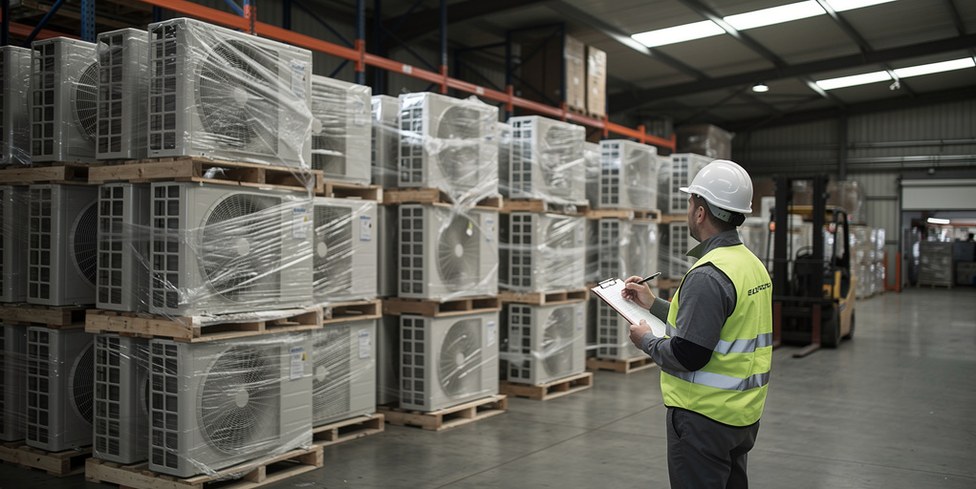
Split systems, chillers and fan coils bound for Russia: from now on the packing list carries as much weight as the invoice
TR CU 004/2011, EMC and refrigerant: the documents that really can stop the goods
The recycling obligation is an extra layer on top of the existing permit package — it does not replace it. And it is that existing package, not the waste rules, that determines whether your container clears the border on time.
For climate equipment the baseline set is built around the Technical Regulation of the Customs Union on the safety of low-voltage equipment (TR CU 004/2011) and the regulation on electromagnetic compatibility (TR CU 020/2011). Equipment operating from mains supply within the relevant voltage range must have its conformity confirmed by a declaration or certificate before the customs declaration is filed. The evidence comes from you: test reports, circuit diagrams, component lists, marking layouts, a description of the model range. Russian certification can only be arranged on the basis of the manufacturer's file — the registration itself is fast, the collection of factory documents is what takes weeks.
Separately there are sectoral permit lists that individual machines may fall under, and the refrigerant question. Part of the substances your systems are charged with are regulated, and their import requires its own permits. For pre-charged equipment this is not a detail: your consignee has to know the refrigerant type and the charge per unit, with a safety data sheet, before booking the vessel. A missing refrigerant permit or an unconfirmed conformity document is a genuine border delay — days or weeks of the container sitting at a temporary storage warehouse, with storage charged daily. The waste obligation is not. Keep the two apart when you plan your lead times.
Check your shipment: situation and action
| Situation in your shipment | What it means for the buyer | What to send with the goods |
|---|---|---|
| Complete air conditioning units that do not fall into separate sub-categories of the classifier | The goods are identified by an OKPD 2 code on the list; the obligation arises for every unit imported | Line-by-line specification with model, type and net weight per unit |
| Separate assemblies and components for on-site installation | Part of the range may fall into other groupings — there is no single answer for the whole shipment | Split the invoice and packing list by position instead of one consolidated line |
| Goods travel on pallets, in crates, cartons and film | Packaging is a separate object of obligations and is the item most often forgotten | Packaging weight by material: wood, cardboard, plastic, foam |
| You have been supplying this buyer for several years without such data | Unclosed obligations accumulate across past periods; customs sends no signal about it | Archive specifications and packing lists for previous shipments on request |
| New series or a changed model range in the next order | Codes have to be re-checked; conformity documents may not cover the new models | Notify the changes before the specification is signed, with the updated technical file |
| Equipment is pre-charged with refrigerant | Regulated substances require separate import permits — this one really can hold the goods at the border | Refrigerant type, charge per unit, safety data sheet |
What the exporter should do
- Issue the specification line by line: model, type of installation, technical characteristics, net and gross weight per unit. One line for the whole lot is no longer usable on the Russian side.
- Break the packing list down by packaging material — wooden pallets, corrugated cardboard, plastic film, expanded polystyrene — with weight by type. Obligations arise on packaging independently of the equipment.
- Declare the refrigerant in advance: type, charge per unit, safety data sheet. Confirm with the buyer that the import permit is in hand before the booking is fixed.
- Hand over the conformity evidence file for TR CU 004/2011 and TR CU 020/2011 — test reports, diagrams, marking layouts — and give your Russian partner written authorisation to use it for the EAC declaration or certificate.
- Notify any change in the model range before the specification is signed, not when the goods are ready. Re-checking codes takes two or three working days in advance instead of container idle time at a temporary storage warehouse.
- Keep the archive: specifications, packing lists and weights for past shipments. Your buyer will need them to close previous reporting periods, and reconstructing the figures six months later is several days of work for both sides.
- Agree in the contract who supplies which data and by when — before shipment, not after arrival. Delivery terms also matter: with sea freight the documents have weeks to catch up, with air freight they do not.
Frequently asked questions
Will this delay release of our container at the Russian border?
No. Extended producer responsibility is checked against reporting, not during customs clearance, and it does not hold up the declaration. What does delay goods at the border is the other layer: missing or incorrect conformity documents under the technical regulations and missing refrigerant permits. Those are worth your attention before loading.
Does this change the duty or import VAT our buyer quotes us against?
No. The duty rate and VAT are unaffected by the clarification. This is a separate payment with its own reporting, outside customs payments, calculated on a different base — the mass of product and packaging placed on the market. It does, however, become part of your buyer's landed cost, so expect it in the next price conversation.
Is this connected to «Chestny ZNAK» marking?
No, these are different systems. Mandatory marking works from its own product lists and its own deadlines; the recycling obligations work from the list under waste legislation. There is no overlap in the documents, but both can apply to the same shipment.
We sell ex-works and the buyer imports. Is any of this our legal obligation?
No. The obligation arises for the company that imported the goods into the country, and an onward resale does not move it. For you this is not a legal claim but a data request — and increasingly a condition in the supply contract. Suppliers who provide the figures without a fight keep the order; suppliers who cannot get pushed on price.
What if the goods are returned to us or re-exported?
The customs procedure applied and the subsequent fate of the consignment affect how the volumes are counted on the Russian side. Whatever happens, document the movement of the batch: the return has to be evidenced, not merely stated.
Summary
Air conditioning equipment identified by OKPD 2 code 28.25.12.190 is on the list of goods whose post-use waste is subject to recycling, which creates extended producer responsibility obligations for the Russian importer. It does not affect release of the declaration, but it does affect reporting and the real landed cost of your goods — and it turns your specification and packing list into documents your buyer genuinely depends on. Itemise the shipment by position, state packaging weight by material, declare the refrigerant, and hand over the conformity evidence file before loading rather than after the vessel arrives. Request a consultation and we will go through your specific consignment.
Send us your specification — we will check the HS and OKPD 2 codes of your equipment and assemble the permit package before your buyer files the declaration.
Read also:
- Shipping to Russia and the CIS: HS codes, permits and the documents your buyer needs before loading
- Russia's Food Import Ban Extended to 2028: What It Means for Your Shipment and What Your Russian Buyer Will Ask For
- War Risk Insurance in Russian Customs Value: What Your Buyer Will Ask You For
- Electronic Waybills for Shipments to Russia: The Carriage UID, Codes 02015 and 02016, and What Your Buyer Will Ask You For