

Alloy Steel Scrap Export from Russia: the New Quota, the MinPromTorg Licence and What Your Russian Counterparty Will Ask You For
If your company buys alloy steel scrap from a Russian supplier, takes scrap back under an equipment supply or trade-in arrangement, or simply moves cargo between Russia and the CIS, one date now belongs in your shipping calendar. From 26 September 2026 a contract and an export declaration are no longer enough on the Russian side: the reduced duty rate applies only to a seller to whom the Russian Ministry of Industry and Trade (MinPromTorg) has allocated part of a tariff quota and issued a one-time licence. Inside the quota the minimum payment is EUR 70 per 1,000 kg; outside it EUR 290 per 1,000 kg, and from 1 November 2026 EUR 490 per 1,000 kg, with the same 5% ad valorem component. On a 20-tonne lot the gap between quota and non-quota shipment runs into thousands of euros — and it is decided long before the border, at the moment the application is filed. That application needs your paperwork: the foreign trade contract and documents supporting the planned delivery come from you, the buyer.
Which HS codes and volumes fall under the quota
The tariff quota was introduced by Resolution No. 1180 of the Government of the Russian Federation dated 16 September 2026 and enters into force seven days after official publication — on 26 September 2026. It covers waste and scrap of alloy steel under three EAEU HS codes: 7204 21 100 0, 7204 21 900 0 and 7204 29 000 0, when the goods leave under the customs export procedure to states that are not members of the EAEU.
The mechanism is split into two periods. From the date the resolution takes effect until 31 December 2026 inclusive, 7,000 tonnes are distributed; for the whole of 2027, another 20,000 tonnes. That is 27,000 tonnes across both periods, and MinPromTorg will allocate the volume and issue one-time licences until 31 December 2027.
For you as the receiving party the practical point is that the volume is finite and will run out. Before your counterparty files anything, confirm that the material in the lot really falls under one of the three codes rather than a neighbouring position of heading 7204. Alloy steel is defined by its alloying elements — nickel and chromium above all — so a classification dispute with Russian customs turns on the chemical composition of the lot, not on the wording of your invoice. Ask for the mill test certificate or the laboratory analysis at the contract stage: it is the same evidence base that will later support the declaration. Scrap of these grades is often generated when imported machine tools and production lines are written off — if you supply that equipment, see how the documentation is handled for customs clearance of machinery and machine tools.
Duty inside the quota and above it
The export duty rate does not depend on the goods. It depends on whether the seller holds an allocated volume and a one-time licence. The ad valorem part is the same everywhere — 5%; what changes is the specific component, that is, the minimum payment per tonne.
| Situation | Export duty rate | What it means for your shipment |
|---|---|---|
| Shipment within the allocated quota | 5%, but not less than EUR 70 per 1,000 kg | The MinPromTorg allocation decision and the one-time licence must be in hand before the declaration is filed — only then is the laycan realistic |
| Shipment outside the quota, 26 September to 31 October 2026 | 5%, but not less than EUR 290 per 1,000 kg | Either the price in your contract absorbs the duty, or the lot waits for a quota volume |
| Shipment outside the quota, 1 November 2026 to 31 December 2027 | 5%, but not less than EUR 490 per 1,000 kg | The minimum payment almost doubles — recalculate the landed cost before you confirm the order |
| Delivery to EAEU member states | The measure does not apply | Mutual trade rules, no one-time licence, no quota |
Note the date of 1 November 2026: it splits non-quota export into «expensive» and «very expensive». If the contract is signed in the autumn and the loading slips into November, the cost of the shipment changes without anyone doing anything. The rate and the minimum payment are applied at release, not at signature — so the delivery window, the Incoterms rule and the moment risk passes should be agreed before the application is filed, not after. The same logic applies to the transport booking, whether the lot moves by sea freight or by rail.
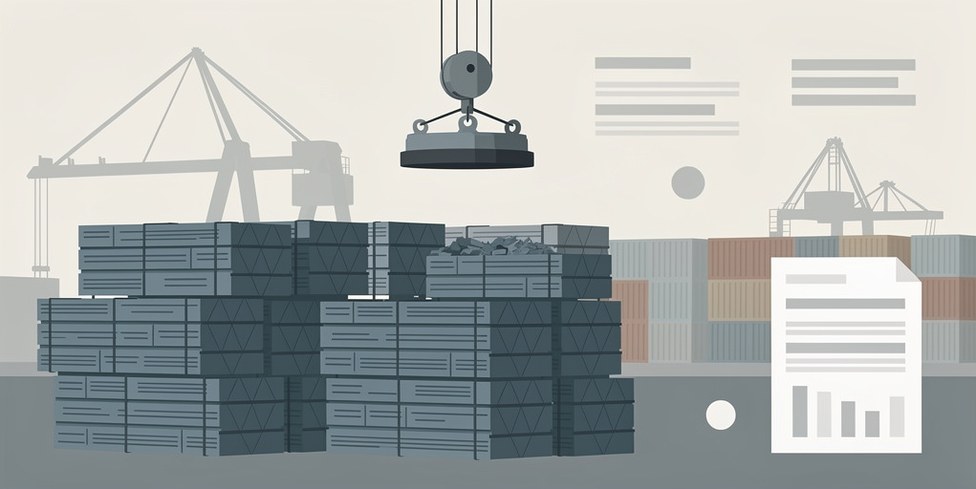
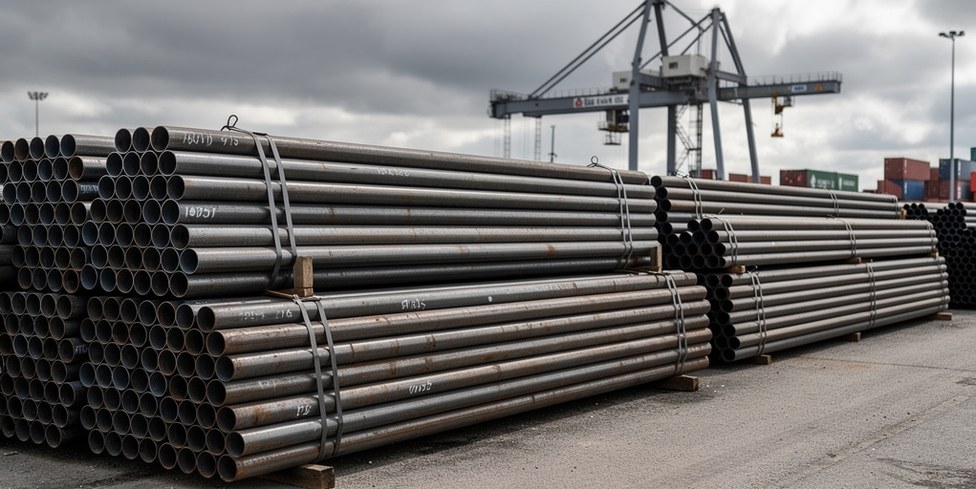
Alloy steel scrap prepared for an export lot: from 26 September 2026 the duty depends on the quota and the licence, not on the metal itself
What your Russian counterparty must obtain — and what they need from you
MinPromTorg allocates the quota on the basis of applications from participants in foreign trade activity. The application states the intended export volume in kilograms and the delivery period. Attached to it are the foreign trade contract and documents confirming the planned delivery — which is exactly where the foreign party is on the critical path. A draft contract without firm tonnage, without a delivery schedule and without a signature does not support an application. If you delay signing by two weeks, your counterparty loses two weeks of quota availability, and the remaining balance is shared with everyone else.
A second requirement is purely domestic and sits entirely on the Russian side. The exporter must prove that in the three months preceding the application it shipped scrap to systemically important organisations of the Russian economy, companies affiliated with them, or Russian metallurgical plants. The confirmed volume of those domestic shipments must be at least three times the volume requested for export.
The three-to-one rule is the main filter: to ship 100 tonnes out of Russia, your supplier must document at least 300 tonnes of deliveries to Russian consumers over the preceding three months. This cannot be assembled retroactively — so ask your counterparty for their confirmed domestic volume before you sign for tonnage they may not be able to move.
The review timetable is short and predictable. Documents are registered on the day of receipt. Within five working days the ministry checks the application and its annexes for compliance. If there are no grounds for refusal, the allocation decision is taken within 10 working days from the date of registration. The decision and the information on the undistributed balance are published on the official MinPromTorg website within one working day of being taken — that publication is how you track how much volume is still available.
If more applications are filed on a single calendar day than the remaining balance covers, the volume is distributed in proportion to the quantities applied for: everyone receives a share of what they requested, not the full amount. This is the part that hurts a shipping plan. Booking a vessel or a set of wagons «exactly to the application» is risky — you may end up with a partly loaded conveyance and a dead-freight bill.
The allocation alone still does not confer the right to ship. To use the allocated volume, a one-time MinPromTorg licence is required. For 2026 licences are valid from the entry into force of the resolution until 31 December inclusive; for the 2027 quota, validity starts no earlier than 1 January 2027 and ends on 31 December 2027. The licence number and details are declared in the customs declaration — errors in those fields lead to refusal of release, so the declaration is prepared only once the licence is physically in hand. Practically, that is your border-delay risk: a lot standing at the checkpoint against an unconfirmed licence is a lot generating demurrage. Our customs clearance team normally builds the declaration and the licence data in one pass for exactly this reason.
Uzbekistan and the CIS: why EAEU membership decides the regime
The measure is tied not to the goods as such but to the direction: it applies when goods leave the customs territory of the EAEU. Deliveries to Kazakhstan, Belarus, Armenia and Kyrgyzstan are mutual trade inside the union — no quota, no one-time licence. Uzbekistan, however, is not an EAEU member, so alloy steel scrap moving there travels under the customs export procedure and falls under the general regime: either an allocated quota volume with a licence, or the elevated minimum payment.
This is the classic trap for companies that treat the CIS as one undifferentiated «near market» and do not sort destinations by union membership. If you ship into the region, the same line matters for your own cargo in the opposite direction: a consignment moving to Uzbekistan crosses a real customs border with a full declaration, duty control and origin checks, while the same consignment to Kazakhstan does not.
For the scrap flow itself, the requirements on the Russian side are those of any third-country export: a full goods declaration, export duty control, confirmation of actual export for tax purposes and currency control under the contract. Your counterparty's zero VAT rate is confirmed under the general rules — the quota does not affect that, but a delay in release caused by a missing licence pushes back the whole confirmation package, and with it the payment cycle you may be financing.
Separately, check what the receiving side needs from you. Import requirements for certification and proof of origin in the destination country are not waived because the Russian seller fitted inside a Russian quota. These are two independent sets of paperwork and they are assembled in parallel, not one after the other.
What the shipper should do
- Verify the classification of the lot against codes 7204 21 100 0, 7204 21 900 0 and 7204 29 000 0 using the actual chemical composition of the scrap, not the description in the specification. Request the mill test certificate or laboratory analysis at the contract stage.
- Establish the direction of the delivery: if the consignee sits outside the EAEU, the quota regime applies; inside the union it does not. Uzbekistan counts as outside.
- Ask your Russian counterparty for their confirmed volume of domestic shipments over the past three months and compare it with the tonnage you want. The «three times more» rule caps what they can realistically export.
- Sign the foreign trade contract early and in a form that supports the application: firm tonnage in kilograms, delivery period, and documents evidencing the planned delivery. Your signature is on the critical path.
- Allow time in your schedule: registration on the day of filing, up to five working days of checks, a decision within 10 working days of registration. In practice, three to four weeks from decision to release, with a complete document set.
- Track the undistributed balance published on the ministry's website. If applications filed on the same day exceed the balance, volumes are cut pro rata.
- Do not fix the laycan or book the vessel or wagons until the one-time licence is issued. Without the licence the reduced rate does not apply and the declaration cannot be filed correctly.
- Model the «no quota» scenario in your price: 5% but not less than EUR 290 per 1,000 kg until 31 October 2026, and not less than EUR 490 from 1 November. Agree in advance who carries that difference.
Frequently asked questions
Can the scrap still be shipped if no quota is allocated?
Yes, there is no export ban. But the shipment goes out at the general rate: 5%, but not less than EUR 290 per 1,000 kg until 31 October 2026, and not less than EUR 490 per 1,000 kg from 1 November 2026 to 31 December 2027. That difference has to sit somewhere in the price.
Is the MinPromTorg allocation decision enough to load the goods?
No. The decision only reserves the volume. Actual export at the reduced rate requires a one-time MinPromTorg licence valid within the relevant period — 2026 or 2027. Treat the licence, not the decision, as your green light for booking transport.
What happens if more applications are filed in one day than the quota balance covers?
The available balance is distributed in proportion to the quantities applied for: each applicant receives a share of the requested volume. Not all applications can be satisfied in full, so a partly loaded conveyance is a real risk.
Does the quota apply to deliveries to EAEU countries?
No, the measure concerns export outside the customs territory of the EAEU. Uzbekistan is not a member of the union, so shipments there do fall under the quota regime.
Summary
From 26 September 2026, exports of alloy steel waste and scrap under codes 7204 21 100 0, 7204 21 900 0 and 7204 29 000 0 outside the EAEU are split into two streams: 27,000 tonnes under quota at 5% but not less than EUR 70 per 1,000 kg, and everything else at a minimum payment of EUR 290, then EUR 490 per 1,000 kg. Access to the reduced volume is gated by the three-to-one domestic supply rule, and no shipment is possible without a one-time MinPromTorg licence. The regime runs to 31 December 2027, so contracts, tonnages and transport bookings should be planned across both periods — and your signed contract is part of your counterparty's application file. Request a consultation and we will review your specific cargo and route, including end-to-end logistics and customs clearance.
We prepare the MinPromTorg application package together with your Russian counterparty and clear the export declaration, so your lot is not held at the border.
Read also:
- Zero Export Duty on Russian Sunflower Oil: What the New Quota Means for Your Shipment
- Lead and lead scrap under HS 7801 and 7802: Russia's one-off export licence, documents and shipping timelines
- Urgent shipments to Russia: what drone delivery of parts, samples and batteries means for the exporter
- Russia Extends Customs Monitoring to 2029: What It Means for Your Shipments and Your Russian Buyer