

Chestny Znak marking at a Chinese consolidation warehouse: how the scheme works, who is liable and what your Russian buyer will ask you for
If you ship apparel, footwear or other regulated consumer goods to Russia, sooner or later your buyer will ask you to do something that looks unusual from the outside: apply Russian identification codes to each item before the container leaves China. This is not an extra service request — it is a condition of customs release in Russia. The codes of the national marking system Chestny Znak must be physically on the goods before the import declaration is filed, not after the shipment arrives. If they are not, the consignment sits at a temporary storage warehouse in Russia, labelling turns into a separate operation under customs control, and your buyer's sales start weeks later than planned — with the cost landing, in most contracts, partly on the supplier. This guide explains the whole scheme from the exporter's side: what happens to your shipment, which documents your buyer will now request from you, where liability actually sits, and which mismatches most often stop the goods at the Russian border.
Why the codes are applied in China and not after arrival
For the Russian importer, marking is a condition of customs release, not a task that follows it. Goods that fall into the list of products subject to mandatory identification marking must be marked before the import declaration is filed: the identification codes are declared in the declaration itself, and customs compares them with the data in the system. Goods without codes cannot be put into circulation in Russia at all — not shipped to stores, not listed on a marketplace, not sold. How the system works and what an identification code is, we explain in our glossary: Chestny Znak.
There are essentially two lawful places to apply the codes. The first is abroad, before shipment: at the manufacturer's warehouse, at a consolidation warehouse or at a printing house. The second is in Russia before release: at a temporary storage warehouse or a customs warehouse, while the goods remain under customs control. The difference is not legality — it is time, cost, and whether anything can still be corrected while the goods are within your reach.
What marking in China gives your shipment:
- the cargo arrives sale-ready — after release it goes straight to the buyer's distribution centre instead of an extra processing step;
- mis-picks, short shipments and defects surface before departure, while you are still there and a replacement costs little, instead of after clearance when a claim comes back to you as a commercial dispute;
- no operations with the cargo under customs control are needed — no approvals from the customs authority, no opening pallets and repacking the consignment at a storage warehouse;
- the limited temporary storage period is not consumed and storage charges do not accumulate;
- cartons can be built for specific stores or orders straight away, instead of the consignment being re-assembled a second time in Russia.
What happens when marking is pushed to a temporary storage warehouse in Russia: the goods arrive, have to be placed in storage, permission for the operations has to be obtained, packaging opened, a label applied to every single unit, everything packed back — all of it within a limited storage period and at the warehouse's rates. Those rates are calculated differently from site to site — per unit, per pallet, per hour of a handling team — and depend on the warehouse, the season and the complexity of the assortment, so no single market figure exists. But the main risk is not money. If at that point it turns out that size 42 was shipped instead of size 38, your buyer can no longer put the question back to you in a workable way: the goods are already in Russia and under customs control, and the conversation turns into a claim, a discount demand or a blocked next order.
Marking after import is not a "finishing touch" — it breaks the condition of release: goods must be marked before the declaration is filed, and unmarked goods may not be put into circulation for even a single day. Treat code application as part of the shipment schedule, not as a warehouse task for later.
The scheme step by step: where your shipment fits in
Below is the full cycle for the most common case: your buyer purchases from several factories and consolidates the consignment at one warehouse in China. The scheme works for a single supplier too, but it is with cargo consolidation that every step needs separate reconciliation — one factory's error otherwise dissolves into the total volume and only surfaces in the customs declaration. Your part is marked explicitly.
- A single product reference list and the purchase orders. Who does it: the importer's purchasing team. Output: a list of items with article number, model, colour, size, composition, brand and the expected HS code, plus specifications and orders under the contract with each factory. What is needed from you: exact, stable article numbers and complete product attributes — composition, colour, size scale, country of manufacture. Whatever you write here is what ends up on the label and in the Russian declaration.
- Product description in the national catalogue and GTIN issuance. Who does it: the importer, in their own account. Output: product cards with completed attributes. This is done in advance, before the codes are ordered — with no card there is nothing to issue codes against. From you: answers to attribute questions, quickly. A card cannot be completed while the composition is "to be confirmed".
- Receipt and consolidation at the warehouse in China. Who does it: the warehouse. Output: a separate acceptance act for each supplier, actual quantities by article and size, a discrepancy report against the order. Acceptance must be kept per supplier, not as one bulk lot — confirmation of customs value depends on it. From you: delivery to the warehouse in clearly identified cartons with your own packing list per delivery.
- Quantity and quality inspection. Who does it: the warehouse or an independent inspector against a checklist. Output: a photo report, a list of defects and mis-picks, a decision on replacement or return. This step precedes marking — marking defective goods means paying for codes that will later have to be written off. From you: a realistic replacement window; this is the last point at which a replacement is cheap for both sides.
- Ordering and issuing the marking codes. Who does it: the importer. Output: codes for the quantity actually accepted and a print file. The issuance fee itself is set by regulation and is the same for every participant — a small amount per code; everything else in the budget is printing and application services.
- Label printing and application. Who does it: the warehouse or a printing house — in some schemes, the factory itself. Output: marked units. The method — sewn-in label, hang tag, or packaging — is set by the marking rules for the product group; what matters is that the code survives until the moment of sale and scans reliably. If this is done at your plant: agree the carrier material and placement in writing before the print run.
- Scanning, photo report and reconciliation. Who does it: the warehouse, checked by the importer. Output: an export of the scanned codes, photos of the applied labels per article, and a summary of "article — size — quantity — codes". Reconciliation happens before packing: opening cartons in China is cheaper than in Russia.
- The application report. Who does it: the importer, signed with their own electronic signature. Output: the codes move to "applied" status. Responsibility for the accuracy of this data rests with the importer even if a contractor physically applied the labels.
- Packing, aggregation and shipment. Who does it: the warehouse and the carrier. Output: a packing list broken down by carton, transport packaging markings, invoices, transport documents. From you: the final commercial invoice matching what actually left the warehouse — not the one issued against the original order.
- Customs clearance in Russia. Who does it: the customs broker together with the importer. Output: a declaration containing the identification codes, a confirmed customs value, paid duties, release. More on how we handle customs clearance is on the service page.
- Introduction into circulation. Who does it: the importer. Output: data submitted to the marking system with the details of the released declaration. Only then can the goods be sold.
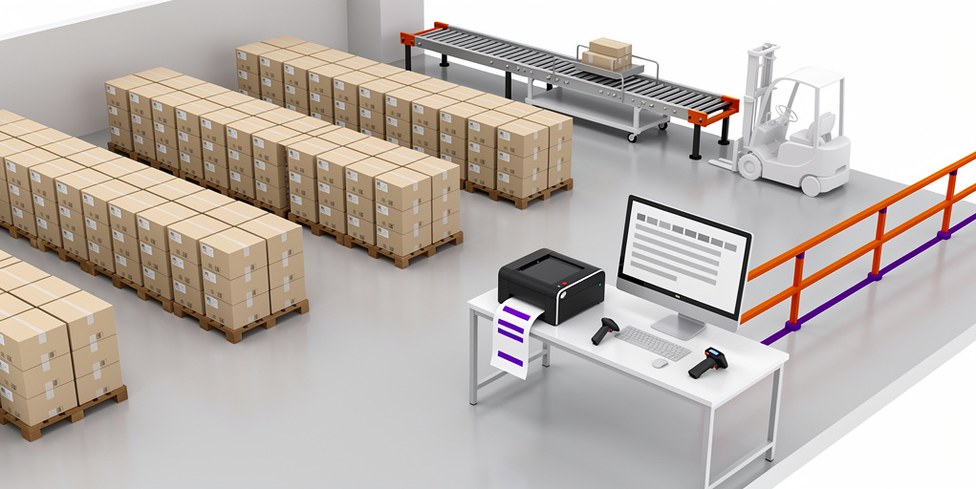
Labels with identification codes are applied at the consolidation warehouse in China — before the goods are packed and shipped to Russia
Who is responsible: importer, customs broker, warehouse, carrier, you
The most common misunderstanding in this scheme is the assumption that "the partner in China takes care of everything". The physical work — yes. The legal liability — no. Here is how it is actually distributed.
- The importer — the legal entity in Russia that owns the goods. Registers in the marking system, obtains a qualified electronic signature, describes the goods and creates the product cards, orders and pays for the codes, signs the application report and introduces the goods into circulation. Before the regulator, marking is their responsibility: circulation of unmarked goods and inaccurate data carry administrative liability up to confiscation of the consignment, and at large volumes the matter becomes criminal. This is why your buyer's requests will look disproportionately detailed to you — the exposure is theirs.
- The customs broker. Prepares and files the declaration, is responsible for HS classification, the structure of the customs value, the completeness of the permit documents and for the declared identification codes matching the goods in the consignment. On customs payments the broker bears an obligation joint with the declarant — which is exactly why they scrutinise supplier documents so closely. For apparel and footwear there are industry specifics around composition, intended use and certification, which we cover as part of clearance of clothing, footwear and accessories.
- The warehouse in China. Receives goods from the factories, recounts, checks quality, prints and applies labels, photographs, scans, packs and prepares the cargo for dispatch. It is liable to its client under contract — for shortages, application quality, deadlines — but not before the Russian regulator. No marking claim will ever be addressed to it by the authorities.
- The carrier. Responsible for cargo safety and transport documents. With marked goods there is an extra risk zone: damaged packaging and water-stained cartons mean unreadable labels, which means re-marking in Russia.
- The printing house or print operator. Responsible for print quality and carrier material: code density, contrast, adhesive durability, resistance to abrasion in transit. In practice this is where saving money produces the most expensive consequences — a re-labelled print run is done unit by unit.
- You, the supplier or manufacturer. You are outside the Russian marking system entirely — you cannot be fined under it and you cannot hold codes. What you do carry is contractual: the accuracy of product attributes, the match between the invoice, the packing list and what is physically in the cartons, and — where your plant applies the labels — the quality of that application. Practically every delay caused at the border by a data mismatch travels back to you as a claim, so the cheapest place to solve it is your production and packing line.
Why the codes cannot simply be handed over to the Chinese warehouse
Suppliers often propose the obvious shortcut: give us the account, we will pull the codes ourselves. It does not work, and it is worth understanding why so that the conversation does not stall.
Marking codes are issued to a specific legal entity — a participant in the circulation of goods — and are tied to that entity's product cards and registration details. A foreign warehouse is not a participant in circulation and cannot hold its own account in the system, so "issuing the codes to the warehouse" is technically impossible: the importer orders them in any scenario.
The second limitation is more serious. The account is access to legally significant actions signed with the importer's electronic signature: ordering codes, the application report, introduction into circulation, write-offs. Handing the signature to a contractor is not handing over "technical access" — it is handing over the ability to sign documents in the importer's name, and everything signed counts as signed by them.
Three workable schemes exist in practice, and none of them requires giving away the account:
- the importer orders the codes and exports them as a print file; the warehouse — or your own plant — receives only that file, which is all that is needed to print and apply the labels;
- the importer creates separate staff accounts with limited rights, where part of the work is run by their own representative in China;
- printing and application run through an operator or integrator connected to the system via a data exchange interface — the data flow is automated, but the report is still signed by the importer.
What you can receive is the code files; what nobody can transfer to you is the electronic signature or the liability. Any discrepancy in the application report is addressed by the regulator to the importer — which means it comes back to you as a contractual claim, not a fine. Put recounting, the photo report and who pays for re-marking into your contract before the first order.
Documents your buyer will request from you
When goods from several factories are consolidated into one shipment, the document set is larger than usual, because a single dispatch is made up of several transactions. Here is what must be assembled by the time the declaration is filed — and what part of it is yours.
- Foreign trade contract and specifications. A separate contract for each supplier, or an annex to a framework agreement with its own specification: items, quantity, price, delivery terms, company details. If the purchase runs through an agent or trading company, the structure of the relationship must be visible from the documents rather than explained verbally. Your part: sign the specification for what you will actually ship, and re-issue it if the order changes before dispatch.
- Invoices and packing list. One invoice per transaction; the packing list covers the goods actually shipped, broken down by carton, article, size, gross and net weight. After consolidation the packing list is produced by the warehouse — and it is the document that most often disagrees with the application report.
- Transport documents. Bill of lading, air waybill or CMR, the carriage contract, freight and handling invoices — these also feed the customs value calculation.
- Marking documents. The export of identification codes for the consignment, the application report, the photo report, and the service act for the marking work from the warehouse or printing house. The code register must reconcile with the packing list line by line.
- Permit documents. For apparel and footwear these are declarations or certificates of conformity with the technical regulation on light industry products, and for children's ranges the regulation on products for children and adolescents. The consumer label is checked separately: mandatory information in Russian and the single market circulation mark. A permit document is issued for a specific applicant and specific products, so a "supplier's certificate" usually does not fit — but the test reports, composition data and product samples behind it will be requested from you. How this is arranged is described on our certification page.
- Documents to confirm the customs value. Payment orders and bank statements, manufacturers' price lists, export declarations, freight, handling and warehouse invoices. With consolidation, value is determined separately for each transaction, and transport and related costs up to the place of arrival are apportioned between the goods. Your part here is real: the export declaration and the price list are supplier documents, and refusing to provide them is one of the frequent reasons a Russian buyer's consignment ends up in an additional verification procedure.
One issue deserves its own line: the cost of marking performed abroad. Depending on how it is documented and in whose favour the services are rendered, it may be subject to inclusion in the customs value. This is settled at the contract stage, not when the declaration is filed — if you invoice marking, printing or labelling separately, say so early so the buyer's declarant can structure it correctly instead of facing a value adjustment after release.
The data that must match across declaration, system and paperwork
Almost every problem at release comes down to the same thing: three data sources — the customs declaration, the marking system and the commercial documents — tell different stories about the same consignment. They have to be reconciled before the cargo departs, not at the border. The rows below are where a supplier's data enters the chain.
| What is checked | Where it is taken from | What it must match |
|---|---|---|
| Name, article number, model | Product card in the marking system | Specification, invoice, packing list, goods description in the declaration |
| Unit quantity per article | Application report and code register | Packing list and the quantity in the declaration |
| HS code | Product card | The code declared in the customs declaration |
| Composition, colour, size scale | Product card | The label on the item, the specification, the permit document |
| Identification codes | Export from the system | Code data in the declaration and the physical labels on the goods |
| Country of origin, manufacturer | Product card | Invoice, certificate of origin, declaration |
| Gross weight and number of packages | Packing list | Transport document and declaration |
A practical device that works well: one working file per consignment, with a row for each article showing the order quantity, the accepted quantity, the number of codes, the packing list quantity and the declared quantity. If any column disagrees, the cargo does not ship until the discrepancy is explained. Ask your buyer to share that file — it is the fastest way to see what will be asked of you three weeks later.
Common mistakes and how they end
- Codes applied to the wrong items. Labels from one model go onto another — typically when article numbers differ by a single character, or when the warehouse works by product name instead of barcode. Result: system data no longer matches the goods, codes have to be written off and re-ordered, and the consignment waits for re-marking. Suppliers whose article numbering is nearly identical across models cause this far more often than they realise.
- Mixed items during consolidation. Goods from two factories end up in one carton and part of the items are attributed to the wrong supplier. Result: a mismatch against the invoices, questions about customs value and, in the worst case, a value adjustment and additional payments.
- The label does not scan. Small print, low contrast, a glossy or fleecy surface, a fold on a seam, adhesive that did not survive the trip. Result: the goods are formally marked but fail acceptance at retail and on marketplaces; re-marking happens in Russia, unit by unit — and that invoice usually travels back to whoever chose the label material.
- Goods marked after import. The most expensive scenario: the very condition of release is breached. Result: refusal of release or release followed by proceedings, risk of seizure and an administrative case.
- Packing list quantity does not match the application report. A classic when the consignment is topped up on the last day before dispatch: the list is redone, the report is not. Result: declaration and system data disagree, documents are requested, release is delayed.
- Wrong size scale or colour in the product card. Sizes given in a different national grid, colour described by a marketing name rather than the actual one. Result: cards have to be redone and codes issued against wrong attributes written off. Send the size conversion table with the specification, not after the first complaint.
- Codes ordered against planned rather than actual quantity. The factory under-delivered, the codes are already paid for and partly unused. Result: leftover codes that must be properly closed in the system, otherwise the reporting shows items applied but never introduced into circulation.
Marking in China vs marking in Russia: comparison table
| Parameter | Marking at a warehouse in China | Marking in Russia before release |
|---|---|---|
| Time to sale | Goods arrive ready: straight to the distribution centre after release | Processing at a temporary storage warehouse is added to transit time, and it runs inside a limited storage period |
| Cost | Printing and application at Chinese warehouse rates, usually per unit; logistics costs do not increase | Temporary storage warehouse services, storage, unpacking and repacking; in our experience more expensive for the same operation |
| Fixing errors | Defects, mis-picks and shortages are settled with the supplier before dispatch | Goods are already in Russia and under customs control: returning or replacing them is practically impossible |
| Customs risk | The main risk is a data mismatch, removed by reconciliation before dispatch | Adds the risk of missing deadlines and of claims regarding operations with the goods |
| Load on the warehouse in Russia | Minimal: acceptance by carton, fast where codes are aggregated | High: unit-by-unit handling of the whole consignment — people, space, time |
| Quality control | Combined with marking, on the same line | Carried out separately, and with no option to send goods back to the factory |
| Contractor requirements | A warehouse experienced with codes and disciplined about scanning | A temporary storage warehouse willing to perform such operations |
| When it makes sense | Regular shipments, wide assortment, size ranges, several suppliers | A one-off consignment, an urgent dispatch, or a case where codes could not be applied abroad in time |
| What it means for the supplier | More preparation before dispatch, a predictable buyer and repeat orders | Less work before dispatch, but a high chance of claims, delayed payment and a blocked next order |
Checklist: what to agree before the first shipment
- Who applies the codes — your plant, the consolidation warehouse or a printing house — and who pays for re-marking if the labels fail.
- The format in which you receive the code files, who sends them, and how long you may keep them.
- Label samples on your materials, tested with an ordinary scanner after abrasion and folding — approved in writing before the print run.
- Where the code goes on your product: sewn-in label, hang tag or packaging, and whether it survives your own packing process.
- The photo report rules: what is photographed, at what resolution, how it is linked to article and carton.
- The export format for scanned codes and the "article — size — quantity — codes" summary.
- How the warehouse keeps records per supplier and what goes into the packing list against your delivery.
- What happens on shortages, defects and mis-picks: notification deadlines, who decides, who pays for the replacement.
- Your deadline for issuing the final invoice and packing list after the actual quantity is confirmed.
- Which supplier documents you will provide for customs value: export declaration, price list, payment confirmations.
- Who on your side owns the product attribute data — composition, colour, size scale — and how changes are communicated.
Frequently asked questions
Can the goods be marked after arrival in Russia?
After release — no: the goods must be marked before the declaration is filed, and unmarked goods cannot be introduced into circulation. Codes can be applied in Russia, but only before release — while the consignment is under customs control at a temporary storage or customs warehouse, and following the established procedure for operations with such goods.
Can we order the codes ourselves as the manufacturer?
No. Codes are issued to the legal entity that is a participant in the circulation of goods and owns the product cards; a foreign supplier or warehouse cannot act in that capacity. You receive ready print files, and the application report is signed by the importer with their electronic signature.
Our buyer purchases from five factories and consolidates in one warehouse. How many invoices do we issue?
As many as there are transactions. Each purchase is a separate transaction with its own price and documents, even if the goods travel in one truck or one container. Consolidation changes the logistics, not the structure of the deals, and customs value is confirmed for each of them separately.
What if some labels are damaged in transit?
Goods with an unreadable code cannot be sold; they must be re-marked under the system rules with the previous code correctly written off. This is exactly why the carrier material and print durability should be tested before the print run, and why the contract should state who bears the cost of re-marking.
Where should the code go — on the product or the packaging?
It depends on the marking rules for the product group: different categories allow a sewn-in label, a hang tag, packaging, or a combination. The common requirement is one — the code must survive until the moment of sale to the end customer and scan reliably.
What happens if the application report quantity does not match the packing list?
The discrepancy surfaces when declaration data is compared with the system, and release will most likely be held until the cause is explained. If it is a documentary error, it gets corrected; if fewer units were actually marked than shipped, part of the consignment is unmarked, and that is no longer a paperwork question but one of whether the goods may enter circulation at all.
Are marking costs incurred in China included in the customs value?
They may be — it depends on how the services are documented, who commissioned them and at what stage they were rendered. This is settled in advance: show the declarant the warehouse contract and the structure of the invoices before dispatch, so the right amounts are included immediately rather than corrected after release.
Does the same apply to our shipments to other CIS countries?
The Chestny Znak identification codes described here are a requirement for goods placed into circulation in Russia, and the scheme above is built around Russian import clearance. For a shipment routed to another destination, the requirements have to be checked against that country's rules before you plan the labelling.
Send us the details of your shipment to Russia and we will tell you exactly which documents and codes must be ready before the goods leave your warehouse.
Expert opinion
 | Yaroslav Loginov — Expert in logistics and customs clearance with 40 years of experience.
|
«When someone comes to me asking for "a warehouse in China that will mark everything", I always start with one question: how is your product reference list organised. Almost always it turns out that purchasing has one version, the warehouse has another, and something else again has been entered into the marking system. Until those three lists are merged into one, any contractor in China will be sticking labels on the items they understood, not the items you meant. Marking is not an operation with glue — it is data discipline, and it has to be sorted out before the first order of codes.
The second thing is time. Buyers budget for production and for transit, but not for product description, test printing and reconciling scans against the packing list. In my experience the first consignment under a new scheme always takes noticeably longer than the ones that follow: it is where label templates, export formats and the acceptance procedure get worked out. Make the first shipment small and deliberately slow — it is cheaper than unpacking a container in Russia where the codes do not agree with the cartons. And I would say the same to the supplier side: the data you send with the first order sets the template for every shipment after it».
Summary
Applying Chestny Znak codes at a warehouse in China solves the core problem for everyone in the chain: the goods arrive sale-ready, and errors surface where they can still be fixed at the factory. Legally the scheme rests on the Russian importer — codes are issued to their legal entity, they sign the application report, and accuracy of the data is their liability; the warehouse answers only under its contract. For you as the exporter the practical consequence is narrower but real: accurate product attributes, an invoice and packing list that match what is physically in the cartons, supplier documents for customs value provided without argument, and label materials tested before the print run. Everything on that list is checked before dispatch; everything missed from it becomes a hold at the Russian border and a claim back to you. Request a consultation and we will go through your specific shipment.
Read also:
- Shipping to Russia through the EAEU: how SPOT filings, marking codes and your buyer's reporting must match
- Toy Marking in Russia from 1 September 2026: What Your Shipment and Your Buyer Now Need
- Alloy Steel Scrap Export from Russia: the New Quota, the MinPromTorg Licence and What Your Russian Counterparty Will Ask You For
- Zero Export Duty on Russian Sunflower Oil: What the New Quota Means for Your Shipment