

China–Russia road crossings in Primorye: what the new capacity means for your shipments
If you ship goods into Russia and your buyer is switching from the sea leg to the road route through Primorye, the change to prepare for is not "a faster border" but a different document set and a different rhythm. On the road crossing the truck reaches the border with the pack already complete: advance information, permit documents under the technical regulations, confirmed customs value. Expanded capacity at the Pogranichny, Khasan and Kraskino crossings will raise the combined throughput to 1,350 trucks per day — 2.7 times the current level — but the days saved go only to shipments whose permit side was closed in advance. Most of that side is built from paperwork that only you, the manufacturer or supplier, can provide. Below is what your buyer will now ask you for, and when.
What is changing at the Primorye road crossings
The Pogranichny crossing is already in operation; the upgraded Khasan and Kraskino are expected to open shortly. Together the three will handle roughly half a million trucks a year. Freight volumes through the road crossings of Primorye already exceed the 2019 level more than twofold, and a further increase of about a third is expected by the end of 2026. The sea leg is growing in parallel: cargo turnover at the region's ports reached 162 million tonnes in 2025 with a container throughput of 2 million units, and added another 6.4% and 10% respectively in the first half of 2026.
For you as the shipper this means one simple thing: the queue at the gate stops being the main constraint. The bottleneck moves from the crossing into the procedure itself — into the completeness of the data in the declaration, the permit documents, and the ability to prove customs value. The rebuilt "Primorye-1" corridor and business interest in "Primorye-2" make road dispatch a working option not only for border-area purchases but also for consignments that used to travel by container by default. Your buyer will therefore start asking for the same documents earlier than before, and with less tolerance for a missing page.
Expanding a crossing removes the queue at the gate, but it does not shorten the release of the declaration: if the certificate or declaration of conformity is not in place before the truck arrives, the cargo goes into a temporary storage warehouse. The days saved at the border are then spent on storage and vehicle idle time — and the invoice for that lands on whichever side the contract assigns it to.
Documents behind a road shipment: EAEU technical regulations
Changing the route does not change the permit side: it is tied to the goods, not to the mode of transport. But a road shipment moves faster than a vessel, and there is no longer the option of "finishing the paperwork while the container is at sea". By the time the truck approaches the border, your buyer must hold — and most of it comes from you:
- the foreign trade contract with its annexes (specification, manufacturer's price list), the invoice and the packing list;
- transport documents for the road carriage and confirmation of the delivery cost up to the border;
- permit documents under the applicable technical regulations: for electronics and household appliances these are typically TR CU 004/2011 and TR CU 020/2011, for clothing and footwear TR CU 017/2011, while children's goods, furniture, food products and building materials have their own regulations and their own conformity assessment schemes;
- test reports from an accredited laboratory and the record of the document in the national part of the register — testing needs product samples from you, and samples have to be shipped and cleared before the main consignment;
- EAC marking on the product and the packaging, and for goods on the mandatory labelling lists, identification codes applied before import — in practice at your factory or at the packing line;
- documents of origin, if preferences are claimed or if trade remedy measures apply to the goods.
Product testing and registration of a certificate or declaration of conformity is a separate project with its own lead time — see certification. Groupage road shipments from China, including bringing the truck to the supplier's loading dock, are arranged under road delivery from China; if the sea leg still suits your volumes, compare it against sea freight before rebuilding the route.
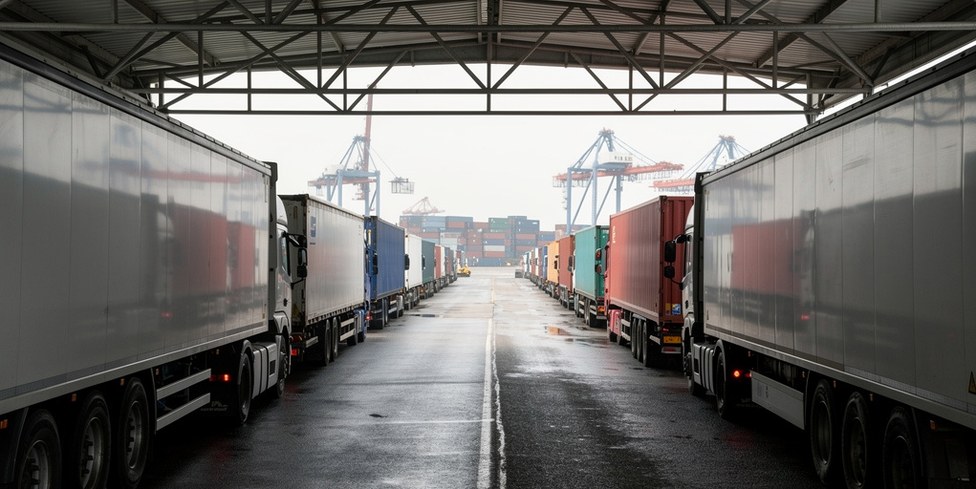
Trucks at a road border crossing in Primorye: the queue is shrinking, the paperwork requirements are not
Safeguard, anti-dumping and countervailing measures: check before you sign
This is the case where a fast route does not help and a mistake costs more than the logistics. Safeguard, anti-dumping and countervailing duties are imposed by decisions of the Eurasian Economic Commission, apply on top of the ordinary import duty, and are tied not only to the HS code but also to the country of origin — and often to the specific manufacturer: one plant gets one rate, another a substantially higher one.
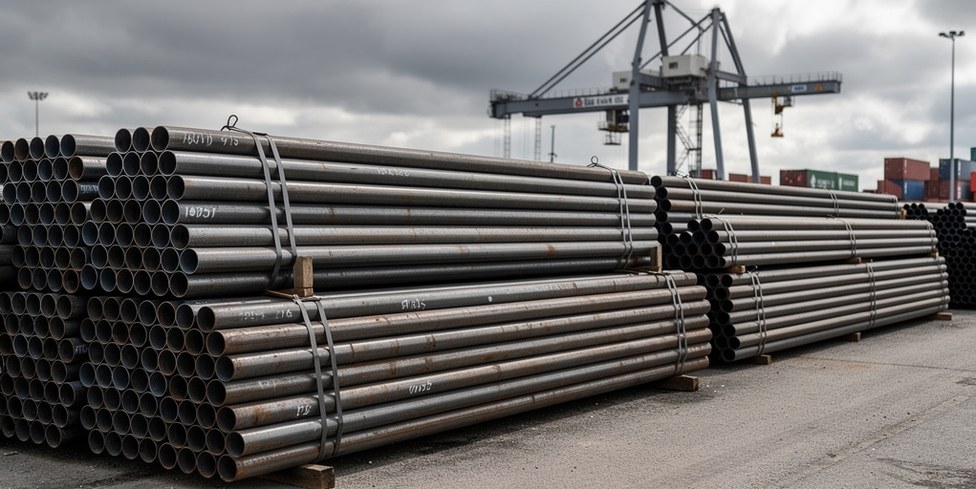
The positions most often covered are industrial ones: rolled metal and pipes, fasteners, bearings, certain types of tools, tyres and equipment. The practical order of work is to have the HS code checked against the current EEC decisions before the contract is signed, and, if a measure exists, to be ready to issue a certificate of origin and the documents proving that the goods were made by exactly the producer for which the lower rate is set — mill certificates, production records, plant identification in the invoice and packing list. The duty is calculated from the customs value or as a fixed amount per unit, so your invoice pricing and delivery terms feed straight into the payment your buyer makes at the border.
Sea leg or road crossing: what changes for the shipper
| Situation | Sea route via port | Road crossing in Primorye |
|---|---|---|
| Document readiness | There is slack to finish paperwork while the vessel is under way | The pack must be complete before the truck reaches the border |
| Consignment size | Suits a full container and large volumes | Suits groupage and small lots, frequent dispatches |
| Permit documents | The same technical regulation requirements | The same requirements, but with no room for delay |
| Risk with an incomplete pack | Storage at the port, demurrage and detention | Vehicle idle time and temporary storage warehouse charges |
| Transport component of the cost | Freight and handling up to the place of arrival | Road carriage up to the crossing |
| What is asked of you, and when | Invoice, packing list and permits during the sea passage | The same set before loading, plus data that matches the advance information |
Your buyer's landed cost is not the invoice figure: it includes your price, transport and insurance up to the border, the import duty, customs fees, any safeguard or anti-dumping duty, the customs broker's fee, temporary storage and delivery to the warehouse. When the route moves from sea to road it is the transport part that changes — and the gain in transit time is sometimes eaten entirely by the truck rate. Expect the discussion about delivery terms and about who carries the carriage cost up to the border to reopen when the route changes; have your ex-works and delivered-to-border price positions prepared.
What the exporter should do
- Agree the HS code with the buyer before the order is placed, and have it checked not only for the duty rate but also for current safeguard, anti-dumping and countervailing measures.
- Ask which technical regulations apply to your product and start the certificate or declaration of conformity early — testing and registration need their own lead time, and the laboratory needs samples from your production, not from the shipment already sold.
- Check whether the product falls under mandatory labelling and agree with the buyer that identification codes are applied at your side before import.
- Supply the customs value evidence pack in full: contract with specification, invoice, your manufacturer's price list, carriage invoices up to the border, payment documents. A price list that contradicts the invoice creates more questions at the border than a high price does.
- Send the buyer the exact data for the advance information — weight, number of packages, marks — and make sure the truck is loaded to match it. A discrepancy in weight or package count takes longer to resolve at the crossing than the clearance itself.
- Make sure the manufacturer named in the certificate of conformity is the same entity as the actual consignor of the consignment, and that the document is still valid on the date of arrival.
- Where an origin-linked measure or preference applies, arrange the certificate of origin and the plant identification documents at dispatch, not after the truck has left.
Frequently asked questions
Is an invoice enough, or does the buyer need a signed contract?
Up to a set amount the Russian buyer's bank does not require the contract to be registered, and the deal can be documented with an invoice or a proforma; the current threshold should be confirmed on the date of the deal, as it has changed. Either way, for customs your invoice must carry enough detail to support the customs value: description, quantity, unit price, delivery terms.
Will the road crossing speed up release of the declaration?
No. Expanded crossings cut the time to enter and to be processed at the border, but the release period depends on the completeness of the data and on whether an inspection or a document request is triggered.
Does the certificate have to be reissued when the route changes from sea to road?
No — the permit document is issued for the product and does not depend on the mode of transport. Check two other things: that it has not expired, and that the manufacturer named in it matches the actual consignor of the consignment.
How do we tell whether our goods fall under an anti-dumping measure?
By HS code and country of origin, against the current EEC decisions — and, where the rate is producer-specific, by the plant. This is checked before the contract: if a measure exists, it changes the economics of the purchase more than any logistics decision, and by the time the goods are moving and the money is sent, nothing can be re-agreed.
Summary
Raising the capacity of the Primorye crossings to 1,350 trucks a day makes the road route from China a real alternative to the sea leg even for medium-sized consignments. But the time saving goes only to shipments whose technical regulation permits, marking and customs value evidence are ready before the truck reaches the border — and most of that pack is assembled on your side. Check the goods separately against safeguard, anti-dumping and countervailing measures: they change the economics of a supply more than the choice of transport does. Send us the details of your consignment and we will go through it item by item with your buyer.
We will plan the route through the Primorye crossings and prepare the declaration for your consignee in Russia.
Read also:
- From 10 August Russia extends simplified certification to 2027 — and tightens the rules for goods on Minpromtorg List No. 4114: what it means for your shipment
- Aluminium Tableware from China: 21.89% Anti-Dumping Duty Runs to 28 May 2027 — What It Means for Your Shipment to Russia
- Russian Grain Export Duty Moves Every Week: What It Means for Your Shipment and What Your Counterparty in Russia Will Ask You For
- Russian industrial zone in Suez: what it changes for your shipment and what your Russian buyer will ask for