

Import of Tractors and Buses: The bill allows for the environmental class to be confirmed by a ZOETS certificate until the end of 2026
If you are importing tractor-trailers or buses and are counting on a reduced import duty rate, you must provide documentation confirming the vehicle’s environmental class; however, the standard document required for this—vehicle type approval—is currently difficult to obtain from non-friendly countries. The Ministry of Finance is proposing a solution: until December 31, 2026, to accept an individual vehicle assessment report (ZOETS) for this purpose. This is still a draft; public comment is open until October 14, 2026. Let’s take a look at which EAEU TN VED codes are affected, which vehicles fall under them, what changes this brings to the customs clearance process, and what you need to prepare to avoid losing your duty exemption.
What the draft proposes
The draft resolution of the Government of the Russian Federation “On Establishing Specifics for the Importation of Certain Types of Motor Vehicles into the Russian Federation” was prepared by the Russian Ministry of Finance and posted on the federal portal for draft regulatory legal acts on September 29, 2026. The public comment period will last until October 14, 2026. This is not yet a law: the text may change, or the draft may not be adopted at all.
In a nutshell: Until December 31, 2026, to confirm the environmental class when importing motor vehicles from a specific list, it is permissible to use a ZOETS (individual vehicle assessment report), issued in accordance with the Rules approved by Russian Federation Government Resolution No. 855 of May 12, 2022. The draft applies to vehicles manufactured in foreign countries and territories included in the list of unfriendly countries, as approved by Government Order No. 430-r of March 5, 2022. The legal basis is Article 18 of Federal Law No. 46-FZ of March 8, 2022.
The wording “may be used” is important: this is an option, not a requirement. The ZOETS does not replace other vehicle requirements but merely serves as another acceptable document for confirming the environmental class.
Which vehicles and codes are affected
The draft lists 19 ten-digit EAEU Foreign Economic Activity Commodity Classification (TN VED) codes from two commodity headings. The first, 8701, covers tractors; specifically, tractor units for semi-trailers: 8701 21 101 1, 8701 22 101 1, 8701 23 101 1, and 8701 29 101 1. The second, 8702, covers vehicles designed to carry 10 or more people, i.e., buses: the list includes subheading codes 8702 10 and 8702 20, for a total of 15 ten-digit codes. Get the full list from the draft text and check it against your customs declaration: a difference in the last digits of the code changes the outcome.
General-purpose trucks (heading 8704) and passenger cars (8703) are not included in the draft. If you transport dump trucks, vans, or flatbed trucks, this draft does not apply to you. We covered the import of electric vehicles in our article on customs clearance for electric vehicles from China.
| TN VED code | What Is It | Affected by the draft |
|---|---|---|
| 8701 (subheadings 8701 21, 8701 22, 8701 23, 8701 29) | Tractor trucks for semi-trailers | Yes, 4 codes |
| 8702 (subheadings 8702 10, 8702 20) | Buses for 10 or more passengers | Yes, 15 codes |
| 8703 | Passenger cars | No |
| 8704 | Trucks | No |
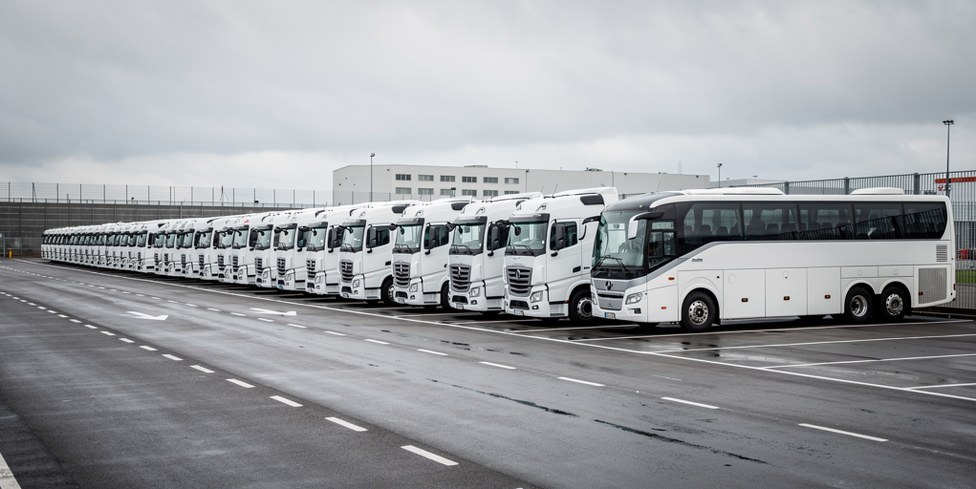
Trucks and buses at the customs yard: confirmation of the emissions class affects the duty rate
How this works in practice and where the risks lie
The logic of the draft is as follows: The EAEU Customs Tariff provides codes with reduced import duty rates for vehicles in environmental class 4 and above, and their environmental class must be verified. This is typically done through an entry in the vehicle type approval or in the certificate of conformity. Due to sanctions, importers from unfriendly countries are often unable to obtain such a document, so market participants issue a ZOETS, which is not recognized as valid confirmation in the customs nomenclature. The draft regulation is specifically aimed at ensuring that such a conclusion is accepted for this purpose on a legal basis during the transition period.
Until the resolution is adopted, the ZOETS does not replace the OTTS for the reduced tax rate. Without a confirmed environmental class, applying the reduced tax rate code is risky.
There are other questions that the draft does not address. The text specifies the deadline as “until December 31, 2026,” but does not state whether this is based on the date the declaration is filed or the date the goods are released. For vehicles transported by sea or rail at the end of the year, this is a significant difference. The draft does not specify duty rates; check them in the Unified Customs Tariff under the relevant code. If the draft is adopted, clarify how customs authorities in your region will accept the ZOETS along with the declaration.
What Importers Should Do
- Check your vehicle’s 10-digit TN VED code against the list of 19 codes in the draft. If your code is not on the list, the draft does not apply to you.
- Make sure the country where the vehicle was manufactured is included in the list of “unfriendly” countries under Order No. 430-r: the draft applies only to such vehicles.
- Check with the manufacturer or seller to see if the vehicle has an OTTS or a certificate of conformity with a notation regarding its emissions class. If it does, you do not need the draft.
- If there is no OTTS, assess in advance how to prepare the ZOETS in accordance with the Rules of Resolution No. 855 and how much time this will take. You must have the report by the time the customs authority confirms the emission class, so do not wait until the days immediately before the vehicle’s arrival to complete the paperwork.
- Determine the realistic timeframe for filing the declaration. If the vehicle is expected to arrive in late 2026, agree with your customs representative on a backup plan in case the draft is not approved or is amended.
- Do not include a reduced rate in the transaction price until the resolution has been signed. Include a scenario with the standard rate and see how the cost changes.
Frequently Asked Questions
Is this already in effect?
No. This is a draft government decree that the Ministry of Finance released for public comment on September 29, 2026. The comment period runs through October 14. Until the decree is signed and published, the current procedure remains in effect.
Does the draft apply to trucks?
No. It only covers tractor-trailers with codes 8701 21, 8701 22, 8701 23, and 8701 29, and buses with codes 8702 10 and 8702 20. Trucks classified under heading 8704 are not included in the list.
What is ZOETS?
It is a vehicle assessment report issued in accordance with the Rules for the Application of Mandatory Requirements for Certain Wheeled Vehicles and the Conduct of Conformity Assessments, approved by Government Resolution No. 855 of May 12, 2022.
Until what date can the ZOETS be used for this purpose?
According to the draft text, until December 31, 2026. The draft does not specify whether this deadline will be determined by the date of filing the declaration or the the date the goods are released; therefore, check the wording after the act is adopted.
Summary
The Ministry of Finance’s draft proposes accepting the ZOETS until December 31, 2026, to confirm the environmental class of semi-trailer tractors (codes 8701 21, 8701 22, 8701 23, 8701 29) and buses (8702 10, 8702 20) manufactured in unfriendly countries. This is still a draft: the previous procedure remains in effect until it is adopted, and the effective date and application procedure are subject to change. Check the 10-digit code and country of origin, find out if the vehicle has an OTTS, and do not factor the reduced rate into the price until the regulation takes effect. Submit a request for a consultation, and we will analyze your specific shipment.
We'll check the TN VED code for your tractor or bus and prepare the documents related to its emissions class
Read also:
- Russia bans sulphuric acid exports until the end of 2026: what it changes for your shipments to Russia and the CIS
- Shipping diesel and petroleum products to Russia: HS code 2710, excise rules and the papers your buyer will now ask you for
- Russia–China: The 2027 Protocol Between the Federal Customs Service and the General Administration of Customs of the PRC—What It Means for Customs Clearance and Border Queues
- Customs Value Verification: Risk Indicators, Customs Inquiries, and How to Support the Price with Documentation