

New Khasan road crossing into Russia: what changes for your shipment and what your buyer will ask you for
If you ship to Russia or the CIS on the Korean route, the thing to prepare is not the road but the paperwork: on the new crossing every consignment goes through full customs clearance — a declaration filed by your buyer, customs value proved with your documents, and permits presented at the border. On 7 September 2026 traffic opened over the bridge across the Tumannaya river, and Khasan in Primorsky Krai became a permanent multilateral road crossing for cargo and passengers; until then goods to and from the DPRK moved only by rail and by air. Declared capacity is 300 vehicles a day. For an exporter this is a new declaration point — and a new deadline for the documents that have to leave your plant together with the truck.
What the status of the crossing means for your cargo
The wording of the Russian government order — a permanent multilateral road crossing for cargo and passengers — is a working description rather than officialese. Multilateral means that vehicles and goods of third countries may pass through it, not only those of Russia and the DPRK: a manufacturer in any jurisdiction can use the route. Cargo and passengers means that individuals and their belongings will be processed here alongside commercial consignments. Permanent means year-round operation, not seasonal as at some remote crossings.
The crossing is built with ten traffic lanes; the bridge over the Tumannaya is two-lane and about a kilometre long, and the whole bridge crossing with its approach roads runs 4.7 km. Planned throughput is up to 6 million tonnes a year. The approach road joins the Ussuri federal highway, so cargo moves from the border straight into the main road network of the Russian Far East and on into the West–East corridor. At the start only freight traffic runs; full operation, including the passenger direction, is due at the end of 2026.
The practical conclusion for a shipper is simple: until the end of 2026 plan the route as a freight-only crossing, and do not build into your schedule a trip by your own representative or a supervising engineer through this same point.
Which goods move first and which documents your buyer will ask you for
The mix in the first months will follow what already travels by rail: food and agricultural products, building materials, equipment and components, consumer goods. Road transport adds the small and urgent consignments that do not justify a wagon — and those are exactly the ones that stumble over permits, because nobody arranges certification for them in advance.
Requirements follow the category of goods, not the route: changing the border crossing changes nothing in the document set. Food and raw materials of animal or plant origin need veterinary or phytosanitary documents and proof of conformity with EAEU technical regulations. Equipment and electrical goods need a declaration or certificate of conformity, and for some items a safety justification. Goods on the mandatory-marking lists need identification codes before they are released for circulation. Restrictions specific to the Korean direction have to be checked separately against your own product range: the lists there are specific, and the usual way of doing things does not apply.
Formally these papers are issued in Russia and the declaration is filed by your buyer — but almost every one of them starts on your side. EAEU certification needs technical documentation, test reports, data on the production site and, as a rule, samples; veterinary documents need the establishment approval and the export certificate of your own competent authority; marking requires labels and codes applied at your plant, not in a Russian warehouse. In practice it is the lead time for these documents, not the transit time, that sets the earliest date on which you can load. Certification arranged in parallel with production is the cheapest version of this work; arranged after loading, it is the most expensive one.
Permits must exist at the moment the declaration is filed, not be sorted out afterwards: a truck that reaches the border without a certificate or a veterinary document stays at a temporary storage warehouse, and the daily demurrage quickly eats up the gain from the short road leg.
The procedure at the new crossing is the usual one: advance information before arrival, opening of the procedure, the declaration, checks on the code and the value, release. Your part of it is the shipping set: contract, invoice, packing list and transport documents whose data match each other to the digit. If the direction is new to you, it is more sensible to run one trial consignment with customs clearance support on the Russian side, and only then set up a regular flow.
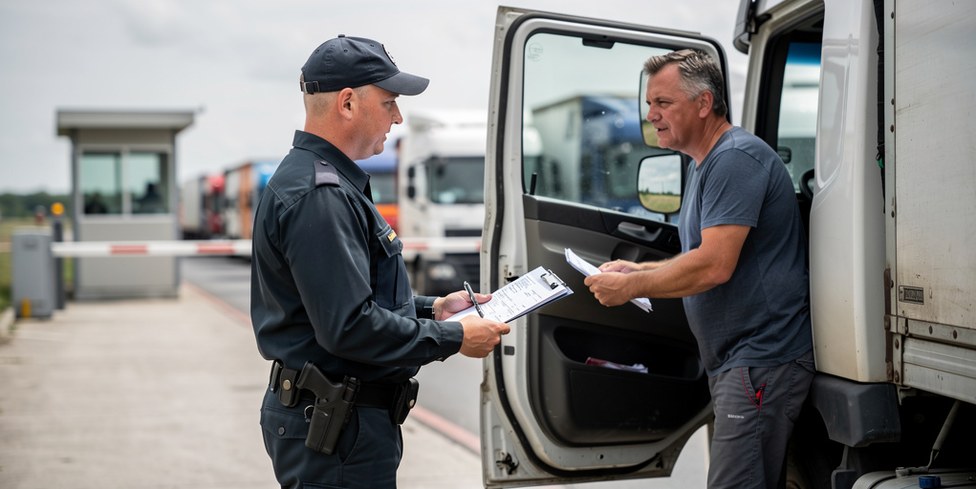
Trucks at the new Khasan road crossing on the Russia–DPRK border
Samples, personal effects and the line where a consignment becomes commercial
Because the crossing handles passengers as well, individuals will travel through Khasan once it is in full operation. Two regimes meet here. Goods for personal use are declared under a simplified scheme, within weight and value allowances, and need no certificates of conformity. A commercial consignment is declared in the general order: full declaration, proof of value, permits, payment of duty and VAT.
The dividing line is drawn by the nature and purpose of the goods, not by the size of the bag. A uniform product range, retail packaging, quantities clearly beyond personal needs, a supplier invoice in the file — all of these mark a commercial consignment even if the goods travel in a car boot. This concerns exporters more often than it looks: trade-show samples, spare parts for a warranty repair, a demonstration unit handed to a travelling employee or to the buyer's driver are the classic cases of reclassification. The saving disappears at that moment, because the additional charges come together with an investigation and a standstill.
Splitting one commercial consignment into several personal imports is the fastest way to be refused release and to have every previous shipment reviewed.
Samples and catalogues have their own, perfectly workable route with normal declaration and their own document set — see customs clearance of samples and catalogues. Sending them through a passenger channel to save a week is the one shortcut on this route that reliably costs more than it saves.
Before and after: rail versus the road corridor
Until the crossing opened, trade with the DPRK rested on the railway bridge built back in 1959 and on air services, and the capacity of the old bridge was no longer enough for the growing flow. A truck leg also makes groupage road deliveries possible on this direction for the first time. What changes for planning a shipment:
| Parameter | Before: rail and air only | Now: the Khasan road crossing |
|---|---|---|
| Minimum consignment | A wagon load or an expensive air shipment | A single truck, groupage cargo, small lots |
| Capacity | Limited by the bridge built in 1959 | Up to 300 vehicles a day, up to 6 million tonnes a year |
| Schedule flexibility | Tied to timetables and wagon allocation | Dispatch when the cargo and the documents are ready |
| Door-to-door delivery | Transfer to trucks after the rail station | No transhipment, direct exit onto the Ussuri federal highway |
| Document requirements | Full set according to the HS code | The same set — the route grants no simplification |
| Main risk | Waiting for rolling stock | A standstill at the border because permits are not ready |
Look at the last row. The saving in transit time is cancelled out if the declaration is filed with the wrong code or without a supporting document. On the railway a shipper usually has a few days of slack; on a road leg there is none — the truck is at the border almost as soon as it leaves.
What the exporter should do
- Agree the HS code with your buyer before the contract is signed: the duty rate, the need for certification and inclusion in restrictive lists all follow from it, and a code agreed after shipment turns into a dispute at the border.
- Check your goods against the restrictions in force on the Korean direction separately from the general import rules: that list is specific and it changes.
- Start the permits early — EAEU declarations and certificates of conformity, veterinary and phytosanitary documents, marking codes — and plan your own part of them: samples, test reports, production-site data, labels applied at the plant.
- Assemble the customs value evidence and make the shipping documents agree with one another: contract, invoice, packing list, payment documents, your price list, the export declaration of the country of departure. Any discrepancy in names, quantities, weights or marks between the invoice, the packing list and the transport document is a reason for an in-depth check, and statistics for the new route have not accumulated yet, so value questions are more likely than usual.
- Allow a few days of slack on the first run and do not lock it into a rigid chain with your customer's own commitments: new crossings always work slower than their design capacity until the processes settle.
- Agree who files the advance information and who answers for the accuracy of the transport documents — the carrier, your buyer or you. This follows the Incoterms rule in your contract: under DAP or DDP a border standstill is your problem, under EXW or FCA it is your buyer's.
- Never combine commercial cargo and goods for personal use in one trip: it is a guaranteed reason for in-depth control.
Frequently asked questions
Can trucks already go through Khasan?
Yes, freight traffic has started. Full operation, including the passenger direction, is due at the end of 2026.
Does the new route simplify customs formalities?
No. Only the logistics change: the document set, the declaration procedure and the payment of duty and VAT are determined by the HS code and the category of goods, not by the border crossing.
Can a shipper from a third country use the crossing?
Yes. The crossing is multilateral, which means it is open to vehicles and goods of third countries, not only those of Russia and the DPRK.
Does the cargo have to be cleared in Primorsky Krai?
No. The place of declaring and the place of border crossing need not coincide: the goods can move under the transit procedure and be cleared closer to the consignee. We work at any customs post in Russia, so your buyer is not tied to the Far East.
Summary
The Khasan road crossing opens the first direct truck route between Russia and the DPRK — up to 300 vehicles a day and up to 6 million tonnes of cargo a year, with a direct exit onto the Ussuri federal highway. For an exporter it is a chance to ship small and urgent consignments without waiting for a wagon, but not a reason to expect lighter formalities: the document set, the HS code and the proof of customs value stay exactly as they were, and your buyer in Russia will need all of it from you before the truck moves. The main risk on a short leg is a standstill caused by permits that are not ready, so certificates, veterinary and phytosanitary documents and marking codes have to be obtained before dispatch. Request a consultation and we will go through your particular shipment.
We will check the permits your Russian buyer needs and prepare the declaration for cargo moving through Khasan.
Read also:
- Rail to Russia via Mongolia: what the Naushki upgrade means for your shipment and your buyer's paperwork
- Russia's Import Restrictions on Armenian Goods: Volumes Have Moved to Georgia and Azerbaijan — What It Means for Your Shipment
- Niobium-Aluminium Master Alloy: New EAEU HS Code, Zero Import Duty and VAT at the Russian Border
- Advance border filing in Russia: what your buyer will ask you to send before the truck reaches the crossing