

Origin Requirements for Government Procurement Effective October 28, 2026: New Criteria for Excavators, Spreaders, and Bearings
If you supply, assemble, or import equipment purchased through state and municipal procurement, please take note of EEC Council Decision No. 99. Effective October 28, 2026, the conditions under which excavators, fertilizer spreaders, and bearings are recognized as manufactured in member states of the Union will change. Important note: These are procurement rules, not customs rules of origin, and they must not be confused: they determine whether goods are recognized as produced within the Union for procurement purposes, not the amount of duties or import preferences.
What has changed in the rules
Decision No. 99 of the Council of the Eurasian Economic Commission dated September 9, 2026, amends Decision No. 105 of the EEC Council dated November 23, 2020 No. 105, which approved the Rules for Determining the Country of Origin of Certain Types of Goods for the Purposes of Government (Municipal) Procurement. The decision was published on September 28, 2026, and takes effect 30 calendar days later, i.e., on October 28, 2026.
The amendments concern Section V of Annex No. 1 to the Rules, which lists, for each type of industrial equipment, the conditions and operations that must be performed within the territory of member states, along with the points assigned for each. In addition, paragraph 4 of Decision No. 105 has been supplemented with items 350–353, and Annex No. 1¹ has been expanded to include four new products: liquid nitrogen and oxygen, and medical furniture and its components.
The practical implication for the market is as follows: a manufacturer or supplier who wants a customer to recognize its equipment as a product of a member state must confirm that it meets a set of conditions and earn the required number of points. For some items, the thresholds will not take effect immediately but will come into force in 2027 and 2029.
Which goods are affected: table
| Product | EAEU HS Codes | What has changed | Point Threshold Relative to Maximum |
|---|---|---|---|
| Self-propelled multi-bucket excavators | from 8429 59 000 0, from 8430 50 000 9 | The heading has been revised; code 8430 50 000 9 has been added | 80% effective April 1, 2027 |
| Mechanical devices for spreading or spraying liquids or powders for agriculture and horticulture; spreaders for organic and mineral fertilizers | of heading 8424, of heading 8432 | New heading | 60% effective January 1, 2027; 80% effective January 1, 2029 |
| Ball or roller bearings | from 8482 | The heading has been revised | 80% effective January 1, 2027 |
| Other agricultural tractors | under heading 8701 | The footnote with the threshold has been revised | 80% effective January 1, 2027 |
| Liquid nitrogen; liquid oxygen | 2804 30 000 0; 2804 40 000 0 | Included in Appendix No. 1¹ (items 350 and 351) | Not subject to the point system under Section V |
| Medical furniture, including surgical and dental furniture, with electronic devices; parts of medical, surgical, dental, or veterinary furniture | of headings 9401 and 9402 | Included in Annex No. 1¹ (items 352 and 353) | Not subject to Section V scoring |
The prefix “of” in the codes means that the rule applies not to the entire commodity heading but to a part of it: whether your goods qualify is determined by the heading description and the 10-digit code. Therefore, correct classification here is not a mere formality: it determines the conditions under which you will be assessed. If you are unsure about the code, confirm it before shipment.
For headings 350–353, the amending decision does not repeat the rule for determining origin itself; therefore, refer to paragraph 4 and Appendix No. 1¹ to the Rules for the conditions.
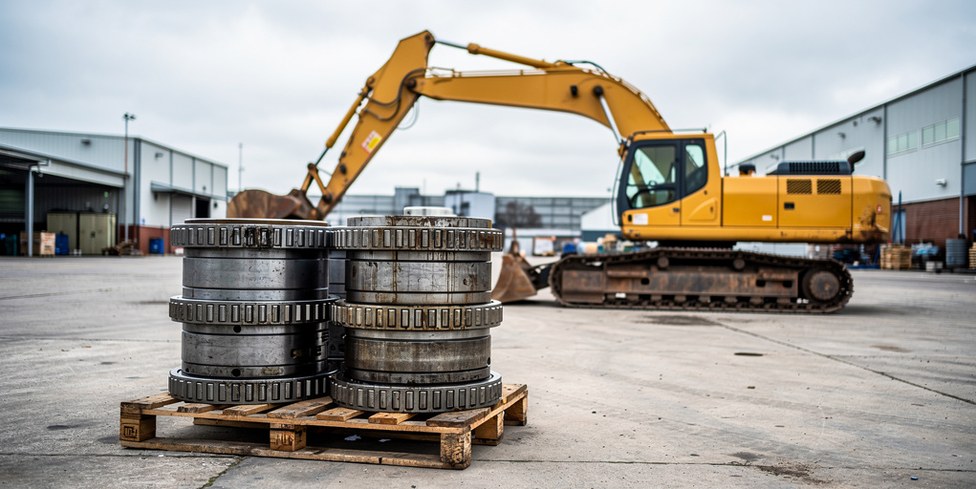
Effective October 28, 2026, new origin criteria apply to excavators, spreaders, and bearings for government procurement
How Points Are Calculated
For excavators, spreaders, and bearings, the logic in Section V is the same: first, the conditions are verified, and then points are awarded for production operations carried out within the territory of member states.
- Design and technical documentation. A tax resident of a Member State must hold the rights to the documentation with the ability to make changes to it, or the right to use documentation developed as a result of research and development work under a government contract (this condition is also specified for bearings).
- Service center. For excavators, spreaders, and sprayers, there must be a center within the territory of the member states authorized to perform repairs, after-sales service, and warranty service.
- Manufacturing Operations. A set of operations for manufacturing components must be carried out within the territory of the member states, or components manufactured there must be used.
- Points for Operations. Points are awarded for each operation; if a component is not present in the product, points for that component are not counted and do not contribute to the maximum score.
Examples from the text illustrate the scoring scale. For an excavator, the production of an internal combustion engine yields 58 points, while the parts and assembly of the tracks together yield 22 points. For spreaders and sprayers, the engine is valued at 29 points. For a bearing, the raw material for the outer ring is worth 14 points, the inner ring 11 points, and the rolling elements 14 points. These are just a few items from a long list of operations; the total maximum for each product is determined according to the text of the Rules.
Scientific and design work is considered separately. For excavators and for spreaders with sprayers, R&D expenditures within the territories of member statesmember states account for 0.3 percent of the maximum number of points for every 0.1 percent of annual R&D expenditures as a percentage of the previous year’s revenue. No more than 10 percent of the points can be earned this way.
The threshold is calculated based on the maximum possible number of points for a specific model. If a particular component is not used in your model, no points are awarded for it, and it is not included in the maximum total; therefore, it does not affect the final score.
How This Differs from Customs Origin
Decision No. 105 addresses the question of whether goods can be considered produced in a member state when purchased by a state or municipal procuring entity. Customs origin addresses a different issue: which duty rate applies, whether preferences are granted, and whether a certificate of origin is required upon import.
| Criterion | Origin for Government Procurement | Customs Origin |
|---|---|---|
| Purpose | To confirm to the buyer that the goods were produced in member states (government procurement) | Duty rates, preferences, market protection measures |
| How it is determined | Conditions and points for operations in member states (Section V for equipment) | Criteria applicable for customs purposes and supporting documentation |
| Who provides proof | Generally, the supplier to the customer | Generally, the importer or exporter to customs |
A common pitfall is that a document certifying customs origin does not serve as proof of origin for procurement purposes, and vice versa. We discussed documents that confirm the country of origin upon import in more detail in our article on changing the country of supply and EAEU preferences.
What Suppliers and Importers Should Do
- Determine whether your products are included in the list: check the EAEU HS code against the headings “from 8429 59 000 0, from 8430 50 000 9,” “from 8424,” “from 8432,” “from 8482,” and “from 8701.”
- If you assemble equipment from imported components, recalculate the points according to the new version for each model separately and compare them with the threshold that will take effect in 2027.
- Check the requirements that do not depend on points: rights to documentation and a service center within the territory of member states.
- Prepare a set of supporting documents for components manufactured in member states so that the customer can verify them.
- If you are importing finished equipment for resale to customers, ask them in advance what documentation they will require, and do not substitute it with a certificate of customs origin.
- Ensure the correct classification of the goods is specified in the documents prior to shipment: the code determines both the customs clearance process and the applicable conditions.
We handle the selection of the code and the preparation of documents for the import of equipment and components as part of our customs clearance services.
Frequently Asked Questions
Does this change the import duty rates for excavators or bearings?
No. The decision applies only to determining the country of origin for the purposes of state and municipal procurement. It does not affect customs duty rates.
When does the decision take effect?
On October 28, 2026. The point thresholds for certain items take effect later: on January 1, 2027, April 1, 2027, and January 1, 2029.
Does this apply to importers who bring in finished excavators?
The rules are directly aimed at those who must prove the origin of their products for procurement purposes—that is, manufacturers and suppliers. Importers of finished equipment are affected indirectly: customers may request proof of origin, and finished equipment manufactured outside the Union does not earn points for production in member states under the logic of the rules.
Where can you find the complete list of operations and points?
In the appendix to Decision No. 99 and in the text of the Rules approved by Decision No. 105. This article provides only examples; the full calculation is based on the text of the regulation.
Summary
Starting October 28, 2026, the conditions and point thresholds for excavators, spreaders, and bearings will change, and liquid nitrogen, liquid oxygen, and medical furniture have been added to Appendix No. 1¹. These are rules for government procurement, not customs origin: they do not affect duties or preferences. Submit a consultation request, and we’ll analyze your specific shipment.
We will verify the HS code and documents certifying the origin of the equipment before the order is placed or the shipment is made
Read also:
- Goods Accounting Rules for EAEU Authorised Operators from 2028: What Your Russian Buyer Will Require from Your Shipping Documents
- Sulphuric Acid Leaving Russia: HS 2807 00 000 1 Now Needs a Government Decision
- DOPP Status and Duplicate DOPPs: How to Report Them on the Indirect Tax Return for Imports from the EAEU
- Medical Devices in the EAEU as of October 28, 2026: Authorized Bodies May Suspend Approval Without a Manufacturing Inspection Report