

Russia–China: The 2027 Protocol Between the Federal Customs Service and the General Administration of Customs of the PRC—What It Means for Customs Clearance and Border Queues
If you’re shipping goods to or from China, the news from Shanghai won’t affect your paperwork tomorrow, but it does indicate the direction border regulations will take in 2027: faster cargo clearance, incentives for compliant operators, and data sharing between customs authorities. The specific terms haven’t been disclosed yet, so the main question for you right now isn’t “what has changed,” but “what do you need to prepare to take advantage of these simplifications once they go into effect?” Let’s break down what is known from the Federal Customs Service’s official announcement, what is missing from it, and what steps it makes sense to take in advance.
What is known about the agreements
On September 29, 2026, the Federal Customs Service of Russia announced that the 18th meeting of the Russian-Chinese Subcommittee on Customs Cooperation had taken place in Shanghai. The delegations were led by Valery Pikalev, head of the Federal Customs Service, and Sun Meijun, head of the General Administration of Customs of the People’s Republic of China. The parties noted that the main goal of their work is to increase mutual trade and simplify customs procedures for bona fide participants in foreign economic activity.
Particular attention was paid to five areas: increasing the throughput capacity of border crossing points along the Russian-Chinese border, further implementation of the “Green Corridor” project, joint efforts to combat customs violations, the development of national “Single Window” mechanisms, and the digital transformation of customs operations. Following the meeting, a protocol was signed that formalizes key agreements on customs cooperation for 2027.
Recent measures at the border are in line with this agenda. In April 2026, the head of the Federal Customs Service, together with the Deputy Minister of Finance, inspected the progress of construction at new road border crossing points and assessed the readiness of the new Kraskino road border crossing point on the Russian-Chinese border.
What’s Missing from the Statement and How to Interpret It
The official statement does not include the text of the protocol, timelines, lists of goods or border crossing points, figures on throughput capacity, or a description of how the “Green Corridor” is structured and who can use it. Therefore, it is important not to attribute to the agreements what is not yet evident in them: this is a framework for cooperation through 2027, not a new declaration procedure.
Until the Federal Customs Service (FTS) or the EEC publishes relevant regulations, the previous procedure remains in effect. Do not factor into your pricing or delivery schedules any acceleration that no one has guaranteed you.
| Question | What Is Known | What to Do |
|---|---|---|
| Have the declaration rules changed? | No, this is not implied by the announcement | Follow the current procedures and monitor regulations issued by the Federal Customs Service and the EEC |
| Will border crossings be faster? | Increasing throughput has been identified as a priority, but no timelines or figures have been provided | Do not promise the buyer exact dates; allow for extra time |
| Who will be eligible to use the Green Corridor? | The conditions have not been disclosed; the focus is on bona fide participants in foreign trade | Get your documents and declaration history in order; ask your customs representative about the conditions for their publication |
| What the Single Window Will Offer | The development of national mechanisms has been mentioned, but no details are available | Prepare documents electronically and in standardized formats |
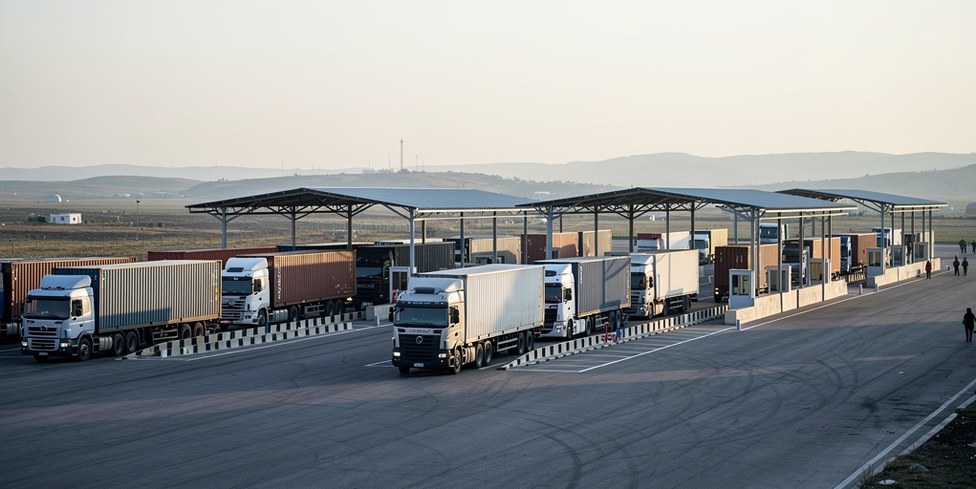
Trucks at the border crossing: Border capacity remains the main constraint on delivery times
Border crossings, the Green Corridor, and the Single Window: what this means for cargo
The throughput capacity of border crossing points directly affects you if your cargo is transported by road: lines at the border and vehicle downtime quickly eat into your profit margin. Expansions and new border crossing points, such as Kraskino (currently under construction), should eventually reduce this burden, but the timing of their opening and operating procedures are determined by separate decisions. When planning seasonal shipments, check with your freight forwarder in advance to find out which border crossing the truck will use and what the traffic volume at that crossing is like during that period.
The “Single Window” system for foreign trade participants means that information and documents are submitted once, rather than separately to each agency. This works for you under only one condition: the data in the declaration, invoice, specification, and permits must match. If the description of the goods and the HS codes differ, neither electronic data exchange nor procedural simplifications will spare you from a request for additional documents. We discussed how to prepare a document package for shipments from China in our article on how to speed up customs clearance for shipments from China, and the general principles of the procedure are outlined in our guide on customs clearance for goods from China.
The “Green Corridor” is referred to in the Federal Customs Service’s announcement as a project that is still being implemented. No details are provided, so it is wisest to view it as a potential simplification for reliable participants and to prepare based on general reliability criteria: correct codes, a reasonable customs value, a complete set of documents, and no discrepancies between the supplier, carrier, and declarant.
What Importers and Exporters Should Do
- Check your most recent shipments for any discrepancies between the invoice, specifications, packing list, and customs declaration—specifically regarding the description of goods, quantity, weight, and HS codes.
- Compile a single archive of documents for each regularly imported or exported item: contract, specifications, certificates and permits, and price confirmation. This will be useful both in response to customs inquiries and when participating in simplified customs procedures.
- For road transport, ask the freight forwarder in advance which border crossings are available for transit and what the alternate route is. Do not tie the delivery to a single crossing point.
- Build in a time buffer at the border into your schedule and contracts with the buyer. Any acceleration, if it occurs, will be a pleasant bonus rather than part of the promised delivery times.
- Ask your customs representative to notify you as soon as the terms of the “Green Corridor” are published and the implementation dates for the new “Single Window” mechanisms are announced, and assess whether these terms are suitable for you.
Frequently Asked Questions
Will the customs clearance procedure for goods from China change starting in 2027?
This is not indicated in the Federal Customs Service’s announcement. A protocol containing agreements for 2027 has been signed, but its terms have not been published. Until new regulations are issued, the current procedure remains in effect.
What is the “Green Corridor” between Russia and China?
This is the name of a Russian-Chinese customs cooperation project which, according to the Federal Customs Service, is still being implemented. The terms of participation and the list of goods are not disclosed in the statement, so it is too early to draw conclusions about who will benefit from the simplifications and how.
Will border crossings become faster?
Increasing the throughput capacity of border crossing points has been identified as a priority, but no specific timelines or figures have been provided. Plan your shipments with a buffer and avoid promising buyers exact dates.
What should you prepare now?
Get your HS codes, product documentation, and price confirmations in order so that customs declarations are processed without discrepancies. This is necessary regardless of the procedure and will come in handy if the simplifications are implemented.
Summary
The 2027 Protocol between the Federal Customs Service (FTS) and the General Administration of Customs of the PRC (GACC) established key agreements regarding the throughput capacity of border crossing points, the “Green Corridor,” the “Single Window,” the fight against violations, and the digitization of customs, but its terms have not been published. For now, the previous procedure remains in effect: do not factor in any acceleration in delivery times, maintain a time buffer, and ensure your documents and HS codes are in order. That way, you’ll be ready for the simplifications once their terms are announced. Submit a consultation request, and we’ll analyze your specific shipment.
Read also:
- China–Russia road crossings in Primorye: what the new capacity means for your shipments
- Russia's Digital Customs: What Online Clearance Means for Your Shipment
- Import of Tractors and Buses: The bill allows for the environmental class to be confirmed by a ZOETS certificate until the end of 2026
- Customs Value Verification: Risk Indicators, Customs Inquiries, and How to Support the Price with Documentation