

Russia's Food Import Ban Extended to 2028: What It Means for Your Shipment and What Your Russian Buyer Will Ask For
If you manufacture or supply meat, fish, dairy, vegetables or fruit and ship to Russia, your working conditions are unchanged for the next two years — but every consignment must still carry proof of the country of origin, and this is the one document error that cannot be fixed by paying more. Non-compliant food is not returned to the sender: it is destroyed. The special economic measures introduced by Decree No. 560 of 06.08.2014 have been extended from 1 January 2027 through 31 December 2028 by Decree No. 665 of 17.09.2026. The list of product categories and countries is unchanged, but your Russian buyer now plans on a two-year horizon and will be reopening contracts, specifications and origin certificates for 2027–2028 in the coming months. The real risk for a shipper is not the list itself — it is stable and well known — but the chain of intermediaries and any repacking that makes the actual origin of the goods diverge from what the Russian declaration states.
What changes for food shipments to Russia
Formally, nothing changes — and that is the main practical takeaway for a supplier. The categories of prohibited goods and the list of countries stay the same, so the shipping schemes and commodity codes you used in 2025–2026 keep working. There is no transition period, and no new permit or certificate has to be obtained on your side.
What changes is the length of the horizon. The restrictions were originally introduced for one year and rolled over annually; in 2024 the term was set for two years for the first time, until the end of 2026, and it has now been set for another two-year period. For you as a shipper this means your Russian counterparty can finally commit beyond a single season: long-term supply contracts, volume commitments, dedicated cold-chain capacity and fixed logistics schemes can be negotiated for a full cycle through the end of 2028.
It also means the embargo is not a ban on food imports as such. Specific categories from specific states are restricted; everything else enters Russia in the normal way — with certification, veterinary and phytosanitary control and a complete set of permit documents. If your production is outside the listed countries, the extension is a planning opportunity, not an obstacle.
Which product groups and countries the ban covers
The restrictions originally covered meat and meat products, dairy, fish, vegetables and fruit. In tariff terms these are primarily lines within HS chapters 02, 03, 04, 07 and 08. The list was later extended: in 2017 it took in live swine, except purebred breeding animals, along with certain edible offal and animal fats.
The detail that matters most when your buyer files the declaration: the ban is set line by line, not by whole chapters. Neighbouring codes inside one chapter can have different status, and processing frequently moves a product into a different heading — in which case admissibility is judged by the finished product, not by the raw material. This boundary is where most disputes with Russian customs arise, which is why the classification of your goods should be agreed before the shipment leaves, not while the declaration is being lodged. The specifics of this nomenclature are covered in our guide to customs clearance of food products.
The country list has expanded over the years too. In addition to states that introduced or supported sanctions, it includes Albania, Montenegro, Iceland, Liechtenstein and Ukraine, and later the United Kingdom and New Zealand. Importers reoriented to alternative markets long ago and the logistics followed: Asian origins now work even for perishable categories, with road groupage from China and air freight giving transit times short enough for fresh produce.
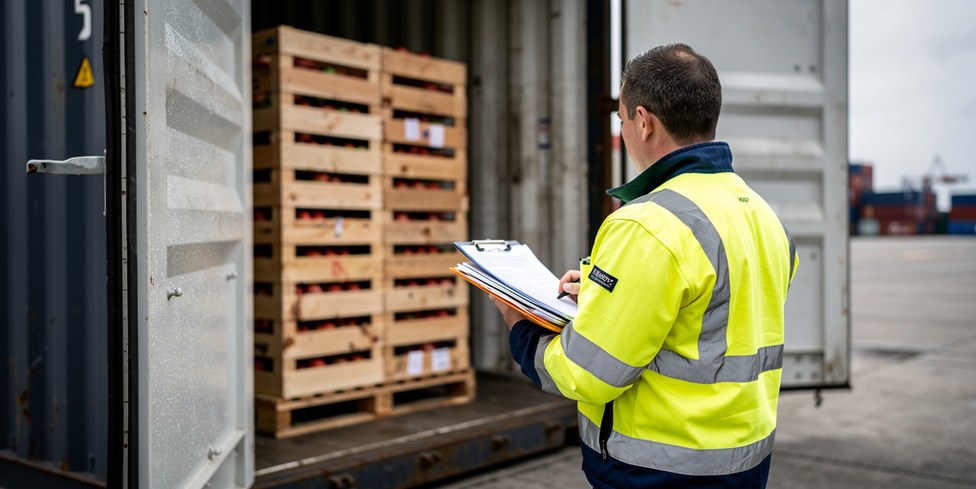
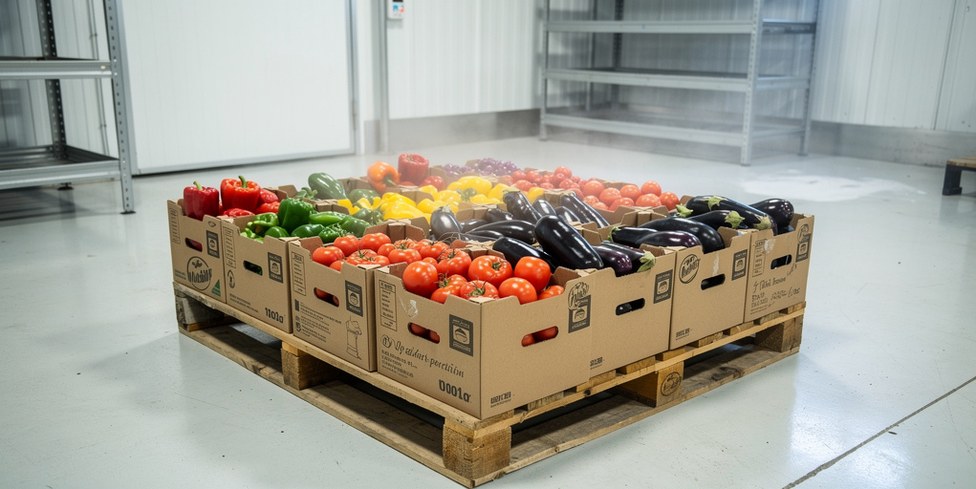
Refrigerated cargo at a Russian border crossing: for food consignments, proof of origin decides whether the shipment is released or destroyed
Border control: what is checked and what your cargo risks
Russian control over incoming food is built around three questions: what the goods are, where they come from and who produced them. Inspectors check the certificate of origin, veterinary and phytosanitary documents, the marking on both consumer and transport packaging, the manufacturer details on the label, and whether the data in the declaration matches the shipping documents. A mismatch between the country of dispatch and the country of origin is a standard trigger for in-depth checks and physical examination — and that examination is of your cartons, your labels and your establishment number.
Since 2015, prohibited food found during unlawful import is destroyed under an established procedure. It is not returned to the sender and not released against a guarantee. The cost of an origin documentation error equals the full value of the consignment, not the amount of a fine — and as the shipper you will normally carry that loss under the contract.
Transit of such products across Russian territory is regulated separately, with its own control procedures including GLONASS seals and tracking documents. If you organise the route yourself or sell on delivered terms, build these requirements into your price and transit time in advance — fitting the control system at the border without preparation almost always means a stand-still. The same long-planning logic applies to other multi-year measures affecting trade with Russia, so schedules for 2027–2028 should be built on the assumption that the current regime stays in place for the whole period.
| Situation on the shipper's side | Risk for the shipment | What to do before dispatch |
|---|---|---|
| You sell through a trader and the producing plant is not disclosed in the documents | Actual origin traced to a listed country, refusal of release and destruction of the cargo | Disclose the certificate of origin and the manufacturer's details to your buyer before the shipment is paid for |
| Goods are repacked or portioned in an intermediate country | Country of dispatch changes while origin does not; claims raised at examination | Document the nature of the operations and the origin of the raw material |
| Product is processed and falls under a different heading | Classification dispute and delayed release, critical for perishables | Agree the code and composition in advance and supply technical and process documentation |
| You are signing a supply contract for 2027–2028 | The list of countries or categories may change during the term | Include a clause on suspending shipments and allocating losses if your country or product is added |
| Labels and cartons carry plant data that differs from the invoice | Discrepancy detected at physical inspection, consignment held | Reconcile marking, label, certificate and invoice as one set before loading |
The EAEU: member states and what it means for your routing
The Eurasian Economic Union has five members: Armenia, Belarus, Kazakhstan, Kyrgyzstan and Russia. Inside the union customs rules are unified and there is no customs clearance at internal borders — but the food embargo is a Russian national measure and does not apply to the other member states. The practical consequence for an exporter is blunt: goods can circulate entirely lawfully in a neighbouring EAEU country and still be prohibited for import into Russia.
Routing through union territory therefore does not remove the restriction; it only moves the point of control. Circulation of such products is monitored inside the country by veterinary services and mobile units on the inbound corridors. For you this means the origin of the goods must be documented along the entire route, not only at the union's external border. If you ship to several CIS destinations from one consolidation point, keep the Russia-bound consignments documented separately — this is exactly where the paper trail usually breaks.
What the exporter should do
- Match the nomenclature of current and planned shipments against the list of prohibited lines by commodity code, not by category name.
- Prepare the certificate of origin and the full manufacturer details, including the establishment number, and make sure they match the marking on the packaging.
- Map your own sales chain: if two or more traders sit between the plant and the Russian buyer, restore the documentary trail back to the producer and be ready to disclose it.
- Extend or re-sign 2027–2028 contracts now — the two-year horizon makes firm volume and price commitments realistic.
- Add a clause on suspending shipments and allocating losses in case the list of countries or categories changes mid-term.
- Agree the classification of processed products in advance and assemble the process documentation that proves what was done to the raw material.
- If your route transits Russia, build the GLONASS-seal control procedures into your quoted transit time and price.
- Confirm with your buyer which certification and veterinary documents must be issued in your name before loading, so nothing has to be reissued at the border.
Frequently asked questions
Do we need to reissue anything because the embargo was extended?
No. The list of categories and countries is unchanged and no new permits are required. The only thing worth revisiting is the validity period of contracts and specifications that were written to expire at the end of 2026.
Can prohibited goods be shipped in for processing or released against a guarantee?
No. Products identified during unlawful import are destroyed. The mechanism has been in force since 2015 and does not provide for returning the cargo to the sender.
Does the ban apply to breeding animals?
The 2017 restriction on live swine does not cover purebred breeding animals. But the status of the animal has to be proven by documents, otherwise the consignment is treated under the general rule.
What if our country could be added to the list later?
The country list has been expanded several times. The sensible hedge is to write the procedure for stopping shipments and the fate of already-paid consignments into the contract in advance, and to keep an alternative delivery route prepared.
Our goods are not on the list at all — does any of this affect us?
Indirectly, yes. Scrutiny of origin documents applies to all food consignments, so your buyer will still ask for the certificate of origin, plant details and consistent marking. Clean paperwork is what keeps your cargo out of extended inspection.
Summary
The special economic measures have been extended from 1 January 2027 through 31 December 2028, with the list of categories and countries unchanged. For an exporter shipping to Russia and the CIS this is not a new requirement but a regime fixed for two years, in which proof of the country of origin remains the decisive document. The main risk is not duty — it is destruction of the consignment when prohibited goods are identified, so the supply chain has to be checked before dispatch rather than at the border. Request a consultation and we will review your specific shipment. See also our full range of logistics and customs clearance services and customs clearance in Russia.
Send us your product specification and we will verify the HS code, country of origin and permit documents for your shipment before the container leaves your warehouse.
Read also:
- Russia's Import Restrictions on Armenian Goods: Volumes Have Moved to Georgia and Azerbaijan — What It Means for Your Shipment
- Shipping to Russia and the CIS: HS codes, permits and the documents your buyer needs before loading
- Russian grain export duty for 23–29 September: why the declaration date, not the loading date, sets the cost
- EAEU register of chemical substances: what your Russian buyer will ask you for before 1 December 2026