

Russia's Seafood Exports to BRICS Are Up 1.5x: What That Means for Your Shipments into Russia and the CIS
Russian seafood shipments to BRICS countries grew roughly one and a half times in value in the first half of 2026, and over five years they have tripled in volume and risen 2.7 times in money, passing USD 3 billion in 2025. For a manufacturer or supplier sending goods the other way — into Russia and the CIS — this is not just a market statistic. It is a preview of the paperwork logic your own shipment will meet at the Russian border, and of the reefer capacity your cargo will compete for on the same lanes. Food and products of animal origin are the clearest case: customs and veterinary control look less at the value of the goods than at the documents attached to them — the veterinary certificate, the status of your plant, vessel or cold store in the receiving country's register, the correct HS code in group 03 or 16. Below: what your Russian buyer will ask you for, where shipments actually stop, and how to keep a frozen consignment from waiting on a terminal while a certificate is reissued.
What gets checked: HS codes, certificates, registries
Most of the seafood nomenclature sits in group 03 — live, chilled and frozen fish, fillets, crustaceans and molluscs. Deep-processed products (canned and semi-preserved goods, surimi-based items, roe in consumer packaging) fall into group 16; fishmeal and feed products into group 23. The difference is not cosmetic: the group drives the veterinary requirements, the form of the certificate, and whether the goods fall under regulatory measures at all. Agree the classification with your buyer before loading — reclassification after the declaration has been filed almost always means the box sits in port.
The pack your Russian consignee will need from you looks like this:
- a foreign trade contract with an exact product description — species, method of processing, size grading, packaging and glazing;
- an export veterinary certificate issued by the competent authority of your country on the form agreed with the Russian veterinary service; on arrival the consignment is entered into the Russian electronic veterinary system by your buyer;
- proof of the legality of the catch and the origin of the raw material — requests for this come from customs and from the buyer with some regularity;
- evidence that your plant, vessel or cold store is listed in the register of approved suppliers maintained by the receiving country's authority;
- laboratory test reports on safety parameters, where the contract or the importing country requires them;
- transport and loading documents, and a packing list stating the temperature regime.
The most common cause of a hold is not the declaration — it is the status of the production site. If the plant, vessel or cold store is not in the receiving country's register of approved suppliers, the consignment will not be accepted on that side even when every document you issued is perfect. Check and renew the listing before the contract, not while the vessel is at sea.
Separately, check the regulatory measures in force for your specific commodity code. For certain aquatic products they change from season to season, and the working reference is the current edition of the lists, not last year's practice. Conformity documents for the Russian market — declarations and certificates under EAEU technical regulations — are a parallel track that we cover under certification.
Delivery terms and the lanes your cargo shares
Delivery terms decide more than they appear to during negotiations. On FOB you are responsible for loading at the port of departure, which means the risk of storing a reefer container on the terminal until it is loaded is yours. On CFR and CIF you take on the freight, and with it the argument with the carrier when the vessel is delayed. For frozen goods an unbroken temperature regime of about minus 18 °C is critical: any break in the cold chain during transhipment is a claim from the buyer and a real risk that the veterinary service of the importing country refuses the consignment. State plainly in the contract who pays for plugging the reefer in on the terminal and from which moment demurrage starts running.
China accounts for 97% of all Russian seafood shipments to BRICS, and the flow runs through Far East ports in reefer vessels and containers. That matters to you because the equipment turns in both directions: the balance on the backhaul leg feeds straight into the cost of a container moving from China into Russia, and therefore into your own freight quote. How these flows are built, and how sea, rail and road options differ, is covered in our article on delivery options from China, and the ocean leg itself under sea freight.
India, the UAE and Egypt are different legs again: Novorossiysk and the Caspian ports, or transhipment via the Middle East. India–Russia container traffic is usually planned as backhaul loading, so transit times and rates swing with the seasonality of the main flow. For background on how that trade is developing, see our piece on Russia's cooperation with South Asia. The customs side for food products, inbound and outbound, sits with us under food product clearance.
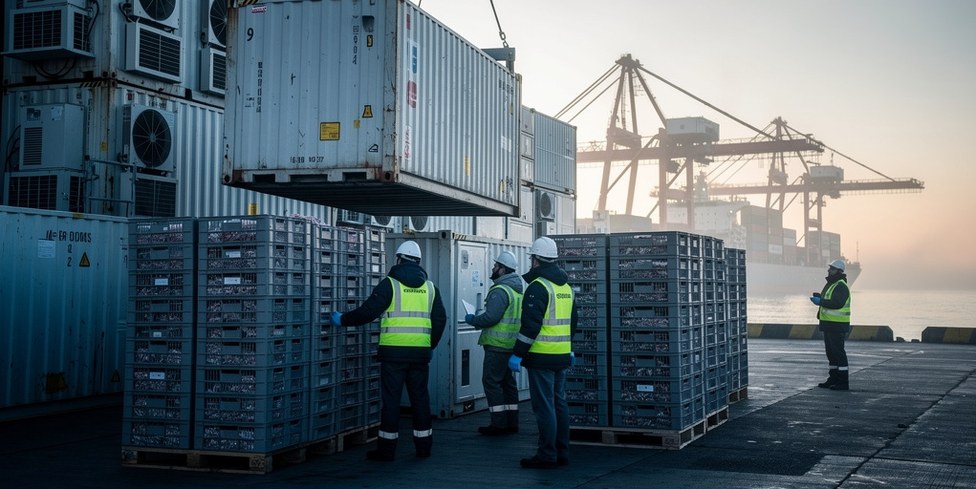
Reefer containers on a terminal: with frozen cargo, registry status and certificate form decide whether the box moves or sits.
Your buyer's VAT file, Uzbekistan and the CIS
One thing worth understanding about the party on the other end of your contract. When goods leave the EAEU, the Russian exporter applies a zero VAT rate — but it is not automatic: the right to it has to be confirmed with the tax authority within 180 days from the date the goods were placed under the export procedure, using electronic registers of data from declarations and shipping documents. Any discrepancy between the contract, the declaration and the weight actually shipped leads straight to refusal and an assessment. If your Russian partner re-exports your goods onward, or if you supply raw material that is processed and shipped on, that discipline lands on your documents: descriptions, weights and packaging data have to match across the contract, the invoice, the packing list and the certificate. Settlement currency plays into it too — the more contracts denominated in roubles, the simpler the banking control, and the growth of rouble settlements in export trade has noticeably eased that part of the work.
The CIS directions deserve a line of their own, because suppliers routinely assume one clearance covers the region. It does not. Kazakhstan is in the EAEU: goods cleared into the Union move on without a new declaration. Uzbekistan is not in the EAEU, so a shipment there is a full customs operation in its own right — a complete goods declaration, a veterinary certificate drawn to Uzbek requirements, and confirmation of the zero rate under the general rules rather than the simplified EAEU procedure. Preferences under the CIS free trade agreement run on a CT-1 certificate of origin, which covers goods originating in the CIS zone — if your product is made outside it, budget for full duty rather than the preferential line. This is exactly why a working scheme for Kazakhstan cannot simply be copied onto Uzbekistan: where transport documents and a statistical form suffice inside the Union, the Uzbek route needs the full customs pack.
BRICS lanes: what is happening and what it changes for you
Over five years, Russian seafood shipments to BRICS countries tripled in physical volume and rose 2.7 times in value, exceeding USD 3 billion in 2025. The structure, however, is extremely uneven — and each lane behaves differently for anyone moving cargo on it.
| Market | What is happening | What it changes for your shipment |
|---|---|---|
| China | 97% of all BRICS shipments; 2.6 times growth in value against 2021 | This is where reefer equipment and cold-chain capacity concentrate. If you ship from China into Russia, you draw on the same container pool, and the outbound balance moves your rate. Registry listings and packaging marking requirements are enforced strictly in both directions |
| India | Growth of roughly 70% against 2021 | Russia-bound boxes are usually planned as backhaul, so rates and transit times move with the seasonality of the main flow. Agree marking and remaining shelf life at the moment of import with your buyer in advance, and build in time for a long leg |
| Brazil | Six-fold growth against 2021 — the steepest of any direction | The longest sea leg of the group. Plant registration with the relevant agricultural authority is a prerequisite, and the crossing time has to be deducted from the shelf life you offer |
| UAE | Shipments effectively started only in recent years | Primarily a transhipment point. Check marking and certification requirements on the importer's side and work through a confirmed consignee holding a valid import licence |
| Egypt | A visible role, though volumes are not comparable with China | Agree the form of the veterinary certificate and the inspection procedure at the port of arrival separately, ahead of loading |
Before you commit volumes to a budget, check the official figures: Russian foreign trade customs statistics show real movement by commodity group and make clear whether a direction is growing on price or on physical volume. For perishable goods those are two different scenarios and two different contract decisions.
What to do as the shipper
- Fix the commodity code against the actual condition of the goods — processing, glazing, packaging type — and write that wording into the contract so your buyer's declaration matches it.
- Check that your plant, vessel and cold store are listed in the receiving country's register, and start the approval procedure early if they are not. It is the longest step in the chain by a wide margin.
- Agree the form of the export veterinary certificate with the veterinary service of the importing country before loading, not when the cargo arrives.
- Set the Incoterms 2020 term in the contract with an explicit split of reefer plug-in, storage and demurrage costs.
- Send your buyer the full document set at the moment of shipment — contract, invoice, packing list, certificates and test reports — with identical descriptions and weights throughout.
- Treat Russia, Kazakhstan and Uzbekistan as separate clearance scenarios: one EAEU clearance does not cover the Uzbek leg.
- Build a shelf-life buffer into long routes. A share of border refusals has nothing to do with quality and everything to do with how much shelf life is left on the day of import.
Frequently asked questions
Do we need a veterinary certificate if our product is deep-processed?
Yes. Even when the goods classify in group 16 rather than 03, they remain a product of animal origin and veterinary documentation is required. The form of the certificate may differ from the one used for frozen raw material.
Can we start shipping while our plant's approval in the receiving country is still in progress?
No. The export declaration will be released on your side, but the consignment will not be accepted at destination, and the cargo will have to go into storage or come back. Finish the approval before signing the contract for a specific consignment.
How is a shipment to Uzbekistan different from one to Kazakhstan?
Kazakhstan is a member of the EAEU, so no new customs declaration is needed once goods are inside the Union. Uzbekistan is outside it, so the shipment is cleared in full, with a goods declaration and confirmation of the zero VAT rate under the general rules.
What happens if a documentary deadline is missed on the Russian side?
For a Russian exporter, missing the 180-day window means charging and paying VAT at the standard rate and reclaiming it later once the full pack is assembled. It is not a catastrophe, but on a large consignment the cash gap is real — which is why your buyer will chase you for documents while the cargo is still moving rather than after it arrives. Send them in parallel with the shipment.
Summary
A one-and-a-half-fold rise in shipments to BRICS in a single half-year means more than new contracts — it means tighter control on the buyer's side everywhere on these lanes: registers, certificate forms and marking requirements are being updated more often than before. For anyone sending goods into Russia and the CIS, the work is not in the declaration but in the preparation: classification, plant approval, an agreed veterinary certificate form and delivery terms that say who pays when a container waits. And treat the CIS as several jurisdictions, not one. Send us a request and we will go through your specific shipment with you.
We handle Russian customs clearance and permit documents for food and seafood shipments, and check your plant's registry status before you load.
Read also:
- Shipping Fish and Seafood on the Russia–China Corridor: Registers, Veterinary Certificates and the Data Your Buyer Checks
- Fish Exports to Russia: Veterinary Papers, HS Codes and VAT Your Buyer Will Ask You For
- Alloy Steel Scrap Export from Russia: the New Quota, the MinPromTorg Licence and What Your Russian Counterparty Will Ask You For
- Zero Export Duty on Russian Sunflower Oil: What the New Quota Means for Your Shipment