

Russian industrial zone in Suez: what it changes for your shipment and what your Russian buyer will ask for
If your Russian customer has told you that their next production line is going to Egypt rather than to a plant outside Moscow, the change reaches your side of the deal before it reaches theirs. The Russian industrial zone (RIZ) in the Suez Canal Economic Zone is being built around pharmaceuticals, chemicals and polymer processing, paints and coatings, thermal insulation, metals processing and food processing — sectors where almost every consignment carries a permit, a safety data sheet or a conformity document. Three things change for an exporter: the delivery address may sit outside the EAEU customs territory, the technical documentation you issue is read by two customs authorities instead of one, and any finished goods that later travel into Russia with a “Made in Egypt” label are cleared as ordinary imports — Egyptian residency buys them nothing at the Russian border. Below: what your buyer will start asking for, where shipments of this type lose time, and how to keep both legs consistent.
Suez is outside the EAEU — and that changes your documents
The Suez Canal Economic Zone lies outside the customs territory of Russia and the EAEU. Any movement of machine tools, process lines, moulds, laboratory equipment, components or raw materials into it is a full export operation with a declaration on the sending side and an import operation under Egyptian rules on the receiving side. If your buyer asks you to redirect an order from a Russian address to the zone, treat it as a different shipment, not a different consignee: the destination decides the document set, the permits and the origin evidence.
Two checks are run before any declaration can be lodged, and both are run against your paperwork. The first is non-tariff regulation: part of the industrial equipment, chemical substances and precursors in these sectors is subject to licensing or to permits from sector regulators. The second is export control: equipment with certain technical characteristics, together with the technical documentation and software supplied with it, may qualify as dual-use, and then an identification opinion is required. Neither check looks at the trade name on your invoice — both work from the description and the technical characteristics. That is why the data sheet, the technical passport and the specification you issue are the operative documents, and why a one-line invoice description is what stalls the shipment while the goods sit in a warehouse.
Exemption from property tax and up to 50% relief on profit tax for five years are Egyptian measures for a resident of the zone. They do not reduce Russian import duty or VAT on a single one of your shipments, and they do not shorten the document set your buyer will ask you for.
The sectors named and the paperwork each one carries
The priority sectors for the zone are pharmaceuticals, chemicals (including polymer and oil processing), paints and coatings, thermal insulation materials and metals processing. Food processing is treated separately, given that Egypt positions itself as a hub for buying Russian grain. In trade terms that is a fairly specific set of commodity groups: polymers in primary forms and articles thereof, paints, varnishes and solvents, inorganic and organic chemicals, ferrous and non-ferrous metals and articles thereof, grain and grain products — plus, on the equipping side, process machinery of chapters 84 and 85.
Each group pulls its own requirements. Chemical raw materials and coatings mean safety data sheets, dangerous goods classification and restrictions on the mode of transport — see customs clearance of chemical products and raw materials. Pharmaceutical and laboratory equipment means evidence of purpose and characteristics. Rolled metal means an exact description of grade, surface condition and dimensions, because the code and the duty rate follow directly from them. Process lines almost always travel knocked down, in several consignments and by several modes of transport: one consolidated set of technical documentation, a through specification tying every package to a unit of the line, and an agreed position on how the complete plant is classified — the practical side of this is covered under clearance of equipment and machine tools. Where the goods will need conformity evidence for onward circulation, close the certification questions before shipment rather than after arrival.
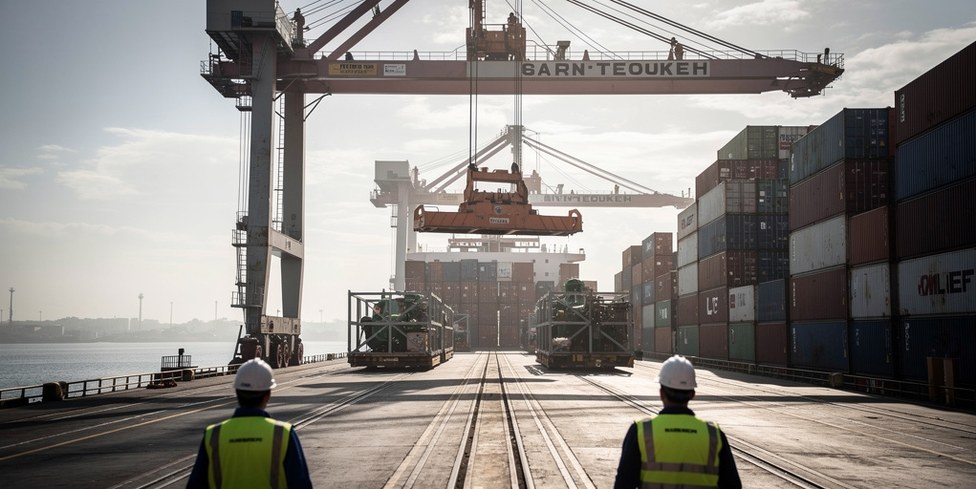
The Russian industrial zone in the Suez Canal Economic Zone sits outside the EAEU customs territory: equipment leaves as an export, finished goods come back as an import
“Made in Egypt”, resident incentives and the Russian border
With a sufficient level of localisation, goods produced in the zone will be able to carry the “Made in Egypt” mark. For sales across the Middle East and North Africa that is the central argument. The same mark has a reverse side: when that product is shipped into Russia it is no longer Russian, and it enters as an import with everything that follows — duty under the EAEU Common Customs Tariff, VAT, confirmation of customs value and proof of origin by a certificate of the appropriate form.
There is no automatic relief attached to residency. Tariff preferences and exemptions apply on the grounds set by EAEU law and Russian legislation, not by virtue of a plant standing in a friendly jurisdiction. Domestic market requirements sit on top: pharmaceutical products and a number of other categories are subject to mandatory digital marking, and the codes have to be applied before the goods are released for free circulation, not after they reach a warehouse. For a supplier that is a familiar line item — in most schemes the codes are applied at the manufacturer or at a warehouse before release, so agree in writing who does it and at which point of the packing line.
| Situation | What resident status in the zone gives | What still lands on your side of the shipment |
|---|---|---|
| Shipping equipment, tooling and materials into the zone | Nothing: the incentives work inside the Egyptian zone | Export declaration in the country of dispatch, non-tariff and dual-use checks, technical documentation, packing and insurance |
| Taxes on the site | Exemption from property tax, up to 50% relief on profit tax for five years | Your buyer’s concern; no effect on your prices, terms or lead times |
| Connection to infrastructure | A substantial share of external utility infrastructure cost is covered by the zone administration | Equipment for the inside of the site, imported and cleared under Egyptian rules |
| Origin of the finished product | With sufficient localisation — the “Made in Egypt” mark | Certificate of origin, sufficient-processing calculation, evidence for third markets |
| Finished goods shipped into Russia | No effect on Russian payments | Import duty, VAT, customs value, permits and digital marking |
Project support and coordination between investors and developers has been taken on by the Crystal Growth investment fund, which acts as the single window. That simplifies entry to the site, but it does not replace the customs part of the project on either the Russian or the Egyptian side — and it does not answer questions about your consignment.
What to prepare on your side
- Ask your buyer which leg they mean: goods for the zone in Egypt or goods for Russia. The destination decides the document set, the delivery terms and the origin evidence, and the two are not interchangeable.
- Describe the goods technically rather than commercially: composition, technical characteristics, capacity, grade, model, intended use. Codes are determined from this description; a trade name on the invoice is not enough for either customs authority.
- For chemicals and reagents, start with the safety data sheet and the hazard class. They determine the permitted mode of transport, the packing and marking requirements and the set of permits. Get them out before booking, otherwise the carrier refuses after the rate has been confirmed.
- Run your own export control check early. Equipment with certain technical characteristics, and the documentation and software supplied with it, can be dual-use in your jurisdiction as well as at the destination. A licence takes weeks and sits on the critical path.
- For a line shipped in parts, issue one specification tying every package to a unit of the line, keep part numbering identical across all consignments and all modes of transport, and agree in advance how the complete plant will be classified.
- Keep the two legs consistent. The specification, invoice and technical documentation for the shipment into Egypt and for any later import into Russia must describe the same goods in the same words. A mismatch between an English data sheet and the buyer’s specification is the most common source of questions at release.
- Confirm in writing who applies digital marking codes and who obtains conformity documents, and at what point. That answer changes your packing line, not just the paperwork.
Frequently asked questions
Does our customer’s residency in the Russian industrial zone lower the duty on our goods in Russia?
No. Resident incentives are Egyptian tax preferences and infrastructure support. Goods entering Russia are subject to duty and VAT on general terms unless a specific relief is set for that product by EAEU law.
At what exchange rate is the duty calculated on goods entering Russia?
At the Bank of Russia rate in force on the day the customs declaration is registered. On a long transit leg the rate at contract date and the rate at release diverge, so flag the gap when you quote a landed price.
Our buyer wants the line shipped under temporary export. Is that realistic?
Temporary export applies where the goods return unchanged. A production line that stays in Egypt for years does not fit that; plan on a normal export and price the shipment accordingly.
What most often delays a shipment of this type?
An incomplete or inconsistent technical set: a dual-use check triggered by characteristics nobody documented, English documentation that does not match the buyer’s specification, and dangerous goods packed in a way the carrier will not accept. Rebuilding the set takes from a few weeks upwards, and that time is paid for in idle transport and storage.
Summary
For a supplier, the Russian industrial zone in Suez is not one destination but two customs jobs: shipments of equipment, tooling and raw materials into a zone that lies outside the EAEU customs territory, and finished goods later moving into Russia as ordinary imports. The resident’s tax incentives work inside the Egyptian zone and cancel nothing at the Russian border. The preparation that actually protects your schedule is classification, an early export control check, safety data sheets and permits for chemicals, and a clear position on the origin of the future product. Request a consultation and we will go through your specific consignment.
We will classify your equipment and raw materials under the EAEU nomenclature, check the permits and clear the shipment at any Russian customs post.
Read also:
- Shipping Gasoline to Russia by Sea: Excise, VAT and the Documents Your Buyer Will Ask You For
- Asian suppliers are opening Russian entities: what changes for your shipment and your buyer's paperwork
- Russian Grain Export Duty Moves Every Week: What It Means for Your Shipment and What Your Counterparty in Russia Will Ask You For
- China–Russia road crossings in Primorye: what the new capacity means for your shipments