

Seeds and planting material for Russia: check the laboratory documents before you load
A consignment of seeds or planting material can be stopped without any country-level ban: it is enough for the status of the laboratory that tested your lot to have expired. Since September 2026 Russia no longer accepts documents issued by three foreign laboratories, and that changes what an exporter has to prepare before shipping. For goods of HS group 06 (live plants, bulbs, cuttings, saplings) and seeds for sowing from group 12, origin and the phytosanitary certificate are no longer the whole story — the identity of the laboratory behind the test report is now part of the check. This is a pre-shipment step, not a border step, and it is more expensive to get wrong than usual: the cargo is alive, storage time is limited, and no document can be reissued retroactively once the goods are on their way.
What exactly is no longer accepted
Since September 2026 the Russian side does not accept documents from three foreign laboratories accompanying seeds and planting material: the National Reference Centre for Agricultural Health and Biosafety of Mexico, the Central Phytosanitary Laboratory of Moldova, and the Czech reference laboratory for GMO identification and DNA fingerprinting. The confirmed competence of the Mexican laboratory expired on 7 September, of the Moldovan one on 14 September, and of the Czech one on 15 September 2026.
All three were audited in 2023 and were the only organisations in their countries whose competence the Russian service had confirmed. The procedure is repeated three years after the previous audit, but none of the three laboratories applied for it. Once the three-year term ran out, the documents they issue can no longer be used to bring the corresponding material into Russia. The restriction stays in place until a new audit is carried out and competence is confirmed again.
The detail that matters for your order book: the restriction applies to specific documents, not to countries. Seeds and planting material from Mexico, the Czech Republic and Moldova may still enter Russia if they are accompanied by documents from competent laboratories in other countries that have passed the established audit procedure. In practice this means that when your Russian buyer places an order, the address of the testing laboratory is now as much a contract term as the origin of the lot itself.
The document pack that travels with your cargo — and its new weak link
Plant material is one of the most document-heavy categories in international trade. Alongside the usual commercial set (contract, invoice, packing list, transport documents), the consignment travels with the phytosanitary certificate issued in the exporting country, documents on variety and sowing qualities, and laboratory test reports. It is the last of these that has become the vulnerable link: the report itself may look perfectly correct, yet it stops working as a document accepted at the Russian border if the issuing laboratory's confirmed competence has lapsed.
The logic is the same as in other permit regimes your goods may fall under. Some products need permits from the Russian Ministry of Industry and Trade, radio-electronic equipment needs a notification, plant products need the phytosanitary set — and in every case the value of the paper is set by the status of the body that issued it, not by how the paper looks. If your buyer also asks you for conformity documents on other items in the same order, the same principle applies to certification: a formally correct certificate does not help when there is no valid procedure behind it.
Keep in mind, too, that plant material is often shipped together with food consignments from the same supplier and cleared in a single broker's file. Customs clearance of food products and of seeds overlaps in terms of the controlling authorities, but the requirements for laboratory documents are not identical. The laboratory status has to be checked for each line item separately, not once for the whole invoice.
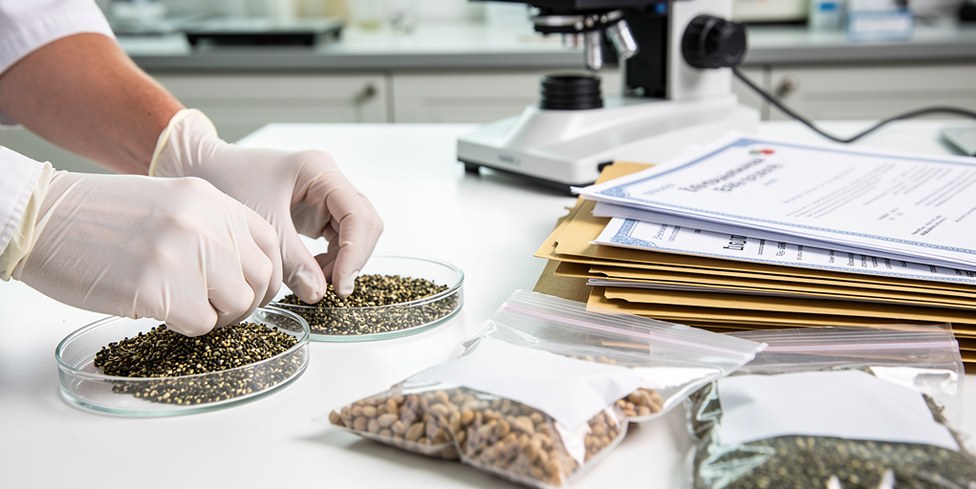
For live plant cargo, the laboratory that issued the test report now matters as much as the country of origin
Before and after: rebuilding your pre-shipment check
Below are the situations exporters are running into right now, and the practical answer to each.
| Situation | How it used to work | What to do now |
|---|---|---|
| You are based in Mexico, Moldova or the Czech Republic and test lots at your national laboratory | The report of the country's single audited laboratory was accepted without questions | Arrange testing at a competent laboratory in another country that has passed the audit, and agree the arrangement with the buyer before production of the order is finished |
| The consignment has already left and the report was issued before the expiry date | The question never arose | Assume that the end of the competence confirmation period removes the document's usability; check the status in advance rather than waiting for arrival |
| New seasonal contract for planting material | Origin and the phytosanitary certificate were the whole check | Expect the buyer to write the laboratory into the contract and to place responsibility for the documents' suitability for import into Russia on you as the seller |
| Long transit leg (sea, multimodal) | Transit time had no effect on the document set | Build in a margin: the laboratory's status can change between the date the report is issued and the date the cargo arrives |
| You refer the buyer to last year's clean delivery | Precedent worked as an argument | Precedent no longer works: competence confirmation has a term and requires a repeat audit |
The date on the form does not protect the consignment: once the laboratory's competence confirmation has expired, a report issued earlier does not automatically remain usable at import. On long-haul routes this means the laboratory's status has to be verified before loading, not when the vessel reaches the port.
Customs Union countries: why rerouting does not fix it
The first reaction to any restriction is to redraw the route through the Customs Union countries and bring the lot into Russia from the EAEU. Here that logic does not pay off: the competence of the laboratory is confirmed by the Russian service, and it is that decision which determines whether the document can be used when plant material enters Russia. A transit scheme does not turn an unusable document into a usable one — it only adds a leg, a transhipment and extra days for cargo that is alive.
The practical conclusion for a shipper is straightforward: spend the effort on the source of the document, not on the route. If you can have the lot tested at a laboratory in another country whose competence is confirmed, the shipment stays exactly as planned — same mode of transport, same border crossing, same schedule. That holds whether you move the cargo by sea freight, by air or by road.
What the exporter should do
- Pull every live order for seeds and planting material bound for Russia and write down which laboratory is named in the test report for each line item.
- Where the report comes from the Mexican, Moldovan or Czech laboratory on the list, hold the loading and contact your buyer before the goods leave the warehouse.
- Arrange testing at a competent laboratory in another country that has passed the established audit procedure, and obtain the new document set before dispatch — not in parallel with it.
- For cargo already in transit, agree the scenario with the buyer now: whether reissuing is possible, what the alternative destination for the lot is, who pays for storage and how the contract allocates responsibility.
- Expect a new contract clause and plan for it: the seller answers for the accompanying documents being usable on the date of arrival, not on the date of issue.
- Reconcile the HS code of the goods with your buyer — group 06 and seeds for sowing from group 12 differ in the permit set and in the release procedure, and a mismatch in the code is a delay of its own.
- Add a separate "laboratory status check" milestone to your shipping plan for every dispatch in the season, rather than a single check at contract signature.
- Allow two to three weeks between the document check and loading, and more on sea and multimodal routes: a live consignment held at the border has no useful waiting time.
Frequently asked questions
Is this a ban on seeds from Mexico, the Czech Republic and Moldova?
No. The restriction concerns the documents of specific laboratories, not the countries. Goods from these states may enter Russia if they are accompanied by documents from competent laboratories of other countries that have passed the audit.
Can we use a report issued before the competence confirmation expired?
It is not something to count on. A document that was valid earlier does not automatically remain usable once the laboratory's competence confirmation period has ended.
Would shipping through a Customs Union country help?
No. Whether the document can be used to bring plant material into Russia is determined by the Russian side's confirmation of the laboratory's competence, so changing the route does not remove the problem.
When will the restriction be lifted?
It applies until these organisations are audited again and their competence is confirmed. No audit applications have been submitted so far, which makes it risky to plan shipments around the restriction being lifted.
What will our Russian buyer ask us for?
The standard commercial set, the phytosanitary certificate of the exporting country, documents on variety and sowing qualities, and a laboratory test report from an organisation whose competence is confirmed — plus, increasingly, written confirmation of that status at the time of shipment.
Summary
Since September 2026 the documents of three foreign laboratories — Mexican, Moldovan and Czech — are not accepted when seeds and planting material are imported into Russia, because the three-year term of their competence confirmation expired and no applications for a repeat audit were filed. This is not a ban on countries: shipments remain possible with documents from competent laboratories of other states. For the exporter it adds one mandatory step before every dispatch — verify the laboratory's status before loading, especially on long-haul routes, and expect the Russian buyer to make document suitability on the date of arrival your contractual responsibility. Send us a request and we will go through your specific consignment with you.
Send us your consignment details and we will check the permit documents and HS codes against Russian import requirements before you load.
Read also:
- Advance border filing in Russia: what your buyer will ask you to send before the truck reaches the crossing
- Russia's record pea season: what it changes for suppliers shipping into Russia and the CIS
- War Risk Insurance in Russian Customs Value: What Your Buyer Will Ask You For
- Electronic Waybills for Shipments to Russia: The Carriage UID, Codes 02015 and 02016, and What Your Buyer Will Ask You For