

Semi-trailer tarpaulin kits at Russian customs: how HS 8716 was defended against "other plastics" — and what it means for your shipment
If you ship components assembled into a complete kit for one specific machine — tarpaulin and curtain sets for semi-trailers, body hardware, a tooling set for a production machine — the HS code of that consignment in the EAEU is driven not by the material, but by what the goods are and what they are for. In a recent dispute the gap between "parts of trailers and semi-trailers" and "other articles of plastics" was 1.5 percentage points of import duty, and the case ran all the way to Russia's Supreme Court. For an exporter the conclusion is practical: almost every piece of evidence that supports the correct code comes from your side — the invoice wording, the packing list, the bill of materials, the drawings, the catalogue — and it has to be in your buyer's hands before the declaration is filed, not after customs issues a classification decision and assesses additional duty. Below: what has to be proven, with which documents, and how this changes your shipping file.
Material or function: what decides the code
The situation behind the dispute is typical for the vehicle-components trade. A Russian company imported complete tarpaulin kits for road semi-trailers from Turkey: side and roof sheets, rollers, tensioning straps, fasteners and the remaining elements needed to mount the kit on a semi-trailer. The declarant entered code 8716 90 900 0 — parts of trailers and semi-trailers, import duty 5%. Customs reclassified the consignment to 3926 90 970 9 — other articles of plastics, duty 6.5% — and the importer ended up overpaying customs charges.
Three court instances sided with customs: the sheets are made of PVC, therefore they fall under the description of articles of plastics. The Supreme Court rejected that logic. The panel held that classification must follow the objective characteristics, the function and the intended use of the goods: the kit is manufactured specifically for a semi-trailer, after installation it forms the vehicle's cargo compartment, closes the body, ensures its integrity, makes sealing possible and protects the cargo in transit. The material alone does not turn such a kit into an ordinary plastic article. The court stated directly that the lower courts had focused on the material and failed to properly assess the purpose of the goods — in other words, they misapplied the General Rules for the Interpretation of the EAEU HS nomenclature. The three judgments were set aside, the customs decision was declared invalid, and the excess payments are refundable.
For a foreign manufacturer the message is simple: the argument that saved this shipment is an argument about your product — how it is designed, what machine it belongs to, what it does once installed. Nobody in Russia can reconstruct that from a roll of PVC and an article number.
What your buyer will now ask you for
A court ruling is only useful to those who can reproduce it on their own paperwork. "This is a vehicle part" does not work as a statement — it works as a proven fact. In practice that means the Russian importer must hold, at the moment of declaration, a set of materials from which the inspector can see the construction and the applicability of the goods, not only their composition. At minimum: a technical description and a specification of the kit listing every element; drawings or an installation diagram; a reference to the semi-trailer models and types (or other equipment) the kit is made for; the manufacturer's catalogue or technical documentation; photographs of the product assembled. For non-standard goods, an expert opinion from an accredited organisation closes the remaining questions before release. All of this originates with you — and all of it will need a Russian translation, which is a lead-time item, not a formality.
Pay separate attention to how the goods are described in the contract, the commercial invoice and the packing list, because those are your documents. "PVC sheeting" on an invoice is a ready-made argument in favour of the "basket" heading; "tarpaulin kit for semi-trailer, model XXX, consisting of: …" describes an article and its purpose. Factory internal nomenclature — material plus article number — is exactly what turns into an argument against the shipment. For vehicle components and kits built for a specific machine, these details are handled as part of customs clearance of auto parts and components; the same logic applies to machinery and industrial equipment, where tooling sets raise identical questions.
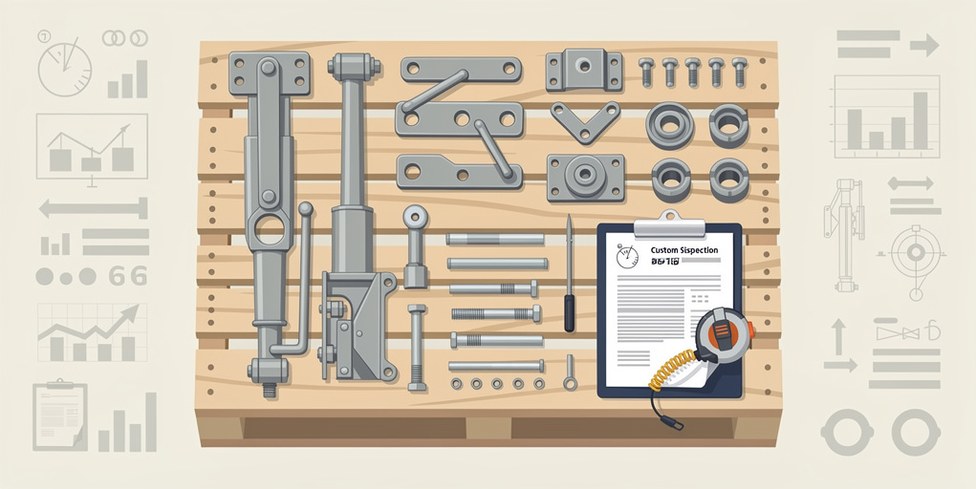
A complete tarpaulin kit for a semi-trailer: at the border it is classified by what it does on the vehicle, not by the PVC it is made of.
"Basket" headings: where the money leaks out of your deal
Heading 3926 is a "basket": it collects articles of plastics that have not been given a more specific description elsewhere in the nomenclature. The Supreme Court restated an obvious rule that is broken regularly: before assigning goods to "other articles of plastics", you must check whether a more specific heading exists for them, taking construction and purpose into account. The same material is used in completely different products, and the material does not always determine the code.
Reclassification into a "basket" heading is almost always built on a single feature — the material. If your invoice, packing list and specification say nothing about the construction, the completeness of the kit and its purpose, the argument moves to a courtroom in Russia, while the additional duty has to be paid immediately — and your buyer will come back to you for the documents you could have issued before shipping.
| Situation | Risk for your shipment | What the exporter does |
|---|---|---|
| The invoice describes goods by material ("PVC sheeting", "plastic parts") | Customs sees grounds for the "basket" heading, the duty rate is higher than quoted | Rewrite the description in terms of the article and its purpose, attach the kit specification |
| The consignment is a complete kit for one specific machine | The kit is broken down into separate materials during control and charges are recalculated | Show completeness and the assembled function: installation diagram, catalogue, photos |
| A classification decision has been issued against the goods | Additional assessment on the whole volume shipped under that code; your buyer freezes further orders | Supply the technical evidence pack fast — the appeal is built on your documents |
| Serial deliveries, the same code shipment after shipment | One error is replicated, the amount in dispute grows in multiples | Help the importer obtain an advance classification ruling: it is issued on your technical file |
| Documents are only in your language | The inspector reads what he can read; translation during control means days of storage | Prepare certified Russian translations of the spec, drawings and catalogue before departure |
This case shows that reaching the highest instance can be necessary even over 1.5 percentage points: the larger the volume, the bigger the price of the question. And every week the consignment spends in dispute is a week of demurrage, storage and a delayed payment to you.
Import formalities that start on the shipper's side
An HS code is not only a duty rate. It also drives the VAT base, the applicability of preferences and, for certain categories, the permit documents: whether a product needs certification or a declaration of conformity is decided by the code, and dual-use screening works the same way — goods are matched against control lists by code. That is why the code should be agreed with your buyer before the contract is signed, fixed in the specification annexed to it, and used identically in every shipping document. A code changed at the border changes the landed cost and, quite often, who pays the difference.
For kits that form a body or a cargo compartment there is one more practical layer. The integrity of the body and the ability to seal it are conditions without which carriage under the customs transit procedure is impossible. If the same products travel onward across the EAEU, the technical documentation works twice: once for classification and once to confirm that the vehicle is fit for carriage under seal. The mode of transport does not change the classification logic, but it does change your timing — road groupage, rail and sea freight all leave a different amount of room to fix a document problem while the cargo is in motion. Air is the only option that leaves almost none.
The practical planning rule: the technical justification and translations take weeks, and an advance classification ruling is a separate procedure that has to start before dispatch, not when the container is already at the port.
What to do as an exporter
- Check on what basis the code in your documents was chosen: by material, or by the objective characteristics, function and intended use of the goods. The second route is the correct one.
- Make sure there is no more specific heading for your product than "other articles of …". A basket heading is the last resort, never the first choice.
- Bring the description of the goods in the contract, the invoice and the packing list to one single wording, built around the article and its purpose, not around the raw material. Drop internal factory nomenclature from export documents.
- Assemble an evidence pack for your buyer: kit specification with every element listed, installation diagram, technical documentation and catalogue, photographs of the product assembled, and an expert opinion where the product is non-standard.
- Have the pack translated into Russian before the goods leave. Translation carried out during customs control is paid for in storage days.
- For repeat or serial deliveries, support your buyer's application for an advance classification ruling: it removes the question on every subsequent consignment and fixes the rate.
- Recalculate the economics of the shipment under both possible codes in advance and agree in the contract who carries the difference: 1–2 percentage points on a large volume changes the margin and the price.
- If a classification decision has already been issued against your buyer, send the technical evidence immediately — duty is paid first to release the cargo, and the refund is won later on documents that only the manufacturer can produce.
Frequently asked questions
Our product is almost entirely plastic — surely that is heading 3926?
Not by itself. The Supreme Court held that the material does not determine the code automatically: if an article is made for a specific machine, is installed on it and performs its function, it is classified as a part of that vehicle despite the PVC it is built from.
Customs reclassified the goods. Can payment wait until the dispute is over?
No. A classification decision is enforced, the additional amounts have to be paid, otherwise release stops and the cargo sits in a warehouse at the importer's expense. A refund of the excess becomes possible only after the decision is annulled — in this case that happened only at Supreme Court level, after three lost instances.
Who is responsible for the HS code — the exporter or the importer?
Legally the declarant in Russia answers for the code. Practically the evidence base is yours: construction, completeness, purpose and the models the product fits are facts only the manufacturer can certify. That is why the code and the wording of the description belong in the contract specification, agreed by both sides.
Does the code affect how long our shipment sits at the border?
Directly. A description built around material invites a request for documents, an examination and sometimes an expert appraisal — days or weeks, with storage charged throughout. A complete technical file submitted with the declaration is the cheapest way to keep the transit time you promised.
Is an advance ruling worth obtaining for every kit?
For a one-off delivery, a well-assembled description and technical documentation are usually enough. For repeat and serial deliveries the ruling pays off: it removes discrepancies between different customs posts and fixes the code for its whole period of validity.
Summary
The material an article is made of does not determine its HS code — the objective characteristics, the construction and the intended use do. Basket headings such as "other articles of plastics" must never be the default choice: a more specific heading is checked first. For a manufacturer or supplier shipping specialised kits, parts and equipment to Russia and the CIS, it is cheaper to invest in the description and the evidence before the declaration is filed than to have a buyer recover an overpayment through the courts a year later. Request a consultation and we will review your specific consignment.
Send us your kit specification and we will confirm the HS code and prepare the classification evidence your Russian buyer will need at the border.
Read also:
- Cargo Classification and Its Impact on Customs Duties: What Exporters Shipping to Russia Should Know
- EAEU HS Codes: How Your Product Gets Classified in Russia and Why the Code on Your Invoice Is Not Enough
- Customs clearance in Russia through 2030: what faster border control and post-release audits mean for your shipments
- Secondary US tariffs: what changes for exporters shipping to Russia and the CIS