

Shipping Beer to Russia: Excise, EGAIS and Digital Marking — What Your Russian Buyer Will Need From You
If you ship beer to Russia, most of the work happens long before the border — and a large part of it lands on you as the sender. Beer is an excisable good: on top of the usual food import package, your Russian buyer has to record the goods in EGAIS, apply Chestny Znak identification marks, pay excise duty at clearance and file the declaration at a specialised excise customs post. The reason to look at this now is July trade data: Polish beer shipments to Russia grew 5.5-fold year on year and reached EUR 3.3 million — roughly four fifths of the whole value of European beer for the month. New suppliers, new routes and new document sets follow, and with them new grounds for a customs value check. The cost of a mistake here is not an argument about a duty rate, it is a pallet of short shelf-life product standing still at the border.
What is behind the record Polish shipments
In July, EU countries shipped EUR 4.2 million worth of beer to Russia — 44% less than a year earlier, but 3% more than in June. Polish shipments, however, grew 5.5-fold year on year and 44% against June, the highest figure in the entire history of this trade. Other origins are far behind: Czechia — EUR 403 thousand, Belgium — EUR 166 thousand, Latvia — EUR 134 thousand, Germany — EUR 114 thousand, Lithuania — EUR 106 thousand. For the month, Russia ranked 12th among buyers of European beer; the leaders are the USA (USD 43 million), the United Kingdom (USD 35.4 million), China (USD 31.4 million), Belarus (USD 18.3 million) and Canada (USD 10 million).
One caveat that is easy to miss when you plan a season: the statistics show the value of shipments, not the physical volume. A 5.5-fold growth in euro does not mean 5.5 times more litres crossed the border — prices and the product mix move the figure too. For you as the sender this is not a technicality. Payments and marking on the Russian side are tied to litres and packaging, while the customs value check is tied to the price per litre. And there is a direct consequence of such concentration: the circle of senders has narrowed, most new contracts are signed with one or two Polish shippers, and Russian customs builds a price profile for that corridor very quickly. If your offer sits noticeably below that profile, your consignment is the one that goes into a check.
Documents and permits: what beer actually requires
Beer is classified in chapter 22, heading 2203 (beer made from malt); beer-based drinks and cider fall under neighbouring headings, and the classification drives both the rate and the set of requirements. Several items in the standard package can only be produced by you, the manufacturer or supplier:
- Declaration of conformity with the technical regulations on food safety, food labelling and the safety of alcoholic products — it is issued in the importer's name before the goods arrive, but it is built on your data: recipe, composition, ABV, shelf life, production site. Test reports and product specifications are requested from the manufacturer, and this is usually the first bottleneck with a new supplier;
- EGAIS — the Russian state alcohol accounting system. Registration, a crypto key with a qualified signature and a transport module are the buyer's responsibility, but until it works the released consignment cannot legally move any further down the chain. Ask for written confirmation that the system is live before you book transport;
- identification marks (Chestny Znak): imported beer is marked either outside the EAEU — that is, at your production or packing line — or at a temporary storage or bonded warehouse in Russia. Marking abroad is normally the faster and cheaper option; unmarked goods presented for release will simply not be released;
- Russian-language label with composition, volume, alcohol content, shelf life, and the producer's and importer's details. Applying it on your line saves the buyer a re-labelling operation at the warehouse and several days of storage;
- commercial pack: contract, invoice, packing list, transport documents, proof of origin, payment confirmation and the manufacturer's price list. The price list and the export declaration are documents only you can supply.
One point that often confuses newcomers: no licence for the purchase, storage and supply of alcoholic products is required for beer, unlike wine and spirits. That is not a free regime — EGAIS, marking and excise all remain in force. Preparation of permit documents for a specific range is covered by certification.
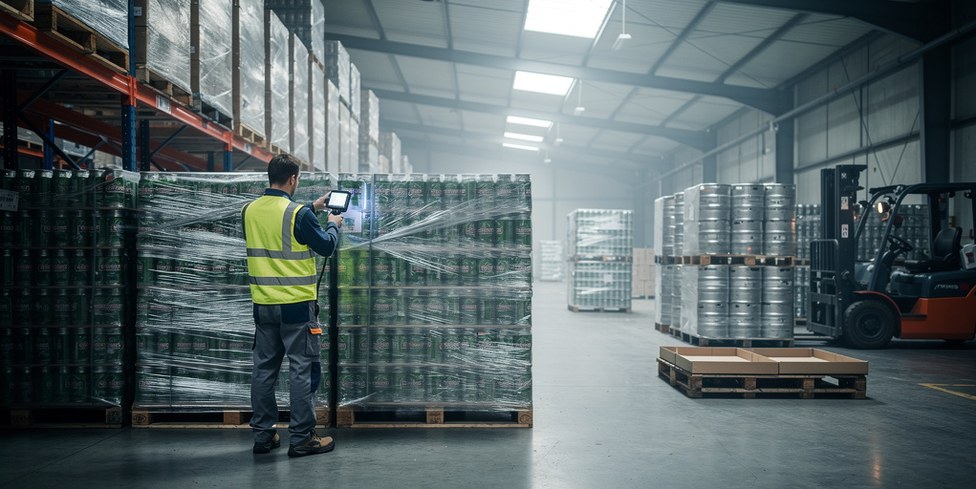
Beer shipments to Russia: excise, digital marking and documents the exporter has to prepare before loading
Import into Russia: how the payments are calculated
On import into the Russian Federation, beer is subject to an import duty by heading, excise duty and VAT. The calculation order matters to you because it shapes what your buyer will ask for: excise is charged on the volume in litres and the alcohol content, while VAT is calculated on the sum of customs value, duty and excise — that is, excise sits inside the tax base and increases it. The landed-cost model of a consignment is therefore built not from the invoice total but from the packaging structure: the ratio of kegs, glass and PET changes both the logistics and the payable amount. Expect the buyer to request litres per SKU, packaging type and exact ABV before the price is agreed, not after.
Excise on beer is charged per litre, not on the invoice amount, so a "cheap" consignment gives no excise saving — while a low price per litre is the first thing to trigger a customs value check, and the goods stay under a security payment until it is over. For short shelf-life beer, that delay costs more than the disputed amount.
The second payment-related risk is timing, and it directly affects your delivery terms. Excisable goods are cleared under a specialised competence: the declaration cannot be filed at an arbitrary customs post. The route and the place of declaration have to be written into the transport contract in advance, otherwise the truck or container arrives where it cannot be released. Agree the destination with your buyer before booking. If the load is mixed and other foodstuffs travel in the same container, the codes and requirements are best sorted out before dispatch — that is what customs clearance of food products covers.
Grey and parallel imports: where the chain breaks
When the value of shipments from one country multiplies within a month, part of the volume inevitably moves through new, unverified counterparties. Hence the familiar grey schemes: understated invoice values, substituted classification (a beer-based drink declared as beer or the other way round), shipping unmarked goods on the assumption that codes will be applied later, and supply through an intermediary with no confirmed trademark rights. A request from a buyer for a second, lower invoice belongs to the same list — and the consequences reach you as well, in the form of a blocked consignment and a suspended contract. Parallel import is a different matter: it is lawful only for items on the current list of the Russian Ministry of Industry and Trade, so before you build a supply channel on it, check whether your brand is on that list and whether the trademark is entered in the customs register of intellectual property.
| Situation | What it means for your shipment | What you do as the sender |
|---|---|---|
| You are a new supplier and your price is noticeably below the market | Customs value correction, security payment, release delayed by weeks | Provide the manufacturer's price list, export declaration and payment documents before dispatch |
| The goods arrive without identification marks | Release refused, storage at a temporary warehouse, demurrage and claims under the contract | Agree who applies the codes: your line abroad or a bonded warehouse in Russia — and fix it in writing |
| A beer-based drink is declared as beer | Underpaid duties, liability for false declaration, claims back to the supplier | Confirm composition and ABV in the specification and test reports before the declaration is filed |
| The brand is not on the Ministry of Industry and Trade list and the goods come via an intermediary | Release suspended on the rights holder's application | Issue written consent of the rights holder or ship directly to the buyer |
| The buyer's EGAIS is not set up by the time of arrival | The consignment is released but cannot move into circulation; shelf life burns in the warehouse | Get confirmation that registration and keys are done before the vessel or truck departs |
What the exporter should do
- Fix the classification for every SKU together with the buyer — beer, beer-based drink, cider mean different requirements and different payments — and put the HS code in the specification.
- Hand over the full product data early: litres per SKU, packaging type (keg, glass, PET), alcohol content and composition. Payments are calculated from litres and packaging, not from the invoice total.
- Supply the data for the Russian-language label and, if it is agreed, apply the label on your own line — composition, volume, ABV, shelf life, producer and importer details.
- Write into the contract who applies the identification marks and at whose expense. Marking at your plant before shipment is normally faster than marking at a bonded warehouse after arrival.
- Prepare the price evidence set in advance: price list, written discount terms, export declaration, correspondence on the agreed conditions, payment confirmation.
- If you own the trademark or act under its owner's authority, issue a written consent letter for the buyer; if you do not, check the brand against the parallel import list before you promise delivery dates.
- Agree the place of declaration and the route before booking transport, with a margin for the temperature regime and the remaining shelf life on arrival.
- Ask for confirmation that the conformity declaration and EGAIS are ready on the buyer's side before loading — a consignment that waits for paperwork is your product losing its shelf life.
Frequently asked questions
Does my buyer need a licence to import beer?
No, the turnover of beer and beer-based drinks is not licensed, unlike wine and spirits. EGAIS, marking, the conformity declaration and payment of excise at clearance remain mandatory.
Can we ship unmarked and apply the codes in Russia?
Yes, provided the marking is done before release — at a temporary storage or bonded warehouse. Unmarked goods presented for release into free circulation will not be released. In practice, applying the codes at your own plant is faster and avoids warehouse handling costs.
If I raise my prices in euro, will my buyer pay more?
Duty and VAT depend on the customs value, so yes. Excise is tied to volume and strength and does not change with the contract price — which means the total burden per litre rises non-linearly when the purchase price goes up.
Can the goods be cleared at the customs post closest to the buyer's warehouse?
No. A specialised competence applies to excisable goods. The place of declaration has to be determined before the transport contract is concluded, otherwise the route has to be reissued and the delivery slips.
Summary
The concentration of European beer shipments on one corridor means new counterparties and new routes — and a rebuilt document package on both sides. The points that decide whether your consignment moves or waits: correct classification per SKU, a conformity declaration issued before arrival, a working EGAIS on the buyer's side, identification marks applied before release, and a ready price evidence file. No licence is needed for beer, and that is the only relaxation — everything else has to be done in full and in advance. Request a consultation, and we will go through your specific shipment.
Send us your SKU list and draft contract, and we will check classification, permits and marking before the truck leaves your plant.
Read also:
- Shipping dietary supplements to Russia: Chestny ZNAK codes, documents and what your buyer will now require
- Customs Clearance Cases in Russia: What They Mean for the Exporter
- Russia extends the diesel export ban into October: what it changes for your shipment and what your Russian buyer will ask you for
- Sulphuric Acid Leaving Russia: HS 2807 00 000 1 Now Needs a Government Decision