

Shipping diesel and petroleum products to Russia: HS code 2710, excise rules and the papers your buyer will now ask you for
If you produce or trade diesel fuel, petroleum products or any cargo whose freight price carries a fuel component, and your delivery address is in Russia or the CIS, the current story is a documents story rather than a price story. Petroleum products sit in HS group 27, they are excisable goods in Russia, and clearance of every batch runs on the papers issued on your side: the refinery quality certificate, the specification, the safety data sheet, the transport documents. The discussion in the United States about a full or partial ban on diesel exports is a good reason to check whether your contract survives a change of producer and route. The real risk is not the tariff — it is desynchronisation: the volume has already been rebooked to another refinery while the specification, the quality certificate and the permits your buyer holds still describe the previous one.
What the measure would change for your shipment
The US Treasury Secretary said the administration is studying a full or partial ban on diesel fuel exports, and that the President supports considering such a measure. No final option has been chosen: what is on the table is the instrument, not the start of its application. The trigger was high domestic retail prices — around 6.53 dollars per gallon on average and 8.44 dollars in California. Those figures describe the American retail market and are not a benchmark for the price of supplies to other countries, so neither you nor your buyer should carry them into a contract calculation.
For a shipper, the form of the restriction is what matters. A full ban, quotas and carve-outs for particular destinations hit signed contracts in completely different ways: in one case the shipment drops out altogether, in another the date slips, in a third only the delivery cost changes. And a restriction on exports does not always look like a ban — a tariff produces the same result: in Russian practice the export duty on sunflower formally prohibits nothing, it simply makes shipping unprofitable. So the thing to monitor is any change in export conditions, not only the word “ban”.
| Scenario | What happens to your shipment | What to settle with your buyer now |
|---|---|---|
| No measure introduced (current situation) | Shipments run as usual | Whether the contract has a clause on government prohibitions and restrictions, and who carries the cost if one is introduced |
| Full export ban | The US volume drops out; the buyer needs a different producer | Your list of alternative refineries, who issues the new quality certificate, and how fast the buyer can have the conformity document reissued for the new manufacturer |
| Partial ban or quotas | Volume shrinks or is allocated; shipment dates slip | Priority of batches, whether partial shipments are allowed, and how a slipped shipping date affects your buyer's guarantee and export-confirmation deadlines |
| Carve-outs for particular destinations | The shipment goes ahead, but the route and the delivery basis change | Incoterms terms, who pays freight and transhipment, and the recalculated customs value — delivery to the Russian border sits inside it |
Petroleum products at the Russian border: code, documents, permits
Diesel fuel is classified in HS group 27, heading 2710, and the exact ten-digit code depends on the characteristics of the batch: sulphur content, distillation range, density, intended use (automotive, marine). This is not a formality — the code drives the duty rate, the non-tariff measures that apply and the list of documents the inspector will ask for. The declarant in Russia picks that code out of your paperwork, which is why a code chosen against the wrong quality certificate is one of the most common reasons a declaration is amended and a batch sits still.
- Refinery quality certificate for the specific batch: the classification figures are read out of it. It has to exist before shipment, not be promised after loading.
- Conformity with the EAEU technical regulation on motor and diesel fuel, where the goods are intended for circulation on the internal market. Your buyer arranges it, but it is held against a particular manufacturer — change the plant and the document has to be reissued. See certification.
- Safety data sheet and dangerous goods documentation: fuel travels as class 3 dangerous cargo, which sets the requirements for tanks, packaging and vehicle placarding. This part is squarely on the shipper.
- Contract and specification describing the goods in wording that matches the quality certificate, plus transport documents — rail waybill for tank cars, bill of lading, CMR.
When the producer changes, the set is assembled from scratch: a different quality certificate, possibly different figures, and with them a different code and different permits. For bulk liquids the logic is the same as in clearance of chemical products and raw materials, and the general sequence is described under customs clearance. If the volume moves in tank cars, issue the documents in step with wagon placement: rail transport tolerates waiting for paperwork badly, because demurrage is counted on the facts. The same applies to sea shipments, where storage at the terminal starts running the moment discharge ends.
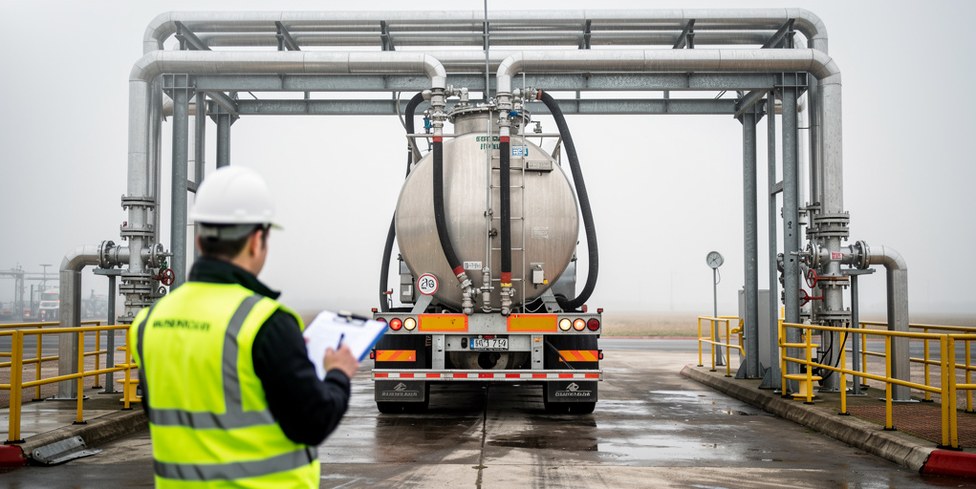
Diesel in rail tank cars: the batch quality certificate decides the HS code — and how long the shipment waits at the border
Excisable cargo: why your buyer counts every litre
Diesel fuel is an excisable good in Russia, and that is the main difference between clearing it and clearing ordinary chemistry. It shows up in the way your buyer handles documents. Where the volume is taken out of the EAEU again, excise need not be paid, but the relief comes with conditions: a bank guarantee or surety has to be filed before shipment — otherwise the excise is paid first and reclaimed afterwards, once actual export has been confirmed. The second route means a large sum leaves working capital for several months, which is why buyers of excisable cargo negotiate shipment dates so stubbornly.
The zero VAT rate is confirmed by the contract, the customs declaration bearing export marks and the transport documents, and the window is limited: as a general rule export has to be confirmed within 180 days from the date the goods were placed under the export procedure. For excisable goods the set is checked more strictly, and any gap in volumes between the specification, the quality certificate, the declaration and the acceptance acts is read against the exporter. Those four figures originate with you.
With excisable cargo there is no tolerance for paperwork that nearly matches: if the volumes in your specification, quality certificate, invoice and transport documents differ, the discrepancy is resolved against the declarant — and the batch waits at the border while the documents are reissued, with demurrage on your tanks running the whole time.
When the volume moves on to Uzbekistan and the CIS
Many buyers in Russia are traders who resell part of the volume across the CIS, so your documents cross two borders, not one. Uzbekistan is not a member of the EAEU, which means a delivery there is handled as a full export procedure with a declaration, not under the rules of mutual trade inside the union. That changes how the zero rate is proved: confirmation rests on the customs declaration with marks of actual export and on the transport documents, rather than on the statement of import and payment of indirect taxes used inside the EAEU. The zero VAT rate applies on general grounds — provided the set is complete and filed inside the allotted period.
One document is worth knowing about even though you cannot issue it: the CT-1 certificate. It confirms origin within the CIS agreements and is what the final customer needs to obtain a tariff preference on import; a chamber of commerce issues it against production documents. Goods you manufacture outside the CIS do not qualify for it, so if a buyer promises their Uzbek customer a preference on your product, that expectation needs correcting early — what they will ask you for instead is a certificate of origin from your own chamber of commerce. Where the goods are excisable, the extra conditions described above apply on that leg too: either a guarantee or excise paid and later reclaimed; and alcohol may only be exported by a holder of an alcohol trading licence. Obtaining origin certificates and arranging guarantees takes weeks, not days — build that into the shipping schedule you promise, not into the week of loading.
What to do on the shipper's side
- Read the clause on government prohibitions and restrictions in your own contract: who carries the cost and the risk if export from your country becomes unavailable, and how the price is revised.
- Line up alternative refineries against your specification in advance and obtain their quality certificates — then compare the figures with what your buyer has already declared on previous batches.
- Check whether a change of producer moves the goods into a different ten-digit code: a difference in sulphur content or distillation range is enough, and the new code brings its own requirements.
- Notify the buyer in writing the moment the manufacturer changes, before loading. The conformity document is held against the actual producer, and reissuing it is their step, done on your timeline.
- Make the volumes identical across specification, invoice, quality certificate and transport documents. One rounding difference is enough to turn a border formality into an amended declaration.
- If the route lengthens, agree the basis explicitly: transhipment, storage and delivery to the border all enter the customs value, so who pays them is a question about the buyer's tax bill as well as your margin.
- If you are a carrier or you price freight yourself, fix the range of the fuel component in your cost model and put a revision procedure into customer contracts rather than reopening the price after the fact.
Frequently asked questions
Is the ban on US diesel exports already in force?
No. The statement is that the measure is being studied; its parameters are undefined and no final option has been chosen. It is too early to speak of American exports stopping, but preparing a substitution plan now makes sense.
Do the 6.53 and 8.44 dollar figures tell me what my customer will pay?
No. Those are US domestic retail prices per gallon, not a benchmark for supplies to other countries. The effect on buyers abroad will depend on how long any restriction lasts, on refinery run rates, on stocks and on how quickly replacement volumes appear.
We are switching refinery mid-contract. What will our buyer in Russia need?
A new batch quality certificate, a check of the ten-digit code against its figures, and the conformity document reissued for the actual manufacturer — plus a specification and invoice that match the new certificate. None of that is instant, so the notice you give matters more than the loading date.
Who bears the loss if the cargo is held at the Russian border over documents?
It follows from the Incoterms term and the contract clauses. Where you deliver to the buyer's country, the delay and the storage sit on your side of the line, and customs value includes delivery up to the border, so a longer route also raises the payments your buyer has to budget. Settle both points before the substitute volume is booked, not after.
Why is customs clearance in Russia so expensive?
Most of the sum is not the representative's fee but payments to the budget: duty, VAT, excise on certain goods, and customs charges. They are assessed on the customs value, which includes delivery to the border, so a long route raises the payments as well. Real savings come from the correct code, a value supported by documents and properly issued preferences — not from understating the invoice.
Summary
The discussion in the United States is still about an instrument, not its application, but it points straight at the weak spot in fuel supplies. A change of producer pulls a new quality certificate behind it, possibly a different code inside HS group 27, a conformity document that has to be reissued, and a customs value recalculated for the new route. For excisable cargo, add the excise guarantee due before shipment and the deadline for confirming the zero VAT rate — both of which run on figures that originate in your paperwork. Request a consultation and we will go through your specific shipment.
Send us the batch documents and we will check the HS code and the document set before your cargo leaves the terminal.
Read also:
- Shipping to Russia and the CIS: export declaration, proof of export and the papers your buyer will now ask for
- Goods Accounting Rules for EAEU Authorised Operators from 2028: What Your Russian Buyer Will Require from Your Shipping Documents
- Transit Through Azerbaijan: What Exporters Shipping to Russia Need to Prepare
- Shipping to Russia through the EAEU: how SPOT filings, marking codes and your buyer's reporting must match