

Shipping to Russia by sea from India and Turkey: how the Novorossiysk freight surge changes your buyer's customs value
If your cargo to Russia moves through Novorossiysk, the economics of your next shipments change before the vessel even sails. Import duty rates in the EAEU have not moved, but the base they are applied to has: the more expensive the freight, the higher the customs value your Russian buyer declares, and the more duty and import VAT they pay. The trigger is the seventh consecutive week of rising freight out of Black Sea ports. Public indices track tanker tonnage, but the causes are common to the whole commercial fleet. Below: what your buyer will now ask you for, how to itemise the invoice so that part of the delivery cost can be deducted, and what to do when shipowners keep steering clear of Novorossiysk.
What is happening on Black Sea routes
The cost of sea carriage out of Novorossiysk has hit an all-time high and has been climbing for seven weeks straight. In the week of 31 August to 6 September, Aframax-class carriage to West India rose 2.7% to USD 23.2 per barrel, to North China 3.1% to USD 25.7, and on the Turkish leg 2.2% (28 cents) to USD 12.8 per barrel. In the Baltic the sharpest increase was on the East India route: plus 3.7% in a week, to USD 17.2 per barrel.
These figures refer to liquid-bulk tonnage, but the three reasons behind them apply to any cargo. First, elevated navigation risk: after drone attacks in the Black Sea became more frequent, commercial shipping as a whole — not just tankers — began avoiding Novorossiysk and picking other routes. Second, higher insurance costs, which carriers pass on as a separate surcharge in the rate. Third, a shrinking pool of available tonnage: part of the world fleet has moved to the Middle East, where owners are offered premium rates for transiting risky waters. For an exporter this means freight that is not only expensive but also short-lived as a quotation — a confirmed rate now holds for days, not weeks.
Same duty rates, a bigger payment on the declaration
Customs value in the EAEU is not just the invoice price. If you sell on E or F terms (EXW, FCA, FOB), the cost of carriage and insurance up to the place of arrival on EAEU customs territory is added to the transaction price — these are the additions under Article 40 of the EAEU Customs Code. So every dollar of freight increase enlarges the base on which the ad valorem duty, the import VAT and the customs processing fees are charged. The tariff itself is unchanged; the object of taxation has grown.
It works the other way round on C and D terms (CFR, CIF, DAP, DDP), where carriage to the warehouse is already inside the price. Delivery costs incurred inside the Union — after the place of arrival — may be deducted from the customs value, but only if they are shown as a separate amount in the documents and backed by a carriage contract and a carrier's invoice. If your invoice carries a single line reading "price including delivery to Moscow", the deduction will be refused and your buyer pays on the entire sum. That is the single most common reason a supplier's invoice becomes a problem at the border, and it is entirely within your control: split the ex-works price, the freight up to the EAEU place of arrival, and the onward delivery inside the Union into separate lines.
What most often breaks a declaration is the war risk and insurance surcharge: the carrier issues it as a separate invoice after the vessel has sailed, by which time the customs value has already been declared without it. If that amount is missing from the declaration, the buyer faces a customs value adjustment, additional assessments and a dispute over misdeclared particulars. Ask the line for every surcharge before your buyer files — and send it to them in writing.
Pay particular attention to how costs are split when part of the route is by sea and part overland. For consolidated cargo, and for shipments where the sea leg from India ends with transhipment in a third port, your buyer needs the full set: bill of lading, freight forwarding contract, freight invoice and proof of payment, plus a document showing how the rate is allocated across the legs of the route. None of these are documents the buyer can produce alone — they come from you and your forwarder.
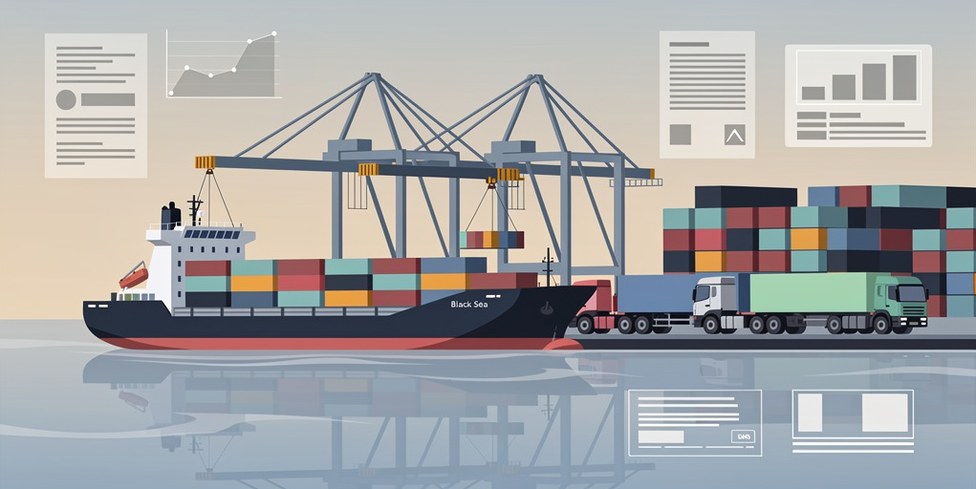
Freight out of Novorossiysk has hit an all-time high — and the extra cost lands in the customs value your buyer declares in Russia
Routes and transit times: replacing Novorossiysk
The shift of part of the flow out of the Azov–Black Sea basin to the Baltic is already visible in the statistics, and it also explains why Baltic routes are getting more expensive faster than Black Sea ones. Tonnage in Baltic ports is balanced for now: there is no shortage, but no surplus either, so this option has limited headroom. Analysts allow for an improvement in the south by October, when some vessels may return to their former routes — but planning a shipment around that scenario is risky. If you ship by sea on a regular basis, price the alternatives in advance: the north-west ports with an onward rail leg, road transport out of Turkey, air for the time-critical part of the range.
| Situation | What changes at clearance in Russia | What you do as the shipper |
|---|---|---|
| The line raises the rate and adds a war risk surcharge | Customs value rises, and with it duty, import VAT and fees | Obtain the full rate breakdown before the declaration is filed and pass it to the buyer in writing, with the invoice numbers |
| The vessel changes the discharge port; container sailings from India to Novorossiysk are moved elsewhere | The place of arrival, the customs office and the length of the EAEU leg all change | Reissue the transport documents and the notify party details, and tell the buyer before arrival so the warehouse booking can be redone |
| Switching to a Baltic routing | A long domestic leg to the consignee's warehouse appears | Book earlier, confirm the ETA in writing and allow for rail transit times in your delivery commitments |
| Part of the consignment is urgent | A different mode means a different document set and a different cost structure | Split the consignment and send the urgent part by air under its own invoice and packing list |
| Shipment from Turkey | The sea leg is getting expensive, road is becoming competitive | Quote road delivery, issue a clean export invoice and get the product documents ready early |
For Turkish product ranges — textiles, apparel, consumer goods — a change of transport mode almost always drags the permit side with it: the carrier, the route and the timing change, while conformity requirements stay exactly the same. Certification in Russia is issued on the buyer's side, but it runs on your documents: technical files, test reports, product photos and samples. If you are switching from sea to road with three days' notice, that package has to be ready already.
What this means for you as the shipper
- Re-read the Incoterms in your live contracts. Under EXW, FCA and FOB the whole freight increase lands in your buyer's customs value — expect them to come back asking to move to CFR or CIF with costs itemised by leg, and decide in advance on what terms you would agree.
- Ask the line or forwarder for the complete rate structure: base freight, bunker and war risk surcharges, insurance, terminal charges. Everything relating to the leg up to the EAEU place of arrival has to reach your buyer before they declare, not after.
- Itemise the invoice. Ex-works price, freight to the place of arrival and delivery inside the Union on separate lines — one combined figure costs your buyer the deduction and makes your price look worse than it is.
- If you sell from Turkey, issue a proper export invoice without local KDV. Russian VAT machinery cannot refund Turkish tax; charged on an export sale it simply inflates the customs value and the duty paid on it.
- Build schedule tolerance into the sales contract. Shipowners are reluctant to send vessels to Novorossiysk, and rolling a booking to the next sailing is a working scenario right now rather than force majeure — agree the tolerance instead of paying penalties for it.
- Check the shelf life of the documents you supply — test reports, manufacturer's declarations, batch certificates. If the cargo sits in port or takes a different route, they can expire before the goods reach customs.
- Price the alternative leg before a sailing is cancelled, not on the day: Baltic ports with an onward rail leg, road through Turkey, or splitting the consignment across modes.
- Assemble the transport-cost evidence pack up front: carriage contract, freight invoice, payment order, bill of lading and the allocation of the rate across the legs. Your buyer cannot file a defensible customs value without it.
Frequently asked questions
We sell FOB and the buyer pays the freight. Does the increase concern us at all?
Indirectly, but materially. The customs value includes the actual cost of carriage and insurance up to the place of arrival in the EAEU — not the figure assumed when the contract was signed. Your buyer's landed cost therefore rises without you touching your price, which is what brings them back to the negotiating table. It also means they will need carrier invoices for the specific voyage, and those are easiest to get through you.
Our Turkish invoice carries KDV. Is that a problem for the buyer?
Yes. A Russian company cannot recover Turkish KDV through the Russian tax authorities — the tax is refunded or simply not charged by the Turkish seller when the shipment is processed as an export. Agree the export invoice before shipping: otherwise the buyer effectively pays someone else's tax and risks overstating the customs value by that amount.
What is more predictable on timing right now — sea via the south, or a combined routing?
On pure transit time the sea route usually wins, but the main risk today is not voyage length; it is cancellations and rolled bookings. A combined scheme with transhipment in the north-west adds a long inland leg, but rail transit times are calculated against published norms and plan far more accurately than waiting for free tonnage.
Can we fix a freight rate for a quarter and quote our buyer a firm delivered price?
On routes with a tonnage shortage the lines are reluctant to give long fixtures, and where they do it comes with risk-surcharge reservations. It is more practical to fix volume and loading priority, and to build the surcharges into the cost of the consignment from the outset — a delivered price quoted without them will have to be revised mid-shipment.
Summary
Freight out of Black Sea ports has been rising for seven weeks and has already set records on the Indian, Chinese and Turkish routes. For an exporter to Russia and the CIS this is primarily a customs value question at the receiving end: the tariff has not changed, but the base for duty and VAT has grown, and part of the cost arrives as separate invoices after the goods have shipped. Check your Incoterms, itemise the invoice by leg, hand over the full freight documentation before your buyer declares, and price an alternative route while the Black Sea situation stays unsettled. Send us a request and we will work through your specific shipment with you. See the full range of logistics and customs clearance services and our customs clearance offering.
Send us your shipment details and we will recalculate the customs value and find a route that bypasses the congested Black Sea.
Read also:
- Russian Container Imports Up 17%: What It Means for Your Shipment, Your Documents and Your Transit Time
- Russia–India routes: the Chabahar–Zahedan rail link by end-2026 and the Vladivostok–Chennai corridor — what it changes for your shipment
- War Risk Insurance in Russian Customs Value: What Your Buyer Will Ask You For
- Electronic Waybills for Shipments to Russia: The Carriage UID, Codes 02015 and 02016, and What Your Buyer Will Ask You For