

Shipping to Russia via Mongolia: what the Naushki and Kyakhta corridor changes for your consignment
If your goods move to Russia through Mongolia — or if your buyer has just asked you to reroute a shipment that way — the first thing to review is not the carrier's rate but your own paperwork. The interim trade agreement between the EAEU and Mongolia is now being implemented: the Mongolian side has reduced or removed import duties on 367 categories of goods, and the corridor has become a live route again. For you as the shipper the tariff line matters less than three things you control at the factory: the HS code your goods will be classified under, the proof of origin issued for the consignment, and the conformity documents and markings your Russian buyer will be asked for at release. The corridor rests on two crossings — the rail link Sukhbaatar — Naushki and the road crossing Altanbulag — Kyakhta. A mistake in any of these links is paid for in border standing time and additional charges, and your buyer will pass that cost back to you.
What the EAEU–Mongolia agreement does and does not do for your cargo
The interim trade agreement between the Eurasian Economic Union and Mongolia is already in the implementation stage. Mongolia has lowered or fully removed import duties on 367 categories of goods. That is a genuine change in landed cost — but it applies to goods of EAEU origin entering Mongolia, not to every box that touches Mongolian soil.
The practical consequence for a supplier is a matter of codes, not product names. Preference lists are always built on the tariff nomenclature, and a single digit moves a consignment from a preferential line into the general one. If a buyer or a forwarder tells you that "the new agreement makes this duty-free", ask which code that claim is based on and whether the origin rules of the agreement are actually met. Then make sure the goods description in your contract and your invoice matches the classification that will be declared — a mismatch between your own documents is the cheapest problem to prevent and one of the most expensive to fix at the border.
The preferential rates work on goods entering Mongolia from the EAEU. Cargo that merely crosses Mongolian territory on its way to Russia is not covered: on import into the EAEU, duty and VAT are calculated under the ordinary rules — and they are calculated from your invoice.
Naushki or Kyakhta: choosing the crossing and the mode
The rail crossing Sukhbaatar — Naushki and the road crossing Altanbulag — Kyakhta carry the bulk of the corridor. For a shipper the choice is between consignment size and speed of reaction, and it changes what you have to prepare.
- Rail via Naushki. Suited to large homogeneous lots, raw materials, machinery, heavy and out-of-gauge cargo. Lower cost per unit and a more predictable schedule, but stricter requirements for a complete document set and less flexibility on dates: a train does not wait while a missing certificate is issued. See rail freight.
- Road via Kyakhta. Convenient for consolidated loads, urgent shipments and smaller volumes that need to reach a specific warehouse without transhipment. The price is a higher cost per tonne-kilometre and exposure to queues at the crossing. See road freight and consolidated cargo.
In both cases, goods moving from China into Russia travel under the customs transit procedure: it is opened on entry into the EAEU and must be closed at the destination customs office within a set deadline. Transit that is not closed on time is the single most common reason a delivery turns into a dispute with additional payments — and although it is opened by the carrier, the consequences land on the cargo and its owner, which is why your buyer will want the destination office and the guarantee agreed before the train or truck reaches the border. Our customs clearance team handles both ends of that procedure.
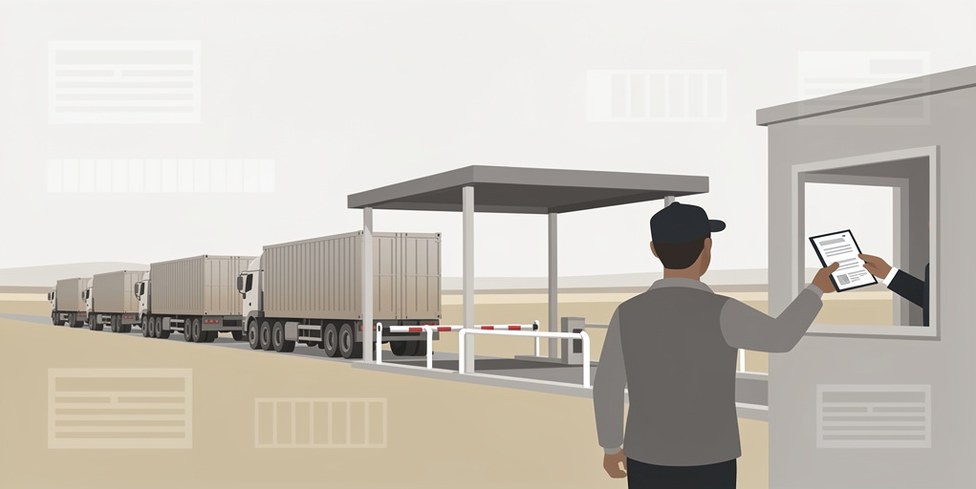
The Naushki and Kyakhta crossings on the Russia–Mongolia border: a working corridor into Russia for rail and road consignments
What your Russian buyer will require from you
The document set for the Mongolian corridor is built in three layers, and a missing layer stops release. All three depend on information that only you, the manufacturer or supplier, can provide.
Layer one — classification. The HS code must be settled before loading, not on arrival. It drives the duty rate, the permits required and whether the goods fall into any preferential list. Your buyer will ask you for technical descriptions, composition, function and intended use — not a price-list name. Supply that material in writing; a code defended with a datasheet survives a customs query, a code taken from a catalogue heading does not. Code lists are amended regularly, so a classification agreed a year ago is worth re-checking before a new season's shipment.
Layer two — origin. Where preferences are claimed, a proof of origin issued under the rules of the relevant agreement is required. A certificate is not issued "for a product" in the abstract — it covers a specific consignment, and the code and description on it must match your invoice and the declaration exactly. Issuing it is your side of the transaction, and in most countries it takes days rather than hours.
Layer three — conformity assessment. If the goods fall under a technical regulation, the Customs Union requirement applies: a TR CU certificate or declaration of conformity is needed, and for many groups the EAC market circulation mark as well. Consumer goods, electronics, children's products, machinery and food are the typical groups. This is where exporters lose the most time. Marking must be applied at the factory before shipment: applying marks or relabelling after arrival is more expensive, slower, and sometimes simply impossible without a temporary storage warehouse. If you manufacture in China, settle the labelling with the plant while the order is still in production. We arrange certification and declarations of conformity for foreign manufacturers, and the paperwork is normally started well before the goods are ready.
Shipment types, risks and what to do before loading
| Your shipment | Main risk | What to do before loading |
|---|---|---|
| You are told the Mongolia agreement makes your goods duty-free | The preference does not apply, the buyer pays full duty and reopens the price | Check the claim against the HS code and the origin rules, and confirm in writing what your goods actually qualify for |
| Goods produced in China, railed through Mongolia via Naushki | Transit deadline missed, wagons idle, additional payments assessed | Have the buyer confirm the destination customs office and the transit guarantee before the train approaches the border |
| Consolidated road shipment via Kyakhta | Queues at the crossing; items in one truck carry different permit requirements | Break the consolidated load down by HS code and permits before departure, and pack so that lines can be separated |
| Goods falling under a technical regulation | Release refused for a missing certificate or a missing EAC mark | Complete the conformity assessment and apply the marking at the plant, not at the destination |
| Equipment shipped in parts across several consignments | Dispute over classification of the complete unit and over customs value | Agree the declaration scheme and supporting documents in advance; keep part lists and values consistent across all shipments |
One planning note: the corridor is developing in both directions. The Mongolian side is also discussing coal supplies to Russian border regions, so pressure on both crossings will grow. Build a time buffer into your shipping schedule even on lanes where clearance used to happen on the day of filing.
Pre-shipment checklist for the exporter
- Fix the HS code from the actual characteristics of the goods, not from the name in your price list, and give your buyer the technical description, composition and intended use in writing.
- Check whether your product line requires conformity assessment in the EAEU, and start the certificate or declaration early — this is almost always the longest item on the list.
- Apply the EAC mark and the shipping labels at the factory, and send photographs of the marked packaging to your buyer before loading.
- Match the transport mode to the consignment: rail through Naushki for large volumes, road through Kyakhta — Altanbulag for consolidated and urgent loads.
- Confirm with your buyer which customs office is the destination for transit and how the procedure will be secured, so it closes within the deadline.
- Cross-check your invoice, packing list, contract and transport documents against each other: description, weight, number of packages and value must be identical in all of them.
- Allow at least two to three weeks for document preparation before shipment, and more where certification is mandatory.
Frequently asked questions
Does the EAEU–Mongolia agreement reduce duty on my goods transiting Mongolia into Russia?
No. The preferences concern trade between the EAEU and Mongolia. Goods of Chinese or other third-country origin moving across Mongolian territory into Russia are cleared on general terms, with duty and VAT calculated in the usual way.
Where will my goods actually be declared after Naushki or Kyakhta?
Declaration in Russia is electronic and is filed with an electronic declaration centre determined by competence — it depends on the transport mode and the category of goods. The place of physical arrival and the place of filing often differ, and that is normal practice. It does not require anything from you beyond documents that are consistent with each other.
My buyer suggests bringing a small commercial consignment as personal goods by car. Is that an option?
No. The "red corridor" is a declaration lane for individuals carrying goods above allowances or subject to written declaration; it does not apply to commercial consignments through Kyakhta or Naushki, which are declared against a contract. Personal effects and commercial cargo are fundamentally different regimes, and moving a consignment "as personal" ends in seizure.
What does Russian customs ask about most often on this route?
Three subjects: justification of the declared code, confirmation of the customs value, and completeness of the permit documents. Every one of those answers is built from documents you issue — the specification, the invoice, the origin certificate and the conformity documents. They should be ready before the declaration is filed, not assembled after a query arrives.
Summary
The Russia — Mongolia — China corridor through Naushki and Kyakhta is becoming a working route, both for transit out of China and for trade with Mongolia, where the agreement with the EAEU has cut or zeroed duties on 367 categories of goods. Those preferences will not travel with a transit consignment, so for an exporter the advantage comes from closing three questions before loading: classification, origin and conformity. What is left after that is simply choosing rail or road for the particular consignment.
Send us your product specification and route, and we will confirm the HS code, list the permits your Russian buyer will need and price the shipment through Naushki or Kyakhta with customs clearance included.
Read also:
- Rail to Russia via Mongolia: what the Naushki upgrade means for your shipment and your buyer's paperwork
- Rail Shipments to Russia via Kazakhstan: What Your Buyer Will Ask For and Where Wagons Stop at Iletsk-1
- Russian Grain Export Duty Moves Every Week: What It Means for Your Shipment and What Your Counterparty in Russia Will Ask You For
- China–Russia road crossings in Primorye: what the new capacity means for your shipments