

Sulphuric Acid Leaving Russia: HS 2807 00 000 1 Now Needs a Government Decision
If sulphuric acid appears anywhere in your Russian trade — you buy it from a Russian plant, or you supply chemicals into Russia and the same product family sits in your catalogue — the planning window has just changed. Until 31 December 2026 inclusive, goods classified under code 2807 00 000 1 of the EAEU CN FEA may leave Russia only on a decision of the Chairman of the Government of the Russian Federation, the First Deputy Chairman or a Deputy Chairman, in line with the allocation of duties and on the basis of proposals from the Ministry of Industry and Trade of Russia. The mechanism was introduced by Resolution No. 1158 of 12 September 2026, which amended the base act — Government Resolution No. 311 of 9 March 2022. In customs terms a new permit document appears: without its details the goods declaration will not clear. A separate list of cases falls outside the restriction, and whether a consignment lands in that list decides if it ships on the usual schedule or waits for a decision.
What changes and whose shipment it touches
The measure is permissive, not prohibitive. Shipments are still possible, but every consignment that does not fall within the list of exemptions needs an individual decision at government level, taken on the proposal of the sector ministry. That rewrites the planning logic on the Russian side: where a lead time used to be production cycle plus transport plus release of the declaration, there is now a stage nobody in the commercial chain controls and no broker can speed up.
Read the scope precisely before you assume it reaches you. The restriction regulates movement out of Russia. If you are a manufacturer or supplier shipping goods into Russia and the CIS, your own consignments are not covered by Resolution No. 1158 — import requirements for chemical products, permit paperwork and dangerous goods carriage stay as they were. The measure reaches you in two other ways: if you buy sulphuric acid from a Russian producer, that seller now needs a decision before your cargo can leave; and if you ship chemicals inbound, the case is a working illustration of how one ten-digit code decides a consignment's fate and what your Russian buyer will ask you to produce.
The resolution enters into force on the expiry of 10 days from the day of official publication. The date to count from is publication, not the date the document was signed. Consignments not placed under a customs procedure by that moment are handled under the new rules even where the contract was signed earlier — so a contract date alone is no protection for a shipment that is still on the plant yard.
Note the horizon as well: 31 December 2026 inclusive. Measures of this kind are often extended or reworked, so an annual contract is safer written with a clause on what the parties do if the regulation changes, rather than on the assumption that the old order returns automatically on 1 January.
HS 2807 00 000 1: classification and the evidence behind it
The measure is tied to a specific EAEU CN FEA subheading, not to the commercial name of the product. Heading 2807 holds more than sulphuric acid — oleum is classified alongside it, and the restriction is named for code 2807 00 000 1 only. The first practical conclusion for anyone whose product sits in this family: classification stops being a formality and becomes the ground on which the permit regime applies or does not. A dispute over the code at release means the consignment stands still, and for chemical raw materials that also means storage under special conditions, on the clock.
The weak point in most chemical consignments is not the permit — it is the evidence on composition. If concentration and product characteristics are only partly supported by the test report, or the laboratory is not accredited, the customs authority is entitled to order an expert examination, and a consignment that is ready to move stands still until the result comes back.
This is where a foreign supplier carries real weight, because the evidence originates with you. Prepare the full set before the goods move: quality passport or certificate of analysis for the batch, test report from an accredited laboratory, safety data sheet for the chemical product, and manufacturer's technical documentation describing how the product is obtained. On the Russian export side those papers support the code and the claim to an exemption. On your inbound shipments the same papers are what your buyer files with the declaration — an incomplete product description in box 31 is the error that repeats from declaration to declaration, and it is normally traceable to a specification that arrived thin from the seller.
If your product has a complex composition, agree the approach in advance with people who handle customs clearance of chemical products and raw materials as routine work, and check early whether the goods you send need conformity assessment documents in the EAEU — that part is arranged in Russia but depends entirely on the technical data you provide.
The logic of the measure is familiar to anyone who exports commodities: the state fixes the priority of the domestic market and allocates outbound volumes by hand. For a foreign counterparty the signal is simple — availability of Russian-origin chemical feedstock is now an administrative variable, not only a commercial one.
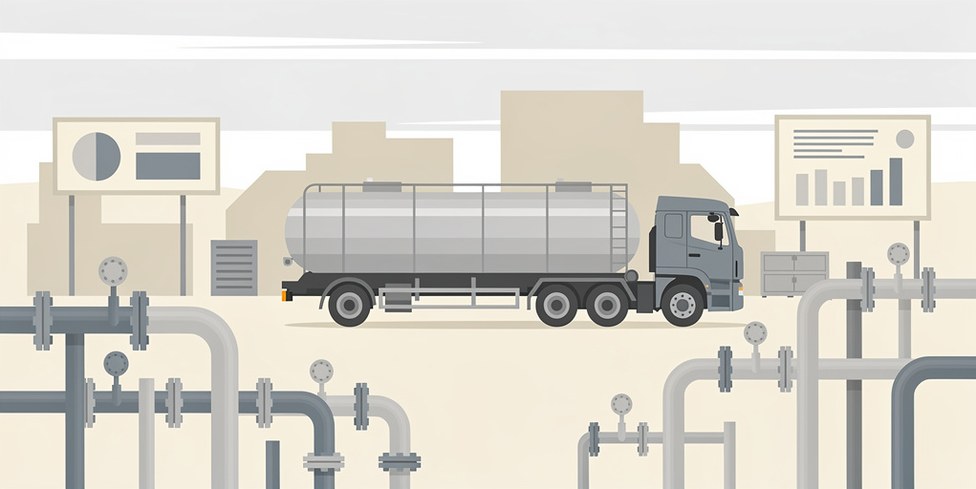
Sulphuric acid travels under HS 2807 00 000 1 — until 31 December 2026 every Russian export consignment outside the exemption list needs a separate government decision.
Dangerous goods and Incoterms: where the duty sits
Sulphuric acid is a corrosive substance, and a permit regime lands on top of transport requirements that are already strict. For sea movements the rules for carriage of dangerous goods apply: a shipper's declaration for dangerous goods, correct marking and hazard labels on the packaging, a container packing certificate, and confirmation that the packaging is fit for purpose. Lines close bookings for such cargo earlier than usual and keep fewer slots open, so losing a slot because a permit is unfinished costs more than it would on general cargo. If you move consignments regularly, build a date buffer into your sea freight planning instead of booking a slot tight against the readiness date.
The rules for carriage of dangerous goods by sea require the data in the transport documents to match the data in the goods declaration: product name, concentration, hazard class, type and number of packages. A divergence between the dangerous goods declaration and the boxes of the declaration is a routine reason for refusal of release, and the new permit document adds one more point of reconciliation. For a shipment into Russia the same discipline applies in reverse — whatever you write on the shipper's declaration is what your buyer's broker must repeat, so a late change of concentration or package count on your side turns into a border delay on theirs.
The contractual layer matters just as much. Incoterms allocate export formalities between seller and buyer. Under most terms in groups C and F, export customs clearance and obtaining outbound permits are the seller's responsibility — meaning the Russian side when you buy from Russia, and your side when you ship from your own country. In practice, if you are buying Russian acid and no decision has been taken on that consignment, the risk of missed dates and contractual penalties sits with your supplier, not with you; but the supply gap is still yours to manage. Before the regime bites, agree an addendum with the counterparty: extend delivery dates, set out what the parties do if the permit is delayed or refused, and rule out automatic penalties triggered by a change in regulation.
Before and after: the procedure compared
| Stage | Before | Now — until 31.12.2026 inclusive |
|---|---|---|
| Basis for the shipment | Foreign trade contract and the standard document set | Contract plus a decision of the Chairman of the Government of the Russian Federation or a Deputy Chairman, unless the consignment falls within the exemptions |
| Ministry involvement | No separate clearance was required for this code | The decision is taken on the basis of proposals from the Ministry of Industry and Trade of Russia |
| Documents with the declaration | Contract, invoice, quality passport, transport documents | The same set plus the permit document details in box 44 |
| Weight of the HS code | Affects duties and statistics | Decides whether the restriction applies at all: the measure is tied to code 2807 00 000 1 |
| Lead-time planning | Production, transport, release | Plus preparation of the application and the time taken to consider it |
| What an error costs | Amendment of the declaration, additional payments | Refusal of release, dangerous cargo standing in store, a lost booking |
| What the foreign counterparty should ask for | Specification, quality passport, shipping schedule | The same, plus written confirmation of the exemption or of the permit application status before production is scheduled |
What the shipper should do
- Go through your live contracts with Russian counterparties and pull out every position that classifies in heading 2807 — by the actual composition of the product, not by the name in the specification.
- Check the code of each consignment down to subheading level and make sure it is supported by a test report from an accredited laboratory and a quality passport.
- Where you buy from Russia, ask the seller in writing which of the exemption cases the consignment falls under and which document proves it; if none applies, ask when the application went in.
- Establish the date of official publication of the resolution and mark the day the measure takes effect — use it to split shipments into those that still make it and those that go under the new order.
- Where you ship into Russia, send your buyer the full technical file in advance — certificate of analysis, test report, safety data sheet, production description — so the declaration is not filed on a thin product description.
- Agree an addendum on dates and on each party's liability if an export permit is delayed, instead of relying on the original delivery schedule.
- Rebuild the dangerous goods transport pack and keep the dangerous goods declaration, the transport documents and the goods declaration saying exactly the same thing about name, concentration, hazard class and packages.
- Warn your warehouse and carrier that dates may move, so you are not paying demurrage and storage on aggressive chemicals beyond plan.
Frequently asked questions
Does this restriction affect the goods I ship into Russia?
No. The measure regulates movement out of Russia. Import into the territory of the Russian Federation is unchanged: the previous requirements on declaring, permit documentation for chemical products and carriage of dangerous goods continue to apply to inbound consignments.
From what moment does the restriction bite in practice?
The resolution enters into force on the expiry of 10 days from the day of official publication. Count from the publication date, not from 12 September 2026 when the document was signed. Consignments not placed under a customs procedure by that moment are handled under the new rules.
My Russian supplier says our consignment is exempt. What do I ask for?
Ask which wording of the resolution they are relying on and which document evidences it. The list of cases outside the restriction is closed, so it has to be matched against the text of the document rather than against a general sense of what the supply looks like — and the evidence has to exist before the goods are ready.
Our contract dates are already tight. What now?
Put the regulatory change in writing to the other party, fix new dates in an addendum, and let the permit procedure run in parallel. Under most common delivery terms export formalities sit with the seller, so silence until the deadline passes is the worst option for whichever side holds that duty: it removes the arguments in any later argument over penalties.
Summary
Until 31 December 2026 inclusive, goods under EAEU CN FEA code 2807 00 000 1 leave Russia on a separate decision of the Chairman of the Government of the Russian Federation or a Deputy Chairman, on the basis of proposals from the Ministry of Industry and Trade of Russia. Import into Russia is not changed by the measure. For a foreign manufacturer or supplier the tasks are concrete: confirm the classification of your product, find out in writing whether a Russian-origin consignment falls within the exemptions, and give your Russian buyer a complete technical file so the declaration matches the cargo. Dangerous goods transport requirements do not go away and must agree with the declaration data line by line. Send us a request and we will work through your specific cargo.
Send us your product specification and we will confirm the EAEU HS code and assemble the document set your Russian counterparty will be asked for at the border.
Read also:
- Russia bans sulphuric acid exports until the end of 2026: what it changes for your shipments to Russia and the CIS
- Electronic Consignment Note in International Transport: The Documents Your Shipment to Russia Will Need
- Shipping Beer to Russia: Excise, EGAIS and Digital Marking — What Your Russian Buyer Will Need From You
- Russia extends the diesel export ban into October: what it changes for your shipment and what your Russian buyer will ask you for