

Titanium dioxide to Russia: the anti-dumping duty is on pause — what it means for your shipment and your buyer's documents
If you manufacture or supply titanium dioxide and ship it to buyers in Russia and the CIS, your next consignments need to be re-costed and watched against a calendar. The Board of the Eurasian Economic Commission (EEC) has suspended the anti-dumping duty on this pigment until 10 August 2027 inclusive, and the decision enters into force ten calendar days after its official publication. For your shipment this is not simply “cheaper” — it is a fork in the road by date: a consignment whose customs declaration is registered before the decision takes effect is cleared under the old rules, with an extra 14.27% to 16.25% of customs value on top. Everything else stays where it was — classification of the goods, proof of origin, the Common Customs Tariff import duty, VAT and customs fees. Below: what your buyer in Russia will now ask you for, and how to keep the consignment from stalling at the border.
What changes in your buyer's calculation and why everything hangs on one date
An anti-dumping duty is an additional protective charge applied to supplies at prices found to be understated. It exists separately from the ordinary import duty and is levied on top of it. It is precisely this additional charge that has been suspended — everything else about importing stays in place, so the landed cost of the consignment is still built up under the usual customs rules. Your invoice price does not change; what changes is your buyer's total cost of taking the goods in.
The date of 10 August 2027 is the outer limit of the relief, not the day it starts. The start is counted from the official publication of the EEC decision plus ten calendar days. The risk zone sits between those two points: the cargo can physically reach the buyer's warehouse before the decision begins to work, and then the additional charge falls due in full.
The payments are calculated as at the date the customs declaration is registered in Russia — not the date of the contract, not the date your invoice was paid, and not the date the vessel arrives. If the declaration is registered even one day before the decision enters into force, the anti-dumping duty is charged in full, and it cannot be recovered afterwards as an overpayment.
Hence the practical conclusion for your shipping plan: for goods moving by sea from Chinese ports, build in a time buffer and agree with the buyer and their customs representative when the declaration will actually be filed. Sometimes it is more sensible to keep the cargo in temporary storage for a few days than to lose about 15% of customs value. What the buyer needs from you in order to hit that date is not goodwill but a complete document pack — an incomplete set means the declaration either slips or is filed early with whatever papers are on hand. See how sea freight and groupage road transport from China differ in transit time: for bagged and bulk pigment, the choice of mode is also a choice of which period your consignment lands in.
Classification and papers: what your buyer will now require from you
The first thing to check is whether your product falls under the measure at all. Titanium dioxide travels in different forms: as a pigment for coatings, polymers and paper, and as a chemical compound. Depending on composition, intended use and the content of the main substance, the goods belong to different parts of the nomenclature — to chapter 28 (products of inorganic chemistry) or chapter 32 (colouring matter and pigments). Trade-defence measures are tied to specific codes, so a classification error produces either an unjustified extra payment or — worse — an underpayment followed by reassessment with interest. Mixtures and ready-made formulations based on the pigment, as well as masterbatches, may be classified differently from the pure pigment. In practice this means your specification has to carry the mass fraction of the main substance, the physical form and the intended application — a one-line “Titanium Dioxide” on the invoice is what starts the arguments.
Second — origin. The measure concerns goods from China, so customs looks at the country of origin, not only the country of dispatch. If the pigment was produced in one country and shipped from a warehouse in another, correctly issued origin documents and an unbroken chain of shipping papers are required. A mismatch in the manufacturer's name between the certificate, the invoice and the packing list is the single most common reason for a request for additional documents — and that request is answered by you, from the other side of the world, while the cargo waits. Name the actual producing plant, spelled identically in every document, not just the trading company on the contract.
Third — the pack for customs clearance of chemical products and raw materials: the contract with a description of the goods, the invoice, the packing list, transport documents, the safety data sheet and technical specifications stating the composition and the mass fraction of the main substance. These same documents are what justifies the EAEU HS code, so there is no point in preparing them as a formality. Chinese and European plants rarely issue a full technical pack in a day — that lead time belongs in your production schedule, not in the buyer's last week before arrival. If the goods on your side also need conformity documents for the Russian market, certification runs as a separate track and on its own timeline.
Fourth — delivery terms. The route and the Incoterms rule directly affect the customs value on which all the charges are calculated, so the shipping scheme and the payment calculation have to be chosen together. A switch from FOB to CIF, or a change of transhipment port, moves the base — and with it the numbers your buyer quoted to their own customers.
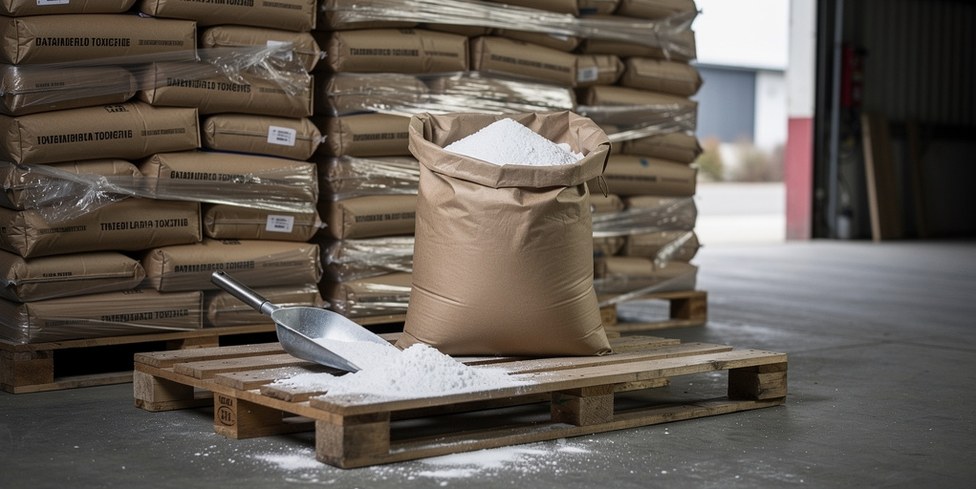
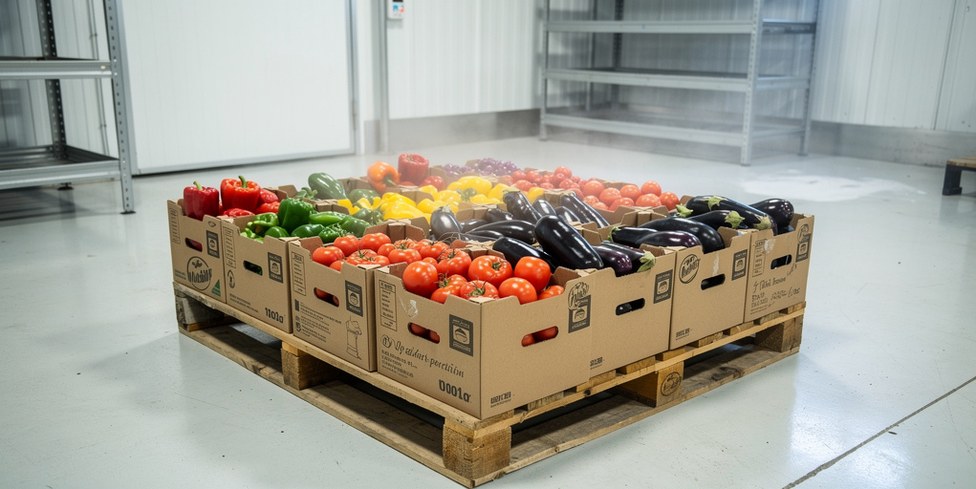
Titanium dioxide pigment packed for shipment to Russia: for the duty pause to apply, the customs declaration must be registered only after the EEC decision has entered into force
What is paid on import: before and during the pause
The duty burden on imported raw material in Russia is not a single line. The calculation involves the import duty under the Common Customs Tariff, customs fees for customs operations, import VAT and — until recently — the anti-dumping duty. The suspension removes only the last of those lines.
| What is counted | Before the decision enters into force | During the suspension |
|---|---|---|
| Anti-dumping duty on Chinese titanium dioxide | From 14.27% to 16.25% of customs value depending on the manufacturer | Not payable — until 10 August 2027 inclusive |
| Price undertakings and duty-free quotas of individual suppliers | Worked as a way of avoiding the additional charge — and as a sales argument | In practice they stop being the deciding argument when a buyer chooses a supplier |
| Import duty, fees, VAT | Charged under the general rules | Charged under the general rules, the procedure does not change |
| EAEU HS code and origin documents | Confirmed at the time of declaring | Confirmed in exactly the same way — scrutiny does not ease off |
| The date that determines the calculation | The date of registration of the customs declaration | |
Duty-free trade, in plain terms, is a regime in which goods move without payment of duties — and it should not be confused with the suspension of an anti-dumping measure. This is not duty-free importing: the ordinary charges remain, only the additional protective one is lifted. In the same way, a duty-free quota granted to a particular supplier only meant a volume within which the additional charge was not levied — it was never an exemption from customs clearance. If your commercial pitch in this market rested on a price undertaking or a quota, that advantage is now flat, and the competition shifts to specification quality, document discipline and lead time.
A separate matter that regularly breaks a supply budget is the exchange rate at which the duty is calculated. The payments are assessed in roubles at the Bank of Russia rate in force on the day the customs declaration is registered — not on the day your invoice is paid and not on the day the contract is signed. In a volatile currency market this can swallow part of the benefit of the lifted charge, which is why buyers will push harder for currency and price-review clauses.
The suspension is a pause, not a cancellation: the grounds for protecting the market have not been declared void, and after 10 August 2027 the charge may come back. Long-term fixed-price contracts are worth writing with a clause stating who bears the risk of a change in customs payments.
What the exporter should do
- Issue a specification that actually supports a code: composition, mass fraction of the main substance and intended use — pigment or chemical compound. If your product sits on the border between chapters 28 and 32, expect your buyer to apply for an advance classification ruling and to ask you for the underlying data.
- State which plant produced the lot. The anti-dumping rate differed by manufacturer, so the buyer's records — and their history of past declarations — are built around the producer's name, not the seller's.
- Give your buyer the shipping dates in writing: planned departure, expected arrival and the date your document pack will be complete. They will match that against the publication date of the EEC decision plus ten calendar days.
- Agree in advance what happens if the dates do not line up: whether the sailing can be moved, whether the container can wait, and who pays for a few days of temporary storage. A short delay is cheaper than roughly 15% of customs value.
- Put the origin documents in order: the manufacturer's name in the certificate of origin, the invoice and the packing list must match literally, character for character, including transliteration.
- Prepare the technical pack early — safety data sheet and specifications with composition and mass fraction. These are requested at the border with no notice, and a delay in answering is a delay of the whole consignment.
- Revisit the contract: fix who gets the benefit while the additional charge is lifted, and add a price-review clause for the period after August 2027, when it may return.
Frequently asked questions
The decision has been adopted — can my buyer already declare the goods without the additional duty?
No, not until ten calendar days have passed since the official publication. Until that moment declarations are processed on the previous terms.
The cargo arrived before the decision took effect — can the anti-dumping duty be refunded later?
No. The payments are determined as at the date the declaration is registered, and a subsequent change in the rules does not reopen that assessment.
Does the suspension cover finished paints, enamels and polymer compounds containing titanium dioxide?
The measure is tied to a specific product and its codes, and finished formulations are usually classified differently. This has to be checked against your specification, not against the presence of the pigment in the recipe.
Which exchange rate applies if my invoice was paid a month earlier?
The Bank of Russia rate on the date the customs declaration is registered. The date of payment under the contract has no effect on the calculation.
Who actually pays the duty — the exporter or the buyer?
The importer of record in Russia is liable to customs. Who ultimately carries the cost is a matter of your contract and Incoterms rule — under delivered terms it comes back to you.
Summary
The suspension of the anti-dumping duty on Chinese titanium dioxide until 10 August 2027 removes an additional charge of 14.27% to 16.25% of customs value from your buyer's calculation, but it only starts working ten calendar days after the official publication of the EEC decision. Everything else — classification, proof of origin, the import duty, fees and VAT — stays as it was, and the calculation is tied to the date the declaration is registered and the Bank of Russia rate on that day. The exporters who come out ahead are the ones whose specification supports the code, whose manufacturer's name matches across every document, and whose shipping schedule is agreed against the buyer's filing date. Send us a request and we will work through your specific consignment.
Send us your specification and shipping schedule — we will check the EAEU HS code, the origin documents and calculate exactly what your buyer will pay on this consignment.
Read also:
- Aluminium Tableware from China: 21.89% Anti-Dumping Duty Runs to 28 May 2027 — What It Means for Your Shipment to Russia
- China–Russia road crossings in Primorye: what the new capacity means for your shipments
- Russia replaces post-release audits with customs monitoring: what it means for your shipments
- SPOT and QR Codes for Shipments to Russia from the EAEU: What a Foreign Supplier Needs to Do