

Toys for Russia: new EAEU marking rules your buyer will check before customs
If you ship toys to Russia or other EAEU countries, your buyer is about to start checking more than the certificate of conformity and the HS code. The EEC Council has amended the EAEU technical regulation on the safety of toys: from now on all the wording that ends up on the product must agree — your factory label, the Russian-language sticker the importer applies, and the information added by the retailer. Marking must not contradict itself and must not change the toy's purpose, its age grading, its warnings or its safe-use restrictions. The amendments take effect 180 calendar days after official publication. That is roughly the lead time of a single order cycle, so the artwork you approve with your Russian customer in the coming months should already follow the new rules.
What changes in the toy safety regulation
The amendments were made to clause 5.3 of article 4 of the regulation (TR CU 008/2011), which sets out the marking requirements. The new provision covers everyone who puts information on the toy or its packaging: the manufacturer, its authorised representative, the importer and the seller. In other words, it applies to every link in the chain that adds something to the box — not only to the factory. Your part of that chain is the first one, and everything printed downstream has to match what you printed.
Information in the marking must not:
- contradict other information on the same toy;
- change the purpose of the toy;
- change its age grading;
- change the warnings and safe-use restrictions;
- mislead the buyer about the purpose and safety of the toy.
The stated goal is to stop a known practice of circumventing the regulation, to protect consumers from being misled and to keep non-compliant products off the market. For an exporter the conclusion is simple: a correctly issued certificate will not save the shipment if the artwork on the product says something different.
The 180 days run from official publication, and the order your customer places today may well arrive at their warehouse right around that date. Any packaging and label artwork you approve with your Russian buyer in the coming months should be built to the new rules from the start — reprinting cartons after production is far more expensive than fixing a file.
Which wording on your packaging becomes a violation
The amendments contain no list of banned phrases. Below is our assessment of the situations from import practice that fall under the new rule first:
- "Not a toy", "souvenir", "decor", "for collectors" on an item that by its appearance and intended use is made for children to play with. Such a line changes the purpose of the product.
- Different ages on different labels. One age group on your factory carton, another on the importer's sticker or the retailer's tag.
- A sticker covering the manufacturer's warnings — for example about small parts or about play being allowed only under adult supervision.
- Incomplete translation: the restriction exists in your original text, but in the Russian version it is missing or watered down.
Note that this is product information marking under the technical regulation, not digital traceability. The Russian "Chestny Znak" code on toys is a separate obligation and does not replace the regulation's requirements for what is printed on the packaging. If your buyer asks you to apply traceability codes at your own warehouse, that task sits alongside the artwork check, not instead of it.
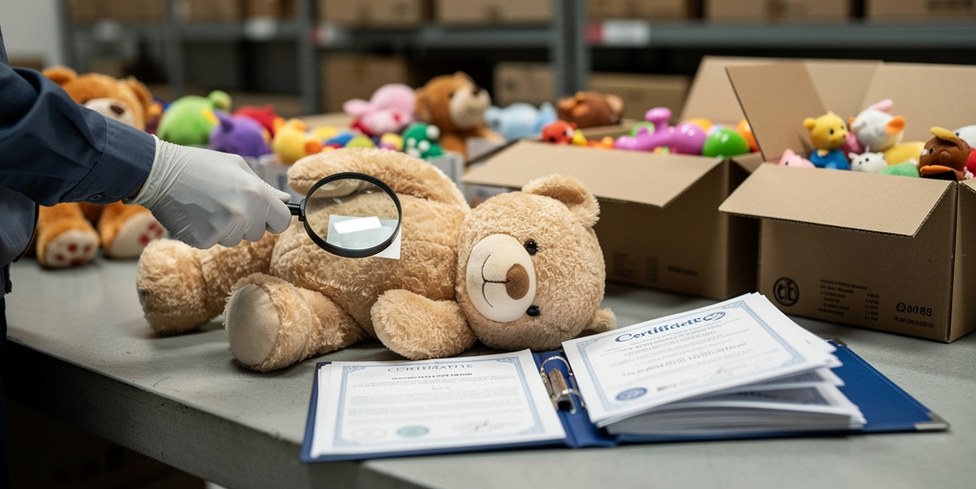
Toy packaging with factory marking and an importer's sticker: from now on all layers of information must say the same thing
Customs control: where marking can hold up your shipment
Marking is mostly policed on the market, but the first questions often come up at the border. The customs declaration states the product name and the details of the conformity document, and during a physical inspection the officer sees the goods and the packaging themselves. If the purpose or the age on the box differs from the certificate and the invoice, that is a reason for an additional check and a document request — and therefore for a delay in release. Your shipping documents and your printed carton are read side by side, so customs clearance of toys should be prepared with an eye on what the packaging actually says.
The documents your Russian buyer will need for the declaration are usually the contract, the invoice, the packing list, the transport documents and the conformity document under the technical regulation. Most of that set is produced by you. If you are not sure whether your product qualifies as a toy and which document it needs, settle the question at the certification stage — before shipment, not during an inspection at the border.
| Situation | Risk | What the exporter should do |
|---|---|---|
| The packaging says "souvenir" or "not a toy", but the item is in fact a toy | The goods are treated as a toy without a valid conformity document | Determine the product status before the contract and have the document issued under the regulation |
| The age on the factory carton and on the importer's sticker differs | Contradictory marking, claims during an inspection | Agree one age grading with the buyer and lock it into the artwork and the certificate |
| The sticker covers the manufacturer's warnings | Safety warnings are deemed altered | Leave a free field on the carton for the Russian-language sticker and approve the layout in advance |
| The product name on the invoice, the certificate and the packaging does not match | Questions during customs control, delayed release | Use one and the same product name in all documents and on the box before shipment |
What the exporter should do
- Ask your Russian buyer to confirm the date of official publication of the decision: the 180-day countdown starts from it.
- List the items that will be sold in Russia after the amendments take effect, including batches already in production and in transit.
- For each item, compare the three layers of marking — your factory label, the importer's sticker and the retailer's tag. Age, purpose and warnings must be identical.
- Check the marking against the conformity document: product name, age group and manufacturer.
- Review items carrying "souvenir", "decor" or "not a toy" wording. If the item is in fact a toy, it has to be documented under the technical regulation.
- Put the marking requirements and the approved sticker layout into the specification annexed to the contract, and check the printed labels at your warehouse before loading — together with any traceability codes your buyer asks for.
Getting this right before the container leaves is also the cheapest option in logistics terms: relabelling at your own warehouse costs a day, while relabelling in Russia happens after duty and import VAT have already been paid. This applies whatever mode you use — sea freight, road groupage, rail or air.
Frequently asked questions
Does this concern the "Chestny Znak" traceability codes?
No. This is information marking under the technical regulation. The traceability code is a separate requirement; both have to be met.
Who is liable if the contradiction was created by the importer's sticker?
The importer is named directly in the rule among those whose information must not contradict the rest of the marking. But the contradiction is only visible when the factory carton and the sticker are compared — so in practice your buyer will send you the sticker layout for approval, and the age and warnings you printed become the reference point.
Does the certificate have to be reissued because of the amendments?
The amendments concern marking, not the safety requirements for the toy itself. But if a review changes the declared age group or purpose, make sure the conformity document matches the new wording.
How long does customs clearance of toys take and will the amendments affect the timing?
It depends on whether the document set is complete and whether a physical inspection is ordered. The procedure itself does not change, but discrepancies between the packaging and the documents are a common reason for additional checks that stretch out release.
Summary
The amendments to the EAEU toy safety regulation prohibit contradictory marking and any wording that changes the purpose, the age grading, the warnings or the safe-use restrictions. They take effect 180 days after publication and may catch orders being placed right now. Reconcile your factory label, the importer's sticker layout and the conformity document before the goods leave your warehouse — that is how you avoid questions during customs control and rework at the destination.
We help exporters get EAEU certification for toys and clear the shipment at the Russian border.
Read also:
- List No. 4114 extended to 1 September 2027: the conformity documents your Russian buyer will need before your goods can be declared
- From 10 August Russia extends simplified certification to 2027 — and tightens the rules for goods on Minpromtorg List No. 4114: what it means for your shipment
- iCustoms launches a blog on vc.ru: the customs questions your Russian buyer will ask you next
- TR CU 021/2011 Standards List Updated: What Your Buyer in Russia Will Ask You For