

What Foreign Suppliers Need to Know: Six HS Codes for Equipment Are No Longer Exempt from VAT in Russia
The list of technological equipment that is exempt from VAT upon import into Russia has been reduced. Russian Federation Government Resolution No. 1246 of September 26, 2026, excludes six items from the EAEU Foreign Economic Activity Commodity Nomenclature (TN VED) from the list. The exemption for these codes will cease to apply as of January 1, 2027: The resolution was published on September 28, 2026, and will take effect no earlier than one month after publication and no earlier than the first day of the next VAT tax period—that is, at the start of the next quarter. For a foreign supplier, this is a matter of price and timing for their Russian buyer: the same equipment under the same contract, declared in Russia in January, will now be subject to import VAT upon arrival. Below is a complete list of items to check in your shipments to Russia and why the date of declaration is the determining factor.
What exactly has changed
The VAT exemption for importing technological equipment into Russia is not based on the description of the goods or their intended use, but on a list: if the EAEU HS code is included in the list approved by Russian Government Decree No. 372 of April 30, 2009, no tax is payable upon import. The list itself is titled “List of Technological Equipment (including components and spare parts thereof) for which no analogues are manufactured in the Russian Federation.” The rationale behind the exemption is that there is no domestic substitute for such equipment.
Decree No. 1246 accomplishes two things. In paragraph 1, it removes six items from the list. In paragraph 2, it repeals the previous amendments that had added these items to the list: the relevant provisions of Resolution No. 796 dated May 27, 2021, and Paragraph 3 of the amendments approved by Resolution No. 376 dated March 11, 2023. The mechanism for the exemption remains unchanged: the rules stay the same; only the composition of the list changes.
A Russian consignee must verify not whether the equipment qualifies for the exemption in principle, but rather the specific HS code listed in the version of the list in effect on the date the customs declaration is filed. Foreign suppliers should clarify with the buyer in advance which code is specified in the contract and how it will be applied.
Six Items: Codes and Descriptions
We list the descriptions exactly as they are worded in the list itself. It is this wording—not the commercial name of the product line—that determines whether the supplied equipment is subject to the change.
| EAEU Foreign Economic Activity Commodity Classification Code | Description of the item in the list |
|---|---|
| 8419 60 000 0 | Equipment for the liquefied natural gas (LNG) production plant at the Yuzhno-Tambayskoye gas condensate field; equipment for the liquefied natural gas (LNG) production plant |
| 8421 39 200 1 | Equipment and devices for filtering or purifying air with the collection of waste from spinning operations |
| 8421 39 800 6 | Gas purification plant equipment |
| 8422 30 000 1 | Equipment for filling, capping bottles and cans, closing boxes, bags, or other containers, for sealing or labeling them, and for hermetically sealing bottles, cans, tubes, and similar containers for the medical industry |
| 8428 33 000 0 | Equipment for a specialized port conveyor complex for transshipment of bulk cargo (coal) |
| 8444 00 100 0 | Machines for the extrusion of chemical textile materials |
Various industries are affected: natural gas liquefaction, air purification in spinning production, gas purification, packaging lines for the medical industry, coal transshipment at ports, and the extrusion of chemical textile materials. There is no common technological thread running through this list. This is a targeted revision of the list, not a sector-wide reform.
Please pay attention to the wording, which can easily be misunderstood. Heading 8422 30 000 1 refers to packaging equipment for the medical industry, not just any filling lines. Heading 8419 60 000 0 specifically mentions the Yuzhno-Tambey field plant and, more broadly, LNG plant equipment in general. If your shipment is similar to the description but does not match it exactly, the classification is determined based on the code and the actual goods, not on the similarity of the name. It is wiser to coordinate the classification of disputed equipment with the Russian buyer before signing the contract. This is part of the process for customs clearance of equipment and machine tools.
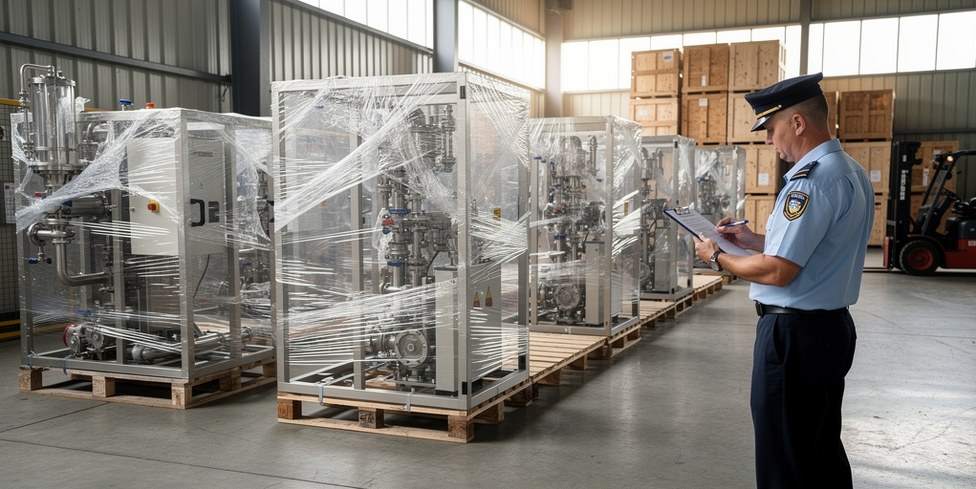
VAT exemption depends on the code in the list, not on the intended use of the equipment
From what date, and why specifically that date?
Paragraph 3 of the resolution does not specify a calendar date but rather a rule: the document takes effect no earlier than one month after the date of its official publication and no earlier than the first day of the next VAT tax period. The VAT tax period is a quarter. The resolution was published on September 28, 2026: the month ends in late October, and the next quarter after that begins on January 1, 2027. Hence the date—January 1, 2027.
This is important for planning shipments: until the end of 2026, shipments under these six codes are declared in Russia according to the previous rules. Eligibility for the exemption is determined by the rules in effect on the date the declaration is filed, not by the date of the contract, shipment, or the vessel’s arrival. A shipment contracted today but declared in Russia in January will no longer qualify for the exemption. Therefore, the date the cargo arrives at the border and the date the declaration is filed may prove to be more important than the shipment date.
How the Cost of the Shipment Is Affected
Exemption under the list is neither a discount nor a deferral, but rather the absence of import tax. When an item is removed from the list, import VAT is calculated on the standard basis: at the rate in effect on the date the customs declaration is filed, and based on a taxable amount that includes the customs value and applicable duties.
For your Russian buyer, there are three practical consequences, and they are of different natures. They may also affect negotiations with you.
- Cash on the date of release. The tax must be paid for the goods to be released. Even if the company later claims the VAT as a deduction, for industrial equipment this is a significant amount that is tied up for weeks or months. The buyer may request a change to the delivery schedule or payment terms.
- Project budget. Investment projections for production lines and plants were often based on the tax incentive. If the equipment arrives after January 1, 2027, the buyer’s project model changes, and they may need to revise the timeline or scope of the purchase.
- Contract Terms. For purchases with long lead times, the question of which party bears the burden of a change in the tax regime is not typically addressed in the contract, but it now arises. Suppliers should verify what the contract states regarding taxes and delivery schedules.
An exclusion from the list does not negate other grounds for tax benefits and preferences if they apply to the supply; these are reviewed separately. Definitions of terms can be found in our Foreign Economic Activity glossary.
What a Foreign Supplier Should Do
- Review your shipments to Russia over the past year and a half and determine, together with the buyer, whether an exemption under the list applied and under which codes.
- Compare these codes with the six excluded items. If there are no matches, the change does not affect your shipments.
- If there is a match, review your delivery schedule to see which shipments fall within the period after January 1, 2027.
- Keep in mind that the Russian buyer will calculate the budget for these shipments including import VAT and assess their cash needs as of the date of issuance. Be prepared for requests to change the deadlines, schedule, or payment terms.
- Work with the buyer and the carrier to verify whether it is feasible, given the contract and logistics, to complete customs clearance in Russia by the end of 2026, provided it is economically justified.
- Ensure that the code is specified correctly and that the description of the goods in the documents corresponds to it: a dispute over classification is a separate risk that most often results in the loss of tax benefits and can also delay the shipment at the border.
- For complete sets, find out how individual components are classified: the list is based on codes, not on the project as a whole.
If you need to verify a specific item on your bill of materials, contact us—we’ll review the code and determine whether the duty exemption applies to your shipment.
Frequently Asked Questions
Has the exemption been completely revoked?
No. The list remains in effect; six specific items have been removed from it, while the rest remain.
What will happen to a shipment that’s already in transit?
The date the customs declaration is filed in Russia is what matters. Until January 1, 2027, the exemption for these codes applies as usual.
Is it possible to retain the exemption by changing the code?
No. The code is determined by the characteristics of the goods, not by the desire to apply the exemption. Selecting a “convenient” code carries the risk of additional assessments and liability for the Russian recipient, as well as the risk of delivery issues.
If a Russian equivalent is not suitable for a Russian buyer, will the exemption still apply?
No. The list contains no provisions regarding whether a substitute is suitable for a specific enterprise: an item is either on the list or it is not.
Does this change affect customs duties?
No. This applies only to value-added tax on imports. Customs duty rates are set separately by the EAEU’s Unified Customs Tariff.
Read also:
- Deferral of Import VAT in Russia: Customs Monitoring Is Open to Almost Everyone, but the Benefit Stays with AEOs
- SPOT and QR Codes for Shipments to Russia from the EAEU: What a Foreign Supplier Needs to Do
- Exporting Frozen Fish and Crab from Russia: What Foreign Buyers Need to Know About Veterinary Certificates and the 0% VAT Rate
- Exports to Russia from the EAEU: What Foreign Suppliers Need to Know About the SPOT System, QR Codes, and Security Deposits