

Transit Through Azerbaijan: What Exporters Shipping to Russia Need to Prepare
If your goods travel to Russia and the CIS through the Azerbaijani direction — to Iran, from Iran, or along the North–South corridor — the bottleneck is rarely the transport leg. It is the junction of two customs territories: the transit declaration, the guarantee covering duties and taxes, the place of delivery, the transit period, and whether the HS code in your documents matches the way the goods are classified on the other side of the border. On the sidelines of the council of heads of customs services, Valery Pikalev, head of the Federal Customs Service of Russia, met Shahin Bagirov, chairman of the State Customs Committee of Azerbaijan, and those were exactly the subjects on the table: cooperation between border customs offices, portal inspection and scanning systems, transit within the trilateral Russia–Azerbaijan–Iran group, the institution of the authorised economic operator, and pre-arrival information. For you as the shipper this means the procedures on this route will keep changing — and that almost everything your consignee needs from you has to be ready before the truck or the train leaves your yard.
What the two customs services discussed and how it reaches your shipment
The agenda was strictly practical. The parties discussed cooperation between border customs offices to speed up the movement of goods; the use of portal inspection and scanning systems, with the Russian side expressing readiness to assist its colleagues in this area; the work of the trilateral working group on facilitating transit traffic between Russia, Azerbaijan and Iran; the development of the authorised economic operator institution and readiness to sign the corresponding agreements; and, finally, pre-arrival information and the classification of goods.
For a supplier shipping into the region, the value is not in the negotiations themselves but in the list of topics: these are precisely the four points where cargo tends to stop on this route. None of them can be fixed while the vehicle is standing at the border — each requires documents and statuses to be in place before departure, and most of those documents originate with you, not with your buyer. So it is worth walking through them in the order a single consignment goes: pre-arrival information, opening of transit, control at the crossing point, completion of the procedure, and declaration at the place of delivery.
Customs transit through Azerbaijan: what the procedure demands from your paperwork
Goods crossing the EAEU territory without being released for domestic consumption are placed under the customs transit procedure. In practice this means a transit declaration is filed, the customs office of departure fixes the place of delivery and the transit period, seals and other identification means are applied, and the carrier is obliged to deliver the goods unchanged and on time. A separate element is the guarantee covering customs duties and taxes: a bank guarantee, a surety, a cash deposit, or a contract with a customs representative. The guarantee is the single most common reason a departure slips, because it is usually arranged at the last moment — and it can only be arranged once the commercial documents are final.
That is where your part begins. The shipping set has to be complete and consistent: invoice, packing list, transport documents (CMR or rail waybill), the contract, and any permits applicable to the goods. Perishable and controlled cargo adds veterinary and phytosanitary documents; products subject to mandatory conformity assessment require certificates and declarations, and those are built on manufacturer data — technical descriptions, composition, test samples. If your buyer is still collecting that from you while the truck is loaded, the schedule is already lost. Our certification team normally starts this work weeks before the first shipment, not after it.
It is also worth agreeing in writing who files what: who submits the transit declaration and who declares the goods at the place of delivery. Gaps in responsibility between the carrier, the forwarder and the declarant cause more standing time than the customs procedures themselves. The same logic applies whichever mode you use — road, rail or sea legs feeding into the corridor.
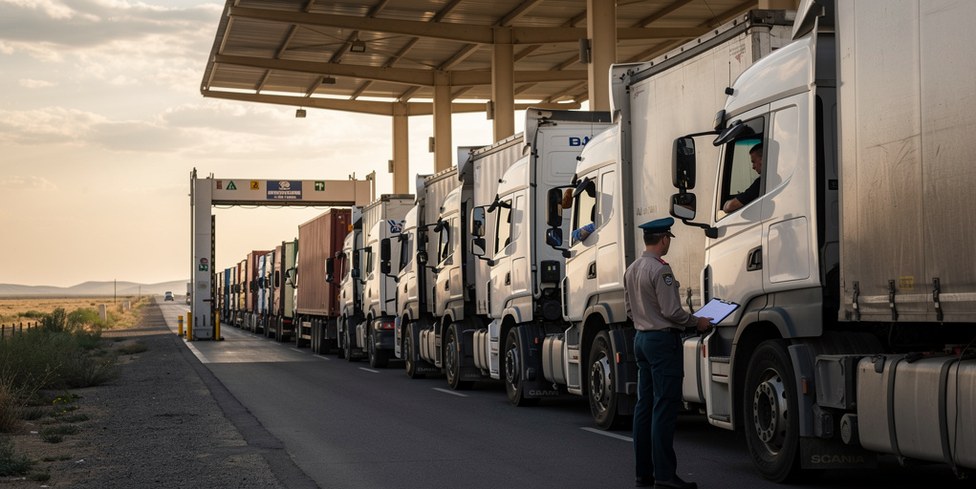
A truck at the Russian–Azerbaijani border crossing: most transit delays are created days before departure, in the paperwork, not on the road.
AEO status and pre-arrival information: where time is actually saved
Authorised economic operator status in the EAEU gives a set of simplifications — from priority handling of customs operations to release of goods before the declaration is filed and completion of transit at the operator’s own site. It is granted under one of several types of certificate, depending on whether the simplifications are needed in transport, in storage and release on the holder’s own premises, or across the board. The requirements are demanding: financial stability, no outstanding debts, a certain trading record, a goods accounting system, and in some cases a guarantee. It is your consignee in Russia who holds this status, not you — but it is your documents that determine whether the status can be used at full speed.
Mutual recognition of AEO status between countries only works once an agreement has been signed and has entered into force. So far the two sides have only declared their readiness to sign, which means a certificate issued in one country gives no automatic simplifications at the other country’s customs. Do not let it into the delivery dates you quote under current contracts.
Pre-arrival information is the second subject that directly affects standing time. Data on the goods is submitted to customs before the vehicle reaches the crossing point, and the form of control is decided in advance on that basis. Errors cancel out the whole point of the procedure: a discrepancy in the description, the weight, the number of packages or the HS code sends the vehicle to in-depth examination. This is where discipline on the shipper’s side matters most — the figures in the pre-arrival information must come from exactly the same documents that physically travel with the cargo. In other words, if you send a revised invoice after the filing, you have created the delay yourself.
Portal scanners and classification: where disputes start
Portal inspection and scanning systems scan the whole vehicle, without unloading and normally without a long stop. For an honest supply chain that is good news: a drive-through instead of a warehouse unloading. But the technology has a flip side. The inspector compares the image with the declared particulars, and any inconsistency — extra pallets, a cargo geometry that does not match, an uneven load where a homogeneous consignment was declared — becomes grounds for a physical inspection. Which means your packing list has to describe how the vehicle was actually loaded, not the ideal stacking plan from the quotation.
The second risk zone is classification. The same product can be assigned to different headings in two countries, and then the transit data will not match the goods declaration. This happens most often with multi-component consignments (equipment shipped disassembled, kits with spare parts), with goods where the share of a material or the intended use decides the heading, and with products that the supplier describes by a marketing name instead of a technical one. If your product range has already caused disputes, an advance classification ruling obtained by your buyer removes part of the questions before the vehicle ever sets off — and for that ruling they will need your technical file. For machinery this is routine practice; see how it works for equipment and machine tools.
| Situation | What it costs you | What to do before loading |
|---|---|---|
| The transit guarantee is not in place when the transit declaration is filed | Transit is not opened, the vehicle stands at the point of departure, your delivery date slips | Confirm with the buyer who arranges the guarantee and by when, and release final commercial documents early enough for them to do it |
| Pre-arrival information filed from a draft invoice | Data mismatch, the shipment is moved to in-depth control | Freeze the document set before loading; send only final shipping documents, and never revise them after filing |
| The packing list does not match the actual load | The portal scanner shows the discrepancy, a physical inspection is ordered | Check the loaded vehicle against the documents at your warehouse and photograph the load and the seals |
| The HS code was taken “same as last time” | Reclassification, recalculated duties, possible penalties — and a claim coming back to you | Provide technical documentation, composition and intended use; for disputed items, support an advance classification ruling |
| Conformity documents are not ready because manufacturer data is missing | The goods cannot be declared at the place of delivery, storage costs accumulate | Supply technical files and samples for certification well before the first shipment |
| Counting on mutual AEO recognition before the agreement is in force | Delivery dates promised to your customer are missed | Plan lead times under the rules in force today; count simplifications only once the agreement takes effect |
What the exporter should do before loading
- Map the route together with the consignee: country of dispatch, crossing points, place of delivery, the customs post where the goods will be declared. For each leg, record who submits which data.
- Give the buyer the technical documentation needed to determine the HS code — datasheets, composition, function — instead of a marketing product name. For multi-component or disassembled items, provide a breakdown and support an advance classification ruling.
- Freeze the document set before the vehicle is loaded: final invoice, packing list, contract, transport document. Any later correction must be agreed before pre-arrival information is filed, not after.
- Make sure the packing list reflects the real load: number of packages, weights, pallet layout. Photograph the loading and the applied seals.
- Deliver everything the consignee needs for conformity assessment — technical files, samples, manufacturer declarations — and, for controlled goods, the veterinary or phytosanitary documents of the country of origin.
- Clarify with the buyer which type of transit guarantee will be used and when it will be arranged, so that it does not become a last-minute issue on the day of departure.
- Build a time reserve for the border sections and fix in the contract who bears the cost of standing time caused by documentary problems — that clause decides who pays when a discrepancy is found at the scanner.
Frequently asked questions
Do I need to change my export documents right now?
No. The rules in force have not changed. What is worth changing is the discipline of preparing documents: the pre-arrival information, the packing list and the transit declaration must describe one and the same consignment without discrepancies.
Will my buyer’s AEO status obtained in Russia give simplifications on the Azerbaijani side?
Not yet. Mutual recognition becomes possible only after the relevant agreement is signed and enters into force; at the meeting the customs services only declared their readiness to take that step.
Does the portal scanner replace physical inspection?
It does not replace it, it reduces the likelihood of it being ordered. If the image diverges from the declared particulars, an inspection is ordered in the usual way and the standing time grows.
Who is liable if transit is not completed within the set period?
Legally, the carrier that delivered the goods. Commercially, the actual losses — demurrage, storage, missed contractual dates — land on the importer, and if the cause was documentary they will be passed back to the supplier. That is why deadlines and cost allocation belong in the contract, agreed in advance.
Summary
The agenda of the talks between the Russian and Azerbaijani customs services — border cooperation, portal scanners, transit in the link with Iran, AEO, pre-arrival information and classification — shows exactly where the real risks sit on this route. Until a mutual AEO recognition agreement is in force, plan lead times under the current rules and invest in document quality: your papers decide whether the vehicle drives through the portal or stops for inspection. Check the HS code, the conformity documents and the completeness of the shipping set before the cargo leaves your warehouse, and agree with your consignee who files what. Request a consultation and we will go through your specific shipment, or see the full range of turnkey logistics and customs clearance services.
We will design the delivery and clearance scheme for your shipment to Russia through Azerbaijan and the North–South corridor.
Read also:
- Selling into Russia through Chinese-style ecosystem platforms: the documents and the value your buyer's customs will ask for
- Shipping auto parts to Russia via Murmansk: what the new Northern Sea Route service means for the exporter
- Shipping diesel and petroleum products to Russia: HS code 2710, excise rules and the papers your buyer will now ask you for
- Shipping to Russia through the EAEU: how SPOT filings, marking codes and your buyer's reporting must match