

Rail from Vietnam via China: how your shipment keeps the preferential duty
A container from Vietnam can be moved to the Moscow region by rail in transit through China. The service has been running since 2025, with several departures a month. For you as the shipper, the documents matter more than the route itself. The goods remain of Vietnamese origin, and for your buyer to apply the preferential duty under the EAEU–Vietnam free trade agreement, it must be proven that the cargo only transited China. The second risk is timing: transit time depends on the border crossings and on the workload of Chinese stations. That is why your Russian buyer will ask for the complete document set well before the container arrives — the declaration, the permits and the money for duties have to be ready on arrival day. Below is what you should prepare on your side.
What is known about the Vietnam – Russia route via China
The rail service from Vietnam to Russia across Chinese territory has been operating steadily since its launch in 2025. The operator sees significant potential in the direction and is working to shorten transit times and make departures more regular. The Russian Ministry of Transport has also announced plans to speed up trains from Vietnam and make the connection more regular.
Any speed-up, however, depends on the coordinated work of everyone involved, on the situation at the border crossings and on the capacity of stations in China. Two practical conclusions follow for the shipper:
- departures run to a schedule, not daily, so production readiness at your plant should be tied to the nearest slot rather than to the end of the month;
- transit time is not yet guaranteed, so keep a time buffer in your sales contract and do not confirm a firm delivery date to the buyer on the basis of the best-case run.
Documents your buyer will ask for: origin, transit, permits
The basic set is standard: the contract, the invoice, the packing list, the rail waybill and the certificate of origin. All of these are issued on your side, and every discrepancy between them is a discrepancy the Russian customs authority will see.
A free trade agreement is in force between the EAEU and Vietnam, and for many lines the duty is reduced or zero. To obtain the preference, a certificate of origin in form EAV is required. In addition, the direct consignment rule must be observed: in the country of transit the goods remain under customs control, and no operations are carried out with them other than transhipment and measures to keep them intact. VAT is paid by the buyer in the normal way and is not affected by the preference.
If the container is opened in China, topped up with other cargo or re-issued to a different consignor, the preference can be lost and the buyer pays the full rate of duty. Agree through transport documents covering the whole route with your forwarder before shipment — afterwards nothing can be corrected.
Permits depend on the goods, and most of them are issued in Russia in your buyer's name — but on your technical documentation, so the timing depends on you:
- clothing and footwear — conformity documents under EAEU technical regulations and Chestny Znak marking; the codes are very often applied at the factory before shipment, so agree the labels, their placement and the artwork in advance (see also clearance of clothing, footwear and accessories);
- electronics and household appliances — certificates or declarations of conformity, marking for part of the radio-electronics range, and a notification or licence for devices with encryption functions; the buyer will need your technical file, test reports and samples (clearance of electronics);
- coffee, seafood, fruit — phytosanitary or veterinary control, which means certificates from the authorities in the country of export and an establishment that is eligible to supply (clearance of food products);
- electronic components, equipment, chemicals — a check against export control lists: the import of dual-use goods into Russia requires permits for certain lines, and the check is made against your specification and datasheets.
The practical consequence is simple: the sooner you hand over the specification, the datasheets, the labels and the samples, the sooner the buyer can obtain the conformity documents — ideally while the container is already on its way.
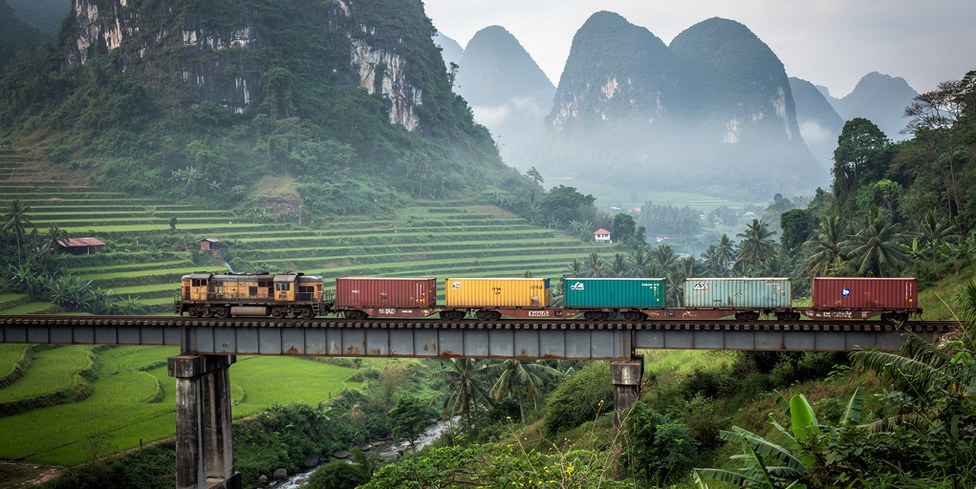
Rail container service from Vietnam to Russia runs in transit through China: the origin and transit documents decide whether the preferential duty survives
Where the container is cleared and where it can get stuck
Customs clearance in Russia means submitting a declaration, paying the duty and VAT, presenting the permits and obtaining release. On this route it is usually most convenient to place the container under customs transit at the border and to declare it in the Moscow region, where it is heading anyway. You can read more about how the process works in our overview of customs clearance of cargo.
Duties and VAT are written off from the buyer's single personal account with the Russian customs service, and topping it up is the buyer's job, not yours. What does depend on you is everything that can hold the container at the terminal: a missing or incorrect EAV certificate, a consignor in the waybill who differs from the one in the certificate, a specification that does not match what is actually inside the box.
| Situation | Risk for your shipment | What the shipper does |
|---|---|---|
| Delay at a border crossing or at a station in China | The delivery date to the buyer is missed and the claim comes back to you | Build a buffer into the contract, tie readiness to a departure slot, track the shipment |
| The cargo was transhipped or re-issued in China | The origin preference is lost, the buyer pays full duty and disputes the price with you | Through transport documents, transit with no operations on the goods |
| An error in the EAV certificate, or no certificate at all | Full rate of duty on your consignment | Check the certificate against the contract and invoice before shipment |
| Conformity documents or marking codes are not ready | Storage at a temporary storage warehouse, paid by the buyer, at your expense in practice | Send the technical file, labels and samples early; apply marking codes at the factory if agreed |
| Goods on export control lists shipped without a check | The container stops at clearance, release is suspended | Send the specification and datasheets to the buyer before booking the slot |
What the shipper should do
- Ask your forwarder for the departure schedule and tie production readiness to the nearest slot, not to your own month-end.
- Agree the HS codes with the buyer and check whether the preference under the agreement with Vietnam applies to them — do this before the preference is priced into your offer.
- Apply for the EAV certificate of origin and reconcile every detail with the contract and the invoice: consignor, consignee, invoice number, marks, quantities, descriptions.
- Agree with the forwarder that the transit through China runs without re-consolidation and without a change of consignor, and obtain through transport documents for the whole route.
- Send the buyer the technical file, test reports, labels and samples as early as possible, so that conformity documents can be issued while the container is in transit.
- Agree who applies the Chestny Znak codes; if it is your side, get the labels and their placement approved before packing.
- Send scans of the full set before departure and the originals as agreed, and confirm the estimated arrival so that the buyer can prepare the declaration and the payments.
Frequently asked questions
Does the preferential duty survive if the cargo moved through China?
Yes, provided that in China it remained under customs control, no operations other than transhipment were carried out with it, and the transport documents confirm this. An EAV certificate of origin is required as well.
How long does the container take?
There is no guaranteed transit time yet. Departures run several times a month, and time on the road depends on the border crossings and the stations in China, so plan the delivery with a buffer.
Who issues the EAV certificate and when?
It is issued on your side, in the country of origin, and it must match the contract and the invoice. A certificate made out to one consignor while the rail waybill shows another is the most common reason the preference is refused.
How is this different from a grey «cargo» delivery?
In a cargo scheme the carrier imports the goods in its own name, so the buyer receives no customs declaration for the consignment and cannot recover VAT. On this route the buyer is the declarant: the cargo travels with a full document set and goes through official release — which is exactly why your paperwork has to be accurate.
Where is the container cleared?
If the consignee is in the Moscow region, it is usually more convenient to place the goods under customs transit at the border and declare them at the destination. That also buys time: documents can be finalised while the container is still moving.
Summary
The rail route from Vietnam via China runs regularly, but transit times still depend on border crossings and Chinese stations. To keep the preferential duty, an EAV certificate and through transit documents are needed, and the container must not be opened or re-issued on the way. Send the technical documentation, labels and samples early so that conformity documents and marking codes are ready before arrival, and clearance in the Moscow region goes through customs transit without a stop. Request a consultation, and we will go through your specific consignment.
Send us the documents for your consignment to Russia, and we will check the origin papers and clear the container on arrival.
Read also:
- Switching sourcing countries: what your Russian buyer will now require from your shipment
- Containers from India via Vladivostok: what your Russian buyer will now need from you
- iCustoms launches a blog on vc.ru: the customs questions your Russian buyer will ask you next
- TR CU 021/2011 Standards List Updated: What Your Buyer in Russia Will Ask You For